


Fluidized Reactor
In the landscape of industrial chemical engineering, the fluidized reactor—often referred to as a fluidized bed reactor (FBR)—represents a pinnacle of heat and mass transfer efficiency. These systems are utilized extensively across the chemical, petrochemical, pharmaceutical, and food processing industries to facilitate multiphase reactions. The fundamental principle involves passing a fluid (gas or liquid) through a granular solid material at high enough velocities to suspend the solid and cause it to behave like a fluid.
For engineers and procurement specialists, the success of a fluidized reactor depends not only on the vessel design but also on the precision of the internal components, particularly the gas distribution plates and filtration systems. High-performance filtration and distribution media ensure uniform fluidization, prevent catalyst loss, and protect downstream equipment. Understanding the technical nuances of these components is essential for optimizing reactor performance and longevity.
Understanding Fluidized Reactor Fundamentals
A fluidized reactor operates on the principle of fluidization, where a bed of solid particles is transformed into a fluid-like state. This occurs when the upward drag force exerted by the fluidizing medium (gas or liquid) equals the gravitational force acting on the particles. The velocity at which this occurs is known as the minimum fluidization velocity ($U_{mf}$).
Once fluidization is achieved, the bed exhibits properties such as high thermal conductivity and uniform temperature distribution, which are critical for exothermic or endothermic reactions. The intense mixing within the bed ensures that there are no hot spots, which significantly reduces the risk of catalyst degradation or unwanted side reactions. However, maintaining this state requires precise control over the fluid flow, which is primarily managed by the distributor plate at the base of the reactor.
In industrial applications, fluidized reactors are categorized based on their flow regimes, including bubbling, circulating, and fast fluidized beds. Each regime places different mechanical and thermal demands on the internal filtration and distribution components. Selecting the right materials and configurations is a prerequisite for achieving the desired reaction kinetics and throughput.
The Critical Role of Porous Media in Fluidization
The distributor plate, often constructed from porous metal or specialized wire mesh, is the most critical internal component of a fluidized reactor. Its primary function is to introduce the fluidizing medium into the bed uniformly across the entire cross-section of the vessel.
Preventing Channeling and Slugging
If the distribution is uneven, the reactor may suffer from "channeling," where the fluid finds a path of least resistance, bypassing large portions of the solid bed. Conversely, "slugging" occurs when large bubbles of gas form and rise through the bed, causing significant pressure fluctuations and mechanical vibration. Both phenomena lead to poor reaction efficiency and potential structural damage. High-precision sintered wire mesh or porous metal plates provide the controlled permeability required to maintain a stable pressure drop across the distributor, ensuring uniform gas entry.
Pressure Drop Management
Engineering a fluidized reactor involves a delicate balance of pressure drops. The pressure drop across the distributor plate must be sufficient to ensure even distribution but not so high that it significantly increases the energy consumption of the compressors or pumps. Typically, a distributor pressure drop of 20% to 40% of the bed pressure drop is recommended to maintain stability. Manufacturers like Kaifil specialize in tailoring the porosity and thickness of stainless steel filter media to meet these specific aerodynamic requirements.
Engineering Requirements for Filtration Components
Filtration components within a fluidized reactor, including both the distributor and the overhead vent filters, must withstand exceptionally harsh conditions. When evaluating filtration solutions, engineers must prioritize the following technical criteria:
Thermal Stability
Many fluidized bed processes, such as catalytic cracking or gasification, operate at temperatures exceeding 500°C. Standard filtration materials may lose structural integrity or undergo oxidation at these levels. Stainless steel alloys like 310S or high-nickel alloys (e.g., Inconel or Hastelloy) are often required to maintain mechanical strength and corrosion resistance at elevated temperatures.
Mechanical Strength and Abrasion Resistance
The constant motion of solid particles in a fluidized reactor creates a highly abrasive environment. The filter media must be robust enough to resist erosion from high-velocity particle impacts. Sintered metal fiber and multi-layer sintered wire mesh are preferred in these scenarios because the sintering process fuses the wires at every contact point, preventing individual wires from shifting or breaking under mechanical stress.
Chemical Compatibility
Fluidized reactors often handle aggressive chemical vapors or liquids. The selection of the filter material must account for the specific pH levels, oxidation potential, and presence of corrosive species like chlorides or sulfides. 316L stainless steel is the industry standard for general chemical resistance, but specialized alloys are deployed for more extreme environments.
Selecting Stainless Steel Wire Mesh for Fluidized Beds
When designing or retrofitting a fluidized reactor, the choice between different types of metal filter media can significantly impact the total cost of ownership. Stainless steel wire mesh is a primary choice due to its versatility and precision.
Sintered Wire Mesh vs. Woven Mesh
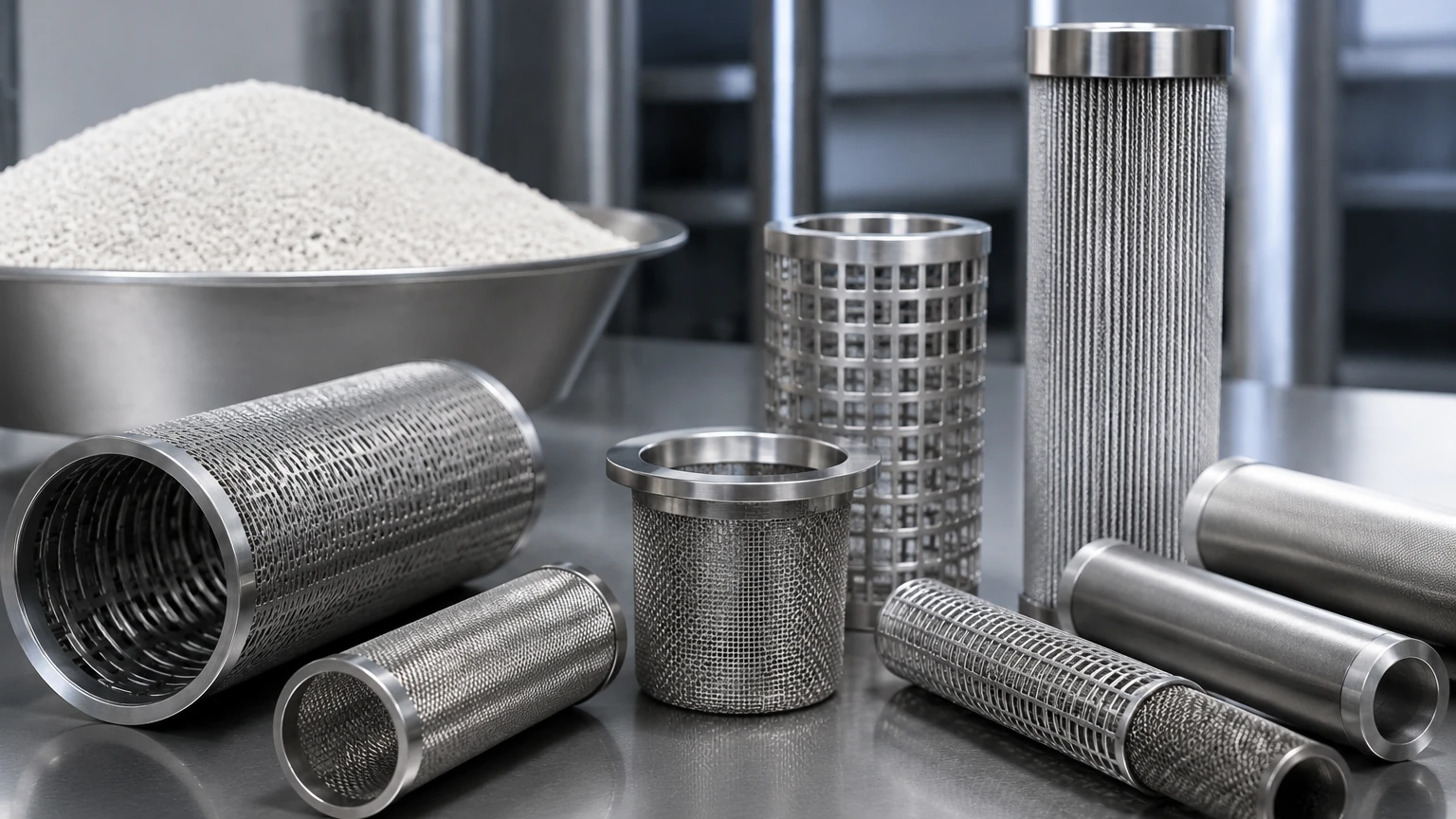
While simple woven mesh is cost-effective, it often lacks the structural rigidity required for the high-pressure environments of a fluidized reactor. Sintered wire mesh, which involves laminating multiple layers of woven mesh and bonding them through a high-temperature vacuum sintering process, offers superior performance. This material provides a fixed pore structure that does not migrate under pressure, ensuring consistent filtration accuracy over the long term.
Pore Size and Permeability
The micron rating of the filter media must be smaller than the minimum particle size of the catalyst or reactant to prevent "weeping" (solids falling through the distributor) or "carryover" (solids escaping through the exhaust). However, the media must also maintain high permeability to allow for efficient fluid flow. Engineers must analyze the particle size distribution (PSD) of the solids to select a mesh that balances retention with flow capacity.
For those seeking detailed technical specifications on various mesh configurations, visiting the Main Page of a specialized manufacturer provides access to performance charts and material data sheets essential for the design phase.
Operational Challenges and Maintenance Strategies
Even the best-engineered fluidized reactor will face operational challenges over time. Two of the most common issues are fouling and blinding of the filtration media.
Fouling and Blinding
Fouling occurs when fine particles or reaction byproducts accumulate on the surface or within the pores of the filter. This leads to an increase in pressure drop and a decrease in fluidization quality. In some cases, "blinding" occurs, where the pores are completely obstructed. To mitigate this, reactors are often equipped with back-pulse or back-wash systems that use a reverse flow of fluid to dislodge accumulated solids.
Cleaning and Regeneration
One of the primary advantages of stainless steel filtration components is their cleanability. Unlike disposable filters, sintered metal components can be cleaned using ultrasonic baths, chemical cleaning, or high-temperature burnout. This ability to regenerate the filter media significantly reduces the long-term operational costs and environmental impact of the process.
Monitoring Performance
Continuous monitoring of the pressure differential ($ΔP$) across the distributor and the exit filters is the most effective way to gauge the health of the reactor's internals. A steady increase in $ΔP$ typically indicates the need for a cleaning cycle or a scheduled maintenance shutdown. Engineers should establish baseline performance metrics during the commissioning phase to identify deviations early.
Customization and OEM Solutions for Reactor Design
Every fluidized reactor application is unique, requiring specific geometries, flow rates, and material properties. Off-the-shelf filtration products rarely meet the exacting standards of high-performance industrial reactors. This is where OEM (Original Equipment Manufacturer) capabilities become vital.
Customization options often include:
* Varying Layer Configurations: Combining different mesh counts to achieve specific filtration and support characteristics.
* Geometric Precision: Fabricating distributor plates in large diameters or complex shapes to fit specific vessel designs.
* Integrated Reinforcement: Adding perforated metal or heavy-duty support grids to the filter media to handle extreme pressure loads.
By working closely with a manufacturer like Kaifil, engineering teams can develop bespoke filtration solutions that are optimized for their specific process conditions. This collaboration ensures that the filtration media is not just a component, but a high-performance tool that enhances the overall efficiency of the chemical process.
Conclusion: Optimizing the Fluidized Reactor Lifecycle
The efficiency of a fluidized reactor is inextricably linked to the quality of its internal filtration and distribution systems. By focusing on engineering fundamentals—such as uniform fluid distribution, material durability, and precise pore control—operators can maximize reaction yields and minimize downtime.
When selecting components, it is critical to look beyond the initial purchase price and consider the total cost of ownership, which includes maintenance cycles, energy consumption, and the lifespan of the filter media. High-quality stainless steel and sintered metal solutions offer the reliability needed for demanding industrial environments. For further technical guidance and to explore custom filtration options, professionals are encouraged to review product options and application support on the Main Page to ensure their reactor designs are supported by industry-leading manufacturing expertise.
