


100 Mesh Screen Filter
In industrial filtration, the selection of the correct mesh size is a critical engineering decision that directly impacts product purity, equipment longevity, and operational efficiency. A 100 mesh screen filter represents a versatile middle ground in the filtration spectrum, offering a balance between fine particulate removal and high flow capacity. This technical guide explores the specifications, material considerations, and industrial applications of 100 mesh filtration systems, providing engineers and procurement teams with the data necessary for informed selection.
Technical Specifications and Aperture Characteristics
The term "mesh" refers to the number of openings per linear inch of the screen. In a 100 mesh screen filter, there are 100 wires and 100 openings in every inch of the mesh surface. Understanding the precise dimensions of these openings is essential for determining the filter's suitability for specific particle sizes.
Aperture Size and Micron Rating
For a standard 100 mesh screen filter constructed with a wire diameter of approximately 0.10 mm (0.0040 inches), the resulting aperture size is typically 0.15 mm or 150 microns. This means the filter is designed to retain particles larger than 150 microns. In many industrial contexts, this is considered a fine filtration stage, capable of removing visible sediment, sand, and larger organic particulates.
Open Area and Flow Efficiency
The "open area" percentage is a vital metric for hydraulic calculations. It represents the ratio of the area of the openings to the total area of the mesh. For a standard 100 mesh screen, the open area usually ranges between 30% and 40%. A higher open area reduces the initial pressure drop across the filter but may compromise the structural integrity of the mesh if the wire diameter is too thin. Engineers must balance the need for high flow rates with the mechanical strength required to withstand system pressures.
Material Engineering for 100 Mesh Screen Filters
While various materials can be used to manufacture wire mesh, stainless steel remains the industry standard for 100 mesh screen filters due to its mechanical properties and resistance to environmental degradation. At Kaifil, the focus is on high-grade stainless steel alloys to ensure durability in demanding environments.
Stainless Steel 304
SS304 is the most common material for industrial filtration. It offers excellent corrosion resistance in most atmospheric conditions and is suitable for applications involving water, mild chemicals, and food products. It is a cost-effective solution for general-purpose industrial filtration where extreme chemical resistance is not required.
Stainless Steel 316 and 316L
For more aggressive environments, such as marine applications, chemical processing, or pharmaceutical manufacturing, Stainless Steel 316 is preferred. The addition of molybdenum enhances its resistance to pitting and crevice corrosion, particularly in chloride-rich environments. SS316L (low carbon) is often specified for components that require welding, as it minimizes carbide precipitation that can lead to corrosion at the weld sites.
Specialized Alloys
In high-temperature or highly corrosive applications, specialized alloys like Monel, Inconel, or Hastelloy may be utilized. These materials maintain their structural integrity at temperatures exceeding the limits of standard stainless steel and resist specific chemical attacks that would degrade 300-series alloys.
Key Engineering Considerations: Pressure Drop and Flow Capacity
When integrating a 100 mesh screen filter into a system, engineers must account for the Clean Pressure Drop ($ΔP$). This is the resistance to flow caused by the filter media before any particulate accumulation occurs.
Factors Influencing Pressure Drop
1. Fluid Viscosity: Higher viscosity fluids require more force to pass through the 150-micron apertures, resulting in a higher pressure drop.
2. Flow Velocity: As the velocity of the fluid increases, the pressure drop increases exponentially. Sizing the filter housing and the mesh surface area correctly is essential to keep the velocity within acceptable limits.
3. Contaminant Loading: As particles accumulate on the 100 mesh surface, the effective open area decreases, leading to a rise in differential pressure. This necessitates a clear understanding of the "dirt-holding capacity" of the filter.
Effective Filtration Area (EFA)
To minimize maintenance intervals and prevent system downtime, engineers often specify pleated 100 mesh screen filters. Pleating significantly increases the Effective Filtration Area (EFA) within the same footprint as a cylindrical filter. A larger EFA results in a lower initial pressure drop and a longer service life between cleaning cycles.
Industrial Applications for 100 Mesh Filtration
The 100 mesh screen filter is utilized across a broad range of sectors, often serving as a secondary filter or a primary protection screen for sensitive downstream equipment.
Chemical and Petrochemical Processing
In chemical plants, 100 mesh filters are used to remove suspended solids from process streams, protecting pumps and valves from abrasion. They are also used in the recovery of catalysts and the filtration of intermediate chemical products where 150-micron clarity is sufficient.
Food and Beverage Industry
Stainless steel 100 mesh screens are integral to the food industry for straining juices, syrups, and oils. Because stainless steel is non-reactive and easy to sanitize, it meets the stringent hygiene standards required for food contact. It is frequently used to remove pulp or large crystals from liquid products.
Hydraulic and Lubrication Systems
Protecting hydraulic components is a primary application for 100 mesh screen filters. They serve as suction strainers or return-line filters to ensure that metal shavings, seal fragments, and other debris do not reach high-precision pumps or servo-valves, which could cause catastrophic system failure.
Water Treatment and Irrigation
In water treatment, 100 mesh screens act as a reliable barrier against sand and organic matter. They are commonly used in cooling tower water loops and irrigation systems to prevent the clogging of spray nozzles and emitters.
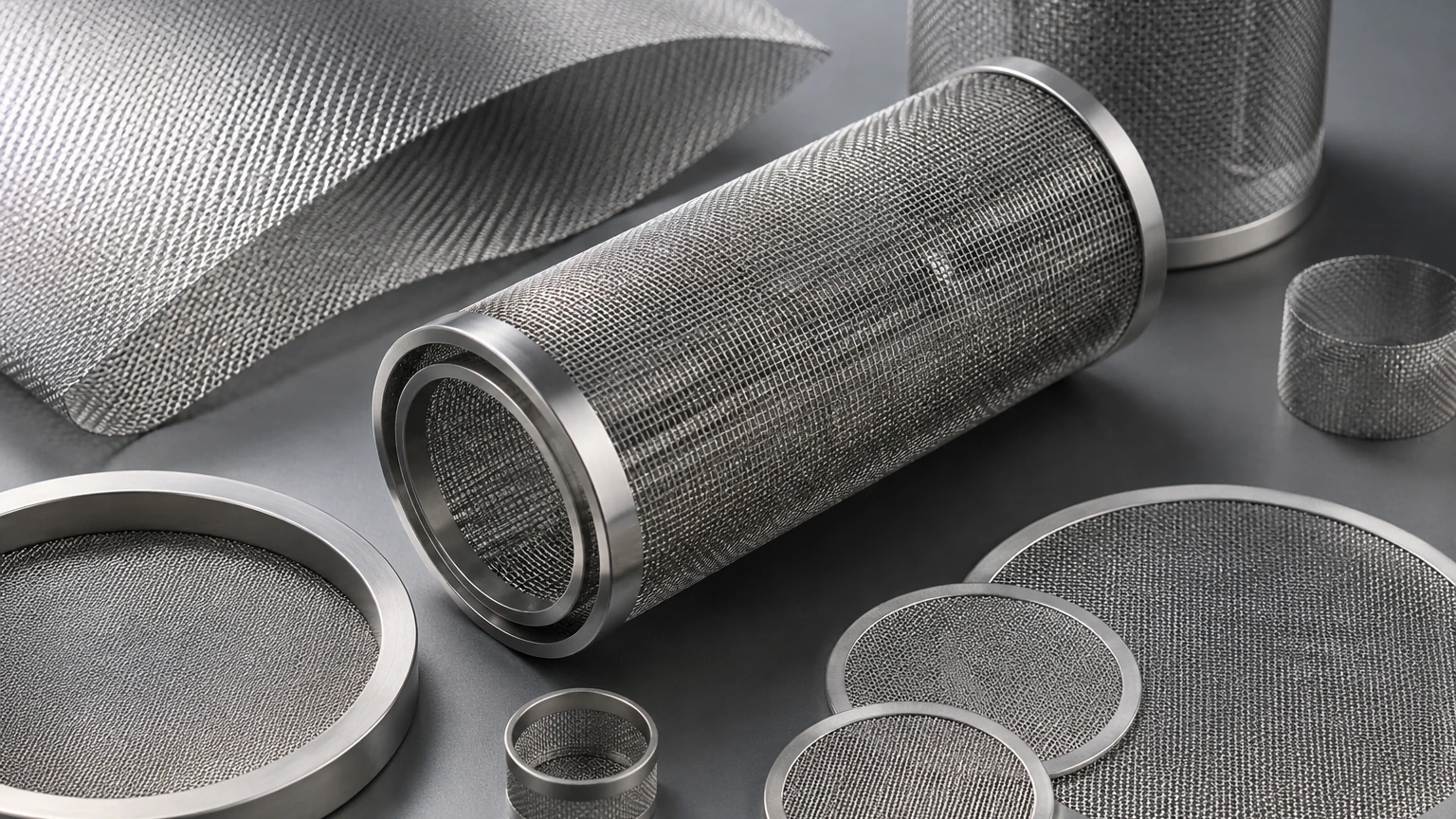
Customization and Structural Integrity in Filter Design
Standard wire mesh is often insufficient for high-pressure industrial applications. Customization of the filter structure is necessary to ensure the 100 mesh screen filter can perform under stress.
Support Layers and Reinforcement
Because 100 mesh wire is relatively thin, it can collapse or deform under high differential pressure. To prevent this, manufacturers like Kaifil often bond the 100 mesh to a coarser support layer (such as a 10 or 20 mesh screen) or a perforated metal core. This multi-layer construction provides the necessary mechanical strength while maintaining the 150-micron filtration rating.
Sintered Mesh Options
For the most demanding applications, sintered 100 mesh is an option. Sintering is a process where multiple layers of mesh are fused together using heat and pressure without the use of binders. This creates a robust, monolithic filter element that will not migrate or shift, ensuring consistent filtration performance even under high-pressure pulses.
Custom End Fittings and Seals
To ensure a leak-proof bypass-free installation, custom end fittings (such as DOE, 222, or 226 O-ring configurations) are manufactured to fit specific filter housings. The choice of gasket material (EPDM, Viton, PTFE) must also be compatible with the process fluid and temperature.
Maintenance, Cleaning, and Replacement Cycles
One of the primary advantages of a stainless steel 100 mesh screen filter is its cleanability. Unlike disposable synthetic filters, metal mesh can be cleaned and reused, providing a lower total cost of ownership.
Cleaning Methods
* Backwashing: Reversing the flow of fluid through the filter to dislodge accumulated debris.
* Ultrasonic Cleaning: Using high-frequency sound waves in a cleaning solution to remove fine particles trapped deep within the mesh weave.
* Chemical Cleaning: Using compatible solvents or acids to dissolve organic or mineral scaling that backwashing cannot remove.
Monitoring Performance
Industrial systems should be equipped with differential pressure gauges. A common industry standard is to clean or replace the filter element when the differential pressure reaches a pre-defined limit (e.g., 15-20 psi over the clean pressure drop). Continuous operation at high differential pressures can lead to "media migration" or permanent deformation of the mesh.
Conclusion: Selecting the Right Solution
Choosing a 100 mesh screen filter involves more than simply selecting a mesh count. It requires a comprehensive analysis of the fluid properties, flow requirements, and environmental conditions. By selecting high-quality materials and considering the structural design of the filter element, companies can achieve reliable filtration that protects their equipment and ensures product quality.
For engineers and purchasing managers looking for precision-engineered filtration components, visiting the Main Page provides access to detailed product specifications and customization options. Whether the application requires a standard cylindrical strainer or a complex multi-layer sintered cartridge, Kaifil provides the technical expertise to deliver high-performance stainless steel filtration solutions tailored to specific industrial needs.
