


Horizontal Filter Separator
In industrial gas processing and transport, the removal of entrained liquids and solid contaminants is critical for protecting downstream equipment such as compressors, turbines, and regulators. The horizontal filter separator is a specialized pressure vessel designed to perform this multi-stage separation with high efficiency. Unlike standard gravity separators, these units utilize high-performance filter elements to coalesce fine aerosols and capture sub-micron particulates, ensuring the gas stream meets stringent purity standards.
For engineering and procurement teams, selecting the right horizontal filter separator involves understanding the fluid dynamics within the vessel, the material science of the internal filter media, and the specific requirements of the application, whether in natural gas transmission, chemical processing, or refinery operations. As a manufacturer of precision stainless steel filtration components, Kaifil provides the technical foundation for these systems through customized filter cartridges and wire mesh solutions.
Engineering Principles of Horizontal Filter Separators
A horizontal filter separator operates on a multi-stage separation principle. The horizontal orientation is often preferred when the gas stream contains a high volume of liquid or when vertical headspace is limited. The process typically follows three distinct phases:
1. Primary Bulk Separation
As the contaminated gas enters the vessel, it undergoes an initial reduction in velocity. The inlet nozzle often features a diverter or a baffle that redirects the flow, causing larger liquid droplets and heavy solids to fall out of the gas stream due to gravity. In a horizontal configuration, the lower portion of the vessel serves as a large collection sump, providing ample residence time for liquid accumulation without re-entrainment.
2. Secondary Coalescing Stage
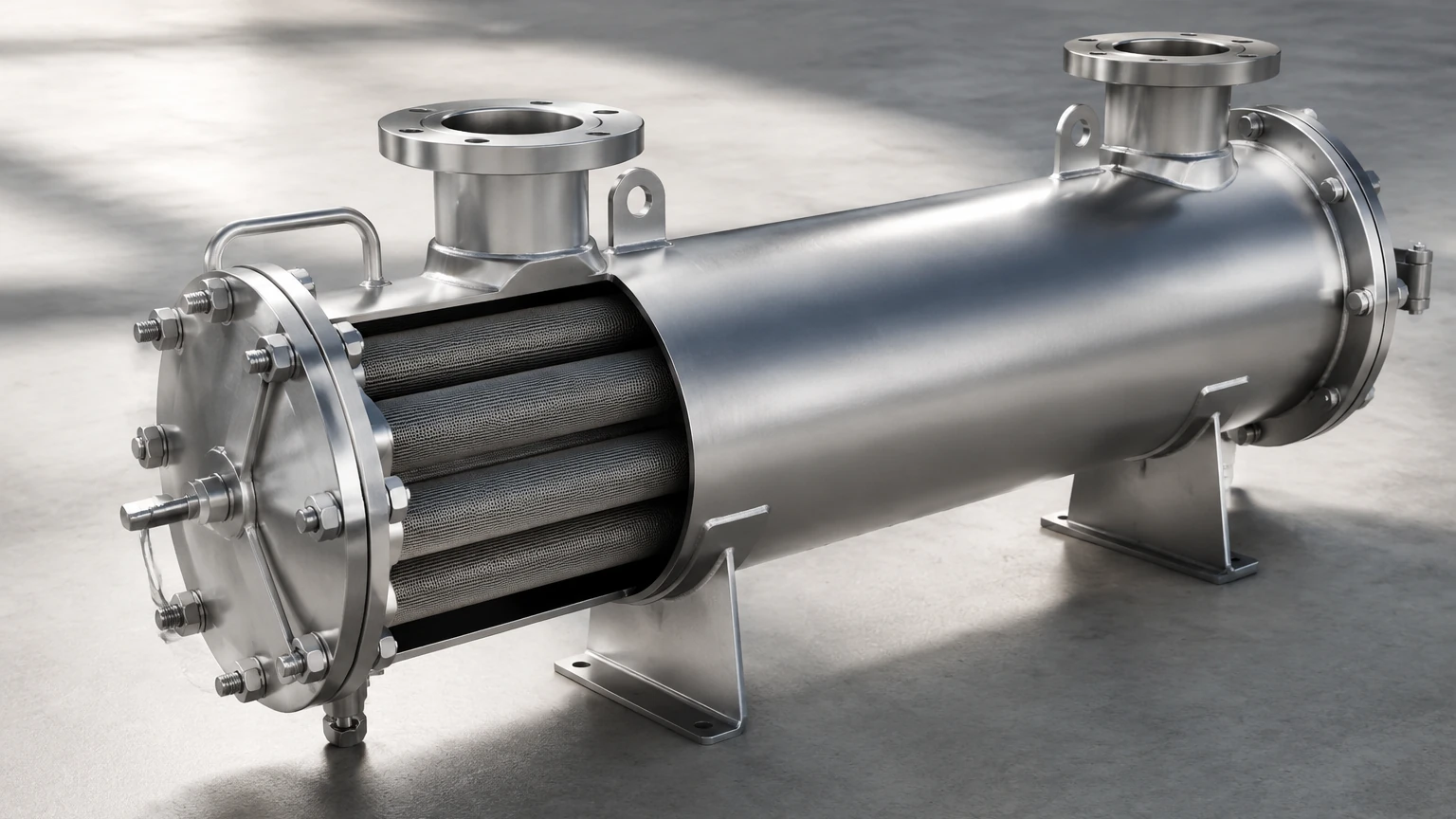
The gas then passes through a bank of filter elements, often referred to as coalescing cartridges. These elements are the heart of the horizontal filter separator. They are designed to trap fine solid particles and force small liquid droplets to collide and merge (coalesce) into larger drops. As these drops grow, they become heavy enough to migrate through the filter media and drain into the secondary sump area.
3. Final Mist Extraction
Before exiting the vessel, the gas typically passes through a final mist extractor, such as a wire mesh pad or a vane pack. This stage captures any remaining trace liquids that may have bypassed the coalescing elements or been re-entrained at high velocities. The result is a dry, clean gas stream ready for downstream processes.
Key Components and Material Selection
The performance of a horizontal filter separator is largely dictated by the quality and design of its internal components. Engineering specifications must account for chemical compatibility, temperature fluctuations, and mechanical stress.
Stainless Steel Filter Cartridges
Stainless steel is the preferred material for filter elements in demanding industrial environments. Unlike disposable synthetic filters, stainless steel cartridges manufactured from pleated wire mesh or sintered metal fibers offer superior structural integrity. They can withstand high differential pressures without collapsing and are resistant to the corrosive effects of sour gas (H2S) or acidic chemical vapors.
Wire Mesh Mist Eliminators
Wire mesh pads, often integrated into the final stage of the separator, are engineered with specific void volumes and surface areas. By utilizing multi-layered stainless steel mesh, these components maximize the probability of droplet-wire impingement. For specialized applications, Kaifil provides custom-engineered mesh densities to balance separation efficiency with acceptable pressure drop limits.
Vessel Internals and Support Structures
Horizontal separators require robust internal support plates and tube sheets to hold the filter cartridges in place. These must be precision-machined to ensure a leak-proof seal. Any bypass of unfiltered gas around the cartridges significantly degrades the system's overall efficiency.
Advantages of Horizontal vs. Vertical Configurations
While both horizontal and vertical separators serve similar purposes, the horizontal filter separator offers distinct advantages in specific technical scenarios:
* Higher Liquid Handling Capacity: The horizontal design provides a larger surface area at the gas-liquid interface. This is particularly beneficial for streams with high liquid-to-gas ratios, as it prevents the liquid level from rising too close to the filter elements, which could cause flooding.
* Longer Residence Time: The elongated path of the gas allows for more effective gravity settling of larger contaminants before they even reach the filter stage, extending the service life of the cartridges.
* Ease of Maintenance: In many horizontal designs, the filter elements are accessible via a quick-opening closure on one end of the vessel. This allows technicians to replace cartridges at ground level without the need for extensive scaffolding or overhead cranes required for tall vertical units.
* Footprint Considerations: While horizontal units require more floor space, they are ideal for skid-mounted applications and offshore platforms where height restrictions are a primary engineering constraint.
* Improved Coalescing Efficiency: The horizontal orientation allows for a more uniform distribution of gas across the filter bank, reducing localized high-velocity zones that can lead to "breakthrough" where liquids are pushed through the media rather than coalesced.
Performance Evaluation and Filtration Efficiency
When evaluating a horizontal filter separator, engineers must look beyond simple flow rates. The following metrics are essential for determining if a unit is fit for purpose:
Micron Rating and Beta Ratio
The filtration accuracy is defined by the micron rating of the internal elements. For critical protection of downstream compressors, a 1-micron or 0.3-micron absolute rating is often required. The Beta Ratio (β) provides a more precise measure of efficiency, indicating the ratio of particles upstream versus downstream of the filter at a specific size.
Liquid Removal Efficiency
Separators are typically rated by their ability to remove liquids of a certain size, often expressed as removing 99.9% of droplets 8 to 10 microns and larger. In high-performance coalescing stages, this can extend down to 0.3 microns.
Differential Pressure (ΔP)
Pressure drop is a critical operational cost factor. A well-designed separator should have a low clean pressure drop (typically 1-2 psi). As the filter elements capture solids, the ΔP will increase. Monitoring this change is essential for scheduling maintenance before the pressure drop reaches a critical level that could trigger a system bypass or damage the elements.
Maintenance and Replacement of Filter Elements
The total cost of ownership for a horizontal filter separator is heavily influenced by the maintenance cycle of its internal elements. While the vessel itself may last for decades, the filter cartridges are consumables that require periodic attention.
Monitoring and Diagnostics
Differential pressure gauges are the primary tool for monitoring filter health. However, engineers should also monitor the liquid discharge frequency. An unexpected increase in liquid volume may indicate a process upset upstream, while a sudden drop in ΔP could signify a ruptured filter element or a failed seal.
Cleaning vs. Replacement
One of the primary benefits of utilizing stainless steel wire mesh filters is the potential for cleaning. Depending on the nature of the solid contaminants (e.g., non-adhesive particulates), stainless steel elements can often be backwashed or ultrasonically cleaned, significantly reducing long-term waste and replacement costs compared to fiberglass or paper elements. If the contaminants are hydrocarbons or resins that polymerize on the surface, replacement may still be the most reliable option to ensure 100% restored flow capacity.
Gasket and Seal Integrity
During every filter change-out, the seals and gaskets must be inspected. High-pressure gas systems are prone to explosive decompression, which can damage standard O-rings. Utilizing high-performance elastomers or metal-to-metal seals is necessary for maintaining the integrity of the separation stages.
Customization for Demanding Industrial Applications
Standard off-the-shelf separators often fail to meet the specific nuances of specialized industrial environments. Customization is frequently required in the following areas:
* Chemical Compatibility: In refineries or chemical plants, the presence of amines, glycols, or aggressive solvents requires specific grades of stainless steel (such as 316L or Duplex) to prevent stress corrosion cracking.
* High-Temperature Service: For applications involving hot gas discharge, filter elements must be engineered to maintain their mechanical strength at elevated temperatures without the risk of media migration.
* Variable Flow Rates: In systems with high turndown ratios, the internal velocity can fluctuate significantly. Custom vane packs or specialized mesh densities can be engineered to maintain separation efficiency even at lower flow velocities.
For engineers seeking to optimize their filtration systems, reviewing technical specifications and manufacturing capabilities is the first step. You can explore a wide range of customized filtration components and engineering support by visiting the Kaifil Main Page.
Conclusion
The horizontal filter separator remains a cornerstone of industrial gas conditioning. By combining gravity separation with advanced coalescing technology, these units provide a robust defense against the damaging effects of solids and liquids in gas streams. The effectiveness of the system, however, is only as good as the internal filtration media. Choosing high-quality, stainless steel components ensures that the separator operates with maximum efficiency, minimum pressure drop, and the longest possible service life. Whether for a new installation or the retrofit of an existing vessel, understanding the engineering fundamentals of these separators is essential for maintaining process integrity and protecting high-value downstream assets.
