


Aquaculture System Technologies Bead Filter Systems
In the modern landscape of Recirculating Aquaculture Systems (RAS), the demand for high-efficiency water treatment has led to the widespread adoption of bead filter systems. These systems serve as a critical nexus between mechanical solids removal and biological nitrification, providing a compact and scalable solution for maintaining water quality in intensive fish farming and aquatic research facilities. For engineers and facility managers, understanding the underlying aquaculture system technologies bead filter systems utilize is essential for optimizing system performance and ensuring the long-term health of the aquatic environment.
Industrial-grade filtration in aquaculture requires a balance of durability, precision, and ease of maintenance. While the plastic media inside a bead filter performs much of the biological work, the integrity of the housing, internal screens, and integrated filtration components often relies on high-performance materials like stainless steel to withstand the corrosive and high-pressure environments common in commercial operations.
The Dual Functionality of Bead Filter Systems
Bead filter systems are unique in their ability to perform two distinct filtration processes within a single vessel. This dual-action capability is what makes them a cornerstone of modern aquaculture system technologies.
Mechanical Filtration
Mechanical filtration occurs as water is pumped through a bed of thousands of small plastic beads. These beads are typically packed tightly at the top of the filter vessel. As water passes through the interstitial spaces between the beads, suspended solids—such as uneaten feed, fish waste, and organic debris—are trapped. The efficiency of this mechanical capture is determined by the size and shape of the beads, as well as the flow rate of the water. High-performance systems can capture particles down to 20-30 microns, significantly reducing the turbidity of the water.
Biological Filtration
Simultaneously, the surface area of the beads provides a substrate for beneficial nitrifying bacteria (*Nitrosomonas* and *Nitrobacter*). These bacteria convert toxic ammonia, excreted by fish, into nitrite and then into relatively harmless nitrate. Because bead filters provide a massive amount of surface area in a relatively small volume, they are exceptionally efficient at biofiltration. Engineers must ensure that the oxygen levels within the filter remain high enough to support these aerobic bacteria, often necessitating pre-aeration or high turnover rates.
Engineering Considerations: Internal Components and Material Selection
While the beads themselves are the primary media, the structural components that manage water flow and keep the media contained are vital. This is where the selection of high-quality filtration components becomes a priority for system designers.
Internal Screens and Laterals
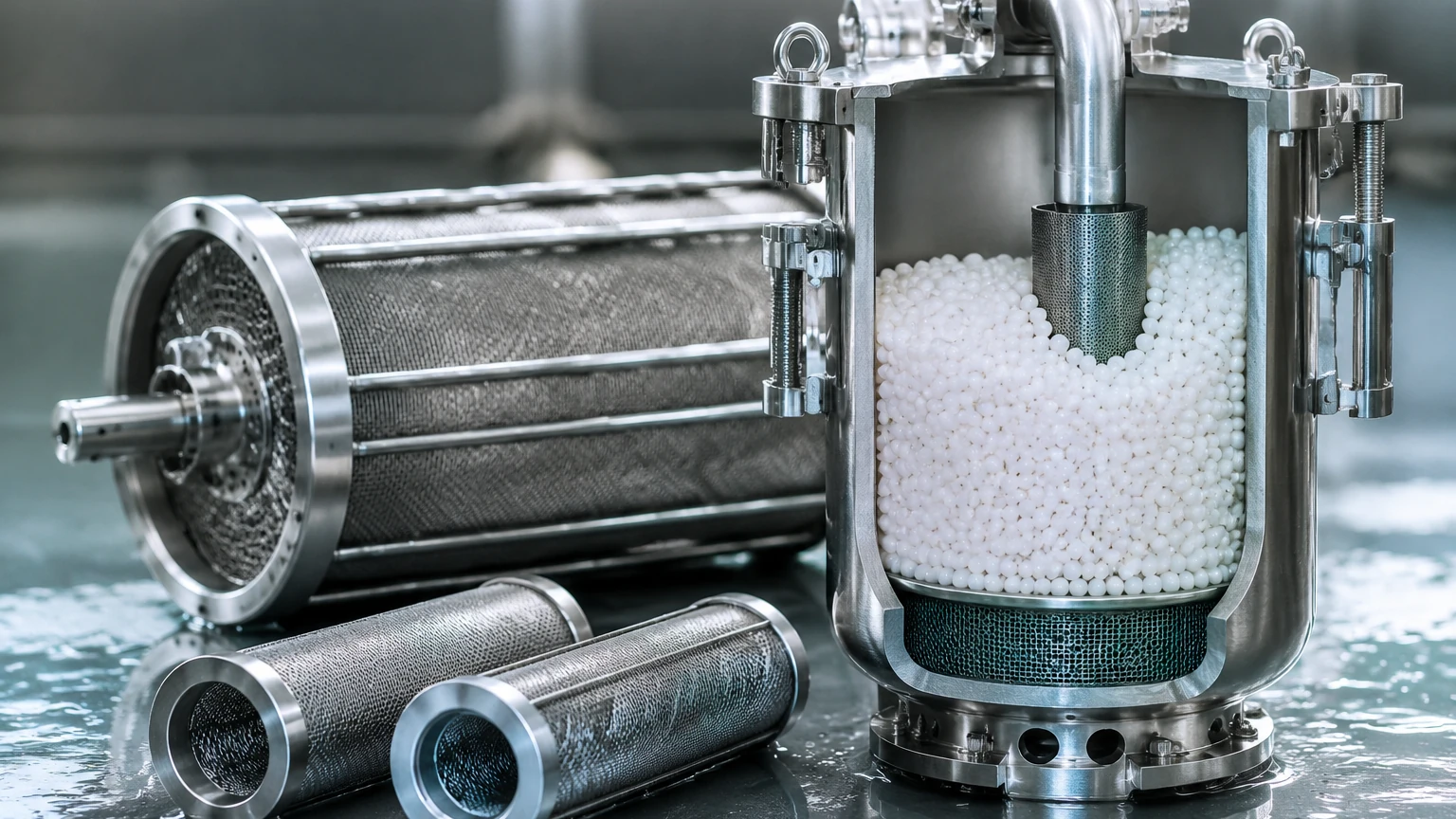
To prevent the loss of bead media during both the filtration and backwash cycles, bead filters utilize internal screens or lateral pipes. These components must feature precise slot sizes or mesh openings that are smaller than the bead diameter but large enough to allow high flow rates with minimal pressure drop. Stainless steel wire mesh and wedge wire screens are frequently specified for these internal components due to their structural rigidity and resistance to biofouling compared to plastic alternatives.
Corrosion Resistance in Aquatic Environments
Aquaculture environments can be exceptionally harsh on metal components, particularly in marine or brackish water systems. The use of 304 or 316L stainless steel is standard for high-end aquaculture system technologies bead filter systems. 316L stainless steel, with its addition of molybdenum, offers superior resistance to chloride-induced pitting, which is essential for saltwater applications. For manufacturers like Kaifil, providing precision-engineered stainless steel components ensures that the internal mechanics of the filter do not degrade over time, which could lead to media loss or system failure.
Optimizing Flow Rates and Pressure Management
The performance of a bead filter is heavily dependent on the hydraulics of the system. Engineers must calculate the "head loss" or pressure drop that occurs as water passes through the bead bed. As the filter accumulates solids, the resistance increases, leading to a rise in internal pressure and a decrease in flow.
Calculating Turnover Rates
In a commercial RAS, the entire volume of the tank should ideally pass through the filtration system every 30 to 60 minutes. Bead filters must be sized to handle these flow rates without fluidizing the bed prematurely during the filtration phase. If the flow rate is too high, the beads may shift, allowing "channeling" where water bypasses the media entirely, resulting in poor filtration performance.
The Role of Backwashing
Backwashing is the process of cleaning the filter by reversing or agitating the flow to dislodge trapped solids. Modern aquaculture system technologies bead filter systems often employ blowers or mechanical agitators to break up the bead pack before flushing the waste out. The design of the waste outlet and the internal distribution screens must be robust enough to handle the turbulence of the backwash cycle without sustaining damage. Precision-manufactured Main Page components are often used in these high-stress areas to ensure longevity.
Integration with Pre-Filtration and Polishing Stages
While bead filters are versatile, they are often part of a larger multi-stage filtration strategy. Relying solely on a bead filter for heavy solids loading can lead to frequent backwashing and reduced biological efficiency.
Pre-Filtration with Wire Mesh
To extend the life of the bead media and reduce the maintenance frequency, many systems incorporate a pre-filtration stage. Stainless steel wire mesh filters or drum filters are used to remove larger particles (above 100 microns) before the water reaches the bead filter. This protects the bead bed from clogging and allows the nitrifying bacteria to function more effectively on dissolved wastes.
Post-Filtration Polishing
For applications requiring extreme water clarity, such as research labs or high-density hatcheries, a post-filtration "polishing" stage may be used. This often involves stainless steel filter cartridges or fine-mesh screens that capture the minute particles that may have escaped the bead filter. By integrating these various aquaculture system technologies, engineers can create a redundant and highly effective water treatment loop.
Maintenance and Life Cycle Costs
When evaluating bead filter systems, the total cost of ownership (TCO) must be considered beyond the initial purchase price. Maintenance requirements and component durability play a significant role in long-term profitability.
1. Media Replacement: While the plastic beads are durable, they can eventually become colonised by "old" thick biofilm that reduces efficiency. Periodic inspection is required.
2. Screen Cleaning: Internal stainless steel screens may require occasional chemical cleaning to remove mineral scaling or stubborn bio-growth that backwashing cannot reach.
3. Energy Consumption: Because bead filters operate under pressure, they require more powerful pumps than gravity-fed systems. Optimizing the internal design to reduce pressure drop can lead to significant energy savings over the life of the system.
Selecting the Right Filtration Partner
For OEM manufacturers and system integrators, the quality of the individual components defines the reliability of the entire aquaculture system. Customization is often necessary to meet specific flow requirements or space constraints. Choosing a partner with expertise in stainless steel filtration solutions allows for the development of bespoke internal screens, housings, and support structures that are tailored to the unique demands of aquaculture.
At Kaifil, we specialize in the manufacturing of precision stainless steel filtration components that support advanced water treatment technologies. Our experience in wire mesh, filter cartridges, and custom metal components allows us to provide the durability and accuracy required for high-performance aquaculture systems. By focusing on material integrity and engineering precision, we help our clients achieve consistent water quality and operational efficiency.
In conclusion, aquaculture system technologies bead filter systems represent a sophisticated solution for modern fish farming. By understanding the mechanical and biological principles at play, and by selecting high-quality stainless steel components for the system's infrastructure, engineers can ensure a stable and productive aquatic environment. As the industry moves toward greater intensification and sustainability, the role of precision filtration will only continue to grow.
Download Aquaculture System Technologies Bead Filter Systems as a PDF
