


Cartridge Filter Stainless Steel
In industrial processing, the choice of filtration media significantly impacts operational efficiency, product purity, and long-term maintenance costs. A cartridge filter stainless steel solution is often the preferred choice for engineers facing extreme temperatures, corrosive chemicals, or high-pressure differentials where polymer-based filters would fail. Unlike disposable synthetic filters, stainless steel cartridges provide a reusable, high-strength alternative that maintains structural integrity under demanding conditions.
Selecting the right filtration component requires a deep understanding of material properties, construction methods, and the specific requirements of the fluid being processed. As a specialized manufacturer, Kaifil provides precision-engineered stainless steel filtration solutions designed to meet the rigorous standards of global industrial sectors. For more information on our full range of capabilities, visit our Main Page.
Engineering Fundamentals of Stainless Steel Cartridges
The performance of a cartridge filter stainless steel depends largely on the grade of metal used and the method of fabrication. Stainless steel is favored for its inherent resistance to oxidation and its ability to be cleaned and reused multiple times.
Material Selection: 304 vs. 316L
The most common materials used in industrial filtration are AISI 304 and 316L stainless steel. While 304 provides excellent durability for general industrial use, 316L is the industry standard for more aggressive environments. The addition of molybdenum in 316L enhances resistance to pitting and crevice corrosion, particularly in the presence of chlorides. For pharmaceutical and food-grade applications, 316L is almost universally required due to its superior chemical stability and ease of sterilization.
Construction Methods
Stainless steel filters are typically constructed using one of three primary methods:
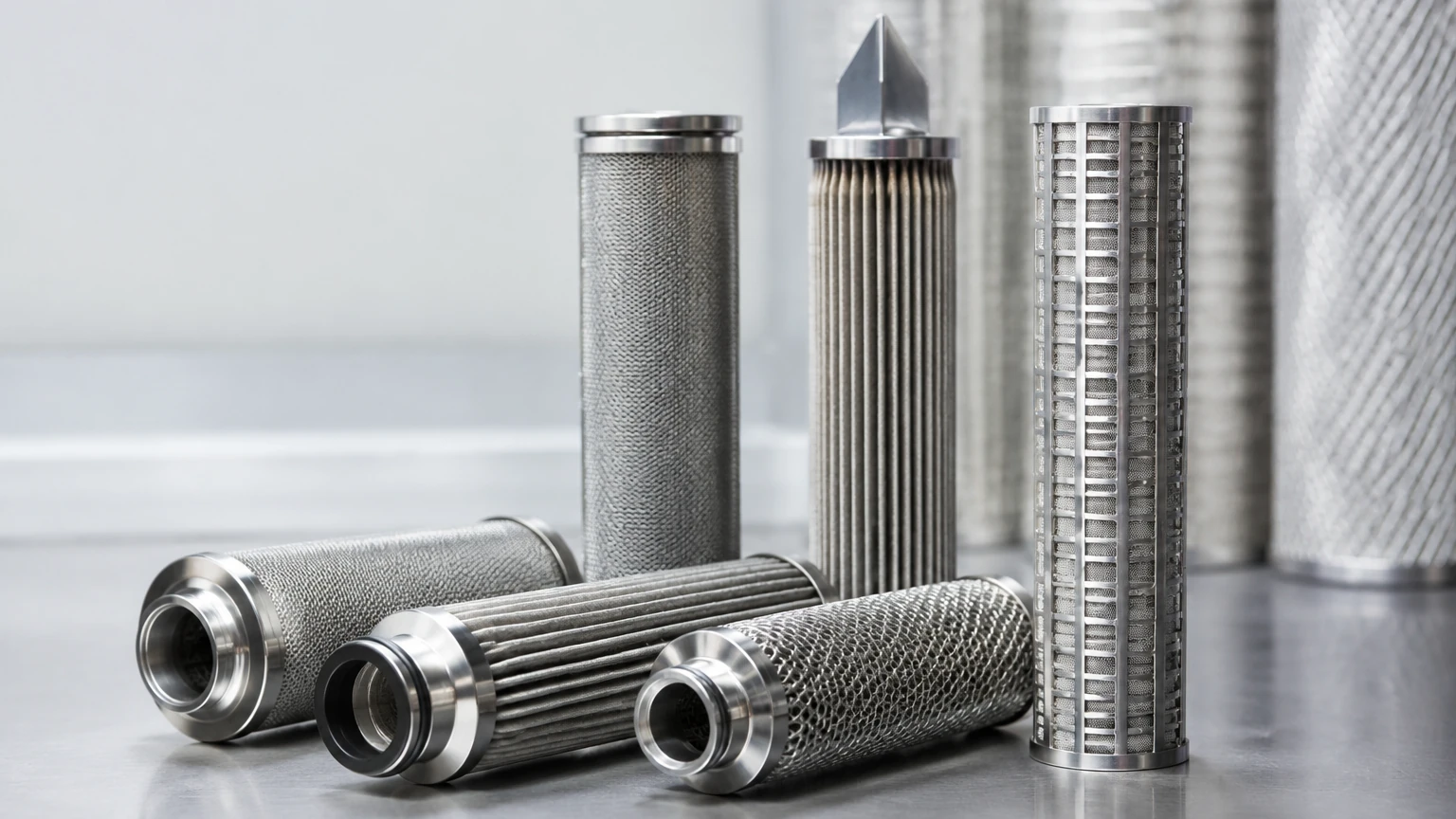
1. Wire Mesh Filters: These utilize woven wire cloth. They are excellent for surface filtration and are easily cleaned via backwashing or ultrasonic baths.
2. Sintered Metal Filters: These are created by fusing layers of wire mesh or metallic powder under high heat and pressure without melting them. This creates a porous, rigid structure with high mechanical strength and precise micron ratings.
3. Perforated Metal: Often used as a support core or an outer protective shroud for finer mesh layers, perforated metal provides the structural backbone necessary to withstand high collapse pressures.
Key Performance Criteria for Selection
Engineers must evaluate several technical parameters to ensure a cartridge filter stainless steel is fit for purpose. A mismatch between the filter's specifications and the application's demands can lead to premature clogging, bypass, or even structural failure.
Micron Rating and Filtration Efficiency
The micron rating determines the size of particles the filter can capture. It is essential to distinguish between "nominal" and "absolute" ratings. A nominal rating refers to a filter's ability to retain a major percentage of particles of a certain size, whereas an absolute rating (often validated through a bubble point test) indicates the diameter of the largest spherical particle that can pass through the filter. In precision industries like hydraulics or pharmaceuticals, absolute ratings are critical for protecting downstream components.
Flow Rate and Pressure Drop (Delta P)
Every filter introduces a degree of resistance to the flow. The initial pressure drop across a clean filter should be minimized to maximize the service life before the terminal pressure drop is reached. Stainless steel cartridges, particularly pleated designs, offer a high surface area which helps maintain lower flux rates and extends the interval between cleaning cycles.
Temperature and Pressure Limits
One of the primary advantages of a cartridge filter stainless steel is its thermal stability. While polypropylene filters may soften or degrade at temperatures above 60°C (140°F), stainless steel can operate effectively at temperatures exceeding 300°C (572°F) depending on the seal materials used (such as PTFE or Viton). Furthermore, the high collapse pressure of metal cartridges makes them ideal for high-viscosity fluids or systems with significant pressure surges.
Industrial Applications and Compatibility
Stainless steel filtration is a cross-industry necessity, providing reliability where other materials succumb to chemical or physical stress.
Chemical and Petrochemical Processing
In chemical manufacturing, filters are exposed to solvents, acids, and bases. A cartridge filter stainless steel made from 316L or specialized alloys can withstand these corrosive agents while removing catalysts or impurities from the process stream. Their ability to handle high-temperature steam also makes them suitable for gas filtration and steam stripping processes.
Food and Beverage Industry
Hygiene is the priority in food and beverage production. Stainless steel filters are non-shedding, meaning they do not release fibers into the product. They are used for filtering cooking oils, syrups, and beverages, and are compatible with Clean-in-Place (CIP) and Sterilization-in-Place (SIP) protocols, ensuring that the filtration system remains free of microbial growth.
Pharmaceutical and Biotechnology
For the pharmaceutical sector, filtration must be precise and verifiable. Stainless steel cartridges are used in the production of active pharmaceutical ingredients (APIs) and the filtration of process gases. The smooth surface finish of precision-engineered metal filters prevents particle entrapment and facilitates thorough cleaning, which is vital for preventing cross-contamination between batches.
Hydraulic and Lubrication Systems
In hydraulic systems, even microscopic metal shavings or contaminants can cause catastrophic pump failure. Stainless steel mesh cartridges provide the high-strength filtration needed to handle high-pressure oil circuits, ensuring that the fluid remains within the required ISO cleanliness codes.
Customization and OEM Capabilities
While standard sizes (such as 10-inch, 20-inch, or 30-inch lengths) are common, many industrial systems require customized filtration solutions to fit existing housings or to meet unique flow requirements. Customization involves more than just changing the dimensions; it includes optimizing the filter structure for specific performance goals.
Tailored Filter Media
Depending on the contaminant load, a filter can be designed with multiple layers of varying mesh sizes. This "graded density" approach allows larger particles to be trapped in the outer layers while finer particles are caught deeper within the media, significantly increasing the dirt-holding capacity of the cartridge filter stainless steel.
End-Cap Configurations
To ensure a leak-proof seal within the filter housing, various end-cap styles are available, including DOE (Double Open End), SOE (Single Open End) with 222 or 226 O-ring configurations, and threaded connections (NPT/BSP). Choosing the correct interface is vital to prevent fluid bypass, which would compromise the entire filtration process.
Kaifil specializes in these OEM capabilities, working closely with engineering teams to develop components that meet exact specifications. By controlling the manufacturing process from material selection to final assembly, we ensure that every custom filter delivers dependable performance in demanding environments.
Maintenance, Cleaning, and Total Cost of Ownership (TCO)
One of the most frequent questions regarding a cartridge filter stainless steel is the total cost of ownership compared to disposable alternatives. While the initial purchase price of a metal filter is higher, the long-term economics often favor stainless steel.
The Reusability Advantage
Disposable filters generate significant waste and require frequent replacement, leading to high recurring procurement costs and system downtime. In contrast, a stainless steel cartridge can be cleaned and returned to service. Common cleaning methods include:
* Backwashing: Reversing the flow of fluid to dislodge particles from the surface of the mesh.
* Ultrasonic Cleaning: Using high-frequency sound waves in a cleaning solvent to remove deeply embedded contaminants from sintered or multi-layered media.
* Chemical Cleaning: Using specialized detergents or acids to dissolve organic or inorganic scale, provided the chemical is compatible with the stainless steel grade.
Calculating TCO
When evaluating the cost, engineers should consider the cost of the filter, the cost of labor for replacement, the cost of disposal for contaminated synthetic filters, and the cost of lost production during downtime. Over a period of two to five years, the ability to clean and reuse a cartridge filter stainless steel typically results in a lower TCO and a reduced environmental footprint.
Technical Specifications to Confirm Before Purchase
Before finalizing a purchase or requesting a custom design, procurement and engineering teams should confirm the following data points to ensure the filtration solution will perform as expected:
1. Fluid Characteristics: What is the chemical composition, viscosity, and density of the fluid? This dictates material choice and flow calculations.
2. Operating Temperature: What are the normal and maximum operating temperatures? This affects the choice of seals and the structural expansion of the metal.
3. Pressure Parameters: What is the maximum operating pressure and the maximum allowable pressure drop before cleaning is required?
4. Contaminant Type: Are the particles hard, soft, fibrous, or gelatinous? This influences whether a pleated or cylindrical mesh design is more effective.
5. Required Micron Rating: Is a nominal or absolute rating required for the application?
6. Housing Compatibility: Does the cartridge length and end-cap style match the existing filter housing exactly?
By addressing these factors, technical professionals can avoid common pitfalls and select a filtration component that optimizes system uptime and product quality.
Conclusion
A cartridge filter stainless steel is more than just a piece of hardware; it is a critical engineering component that ensures the purity and safety of industrial processes. Whether it is protecting high-pressure hydraulic pumps, ensuring the clarity of a beverage, or removing catalysts in a chemical plant, the durability and precision of stainless steel are unmatched.
At Kaifil, we combine manufacturing expertise with deep engineering knowledge to provide filtration solutions that stand up to the most challenging industrial environments. By focusing on quality materials, customized designs, and rigorous production standards, we help our global partners achieve efficient and cost-effective filtration performance. For technical support or to review our product options, please visit our Main Page.
