


Cross Flow Filtration Beer
In the modern brewing industry, achieving clarity and biological stability while maintaining the organoleptic profile of the product is a critical engineering challenge. Traditional methods, such as diatomaceous earth (DE) filtration, have long been the industry standard but are increasingly being replaced by more sustainable and efficient technologies. Cross flow filtration beer processing has emerged as the leading alternative, offering a closed-loop, automated, and waste-reducing solution for clarification and sterile filtration.
For engineers and production managers, transitioning to or optimizing a cross flow system requires a deep understanding of fluid dynamics, membrane material science, and the mechanical integrity of the filtration housing. As a specialist in stainless steel filtration solutions, Kaifil provides the precision components necessary to support these high-performance systems, ensuring that the rigorous demands of industrial brewing are met with durability and accuracy.
The Principles of Cross Flow Filtration in Brewing
Unlike traditional dead-end filtration, where the fluid is pushed perpendicularly through a filter medium and solids accumulate as a "cake" on the surface, cross flow filtration (also known as tangential flow filtration) operates by directing the beer flow parallel to the membrane surface.
In this configuration, the majority of the liquid (the retentate) recirculates across the membrane at high velocity, while a portion of the clarified liquid (the permeate) passes through the pores. The high-velocity tangential flow creates a shearing effect that continuously sweeps away yeast cells, proteins, and polyphenols that would otherwise clog the filter. This mechanism allows for much longer filtration cycles and consistent flux rates compared to static filtration methods.
From an engineering perspective, managing the transmembrane pressure (TMP) is vital. As the run progresses, the concentration of solids in the retentate loop increases, requiring precise control over pump speeds and pressure differentials to prevent irreversible membrane fouling. High-quality stainless steel components, such as those found on our Main Page, are essential for maintaining the structural integrity of the system under these varying pressure conditions.
Advantages Over Diatomaceous Earth (DE) Filtration
For decades, breweries relied on DE filtration, which involves using powdered fossilized algae as a filter aid. While effective, DE presents several operational and environmental challenges that cross flow filtration beer systems successfully resolve.
1. Environmental and Health Safety
DE is a hazardous material that poses respiratory risks to brewery staff during handling. Furthermore, spent DE must be disposed of in landfills, creating a significant environmental footprint and increasing waste management costs. Cross flow systems are entirely contained and do not require consumable filter aids, making them a "green" alternative.
2. Product Yield and Quality
Traditional filtration often results in higher product loss due to the beer trapped within the DE cake. Cross flow systems maximize yield by efficiently concentrating the retentate. Additionally, because the process is automated and closed, there is a significantly lower risk of oxygen pickup, which is the primary enemy of beer shelf life and flavor stability.
3. Labor and Automation
DE systems require manual setup, constant monitoring of slurry dosing, and intensive cleaning after each batch. Cross flow filtration is highly amenable to automation. Modern PLC-controlled systems can manage the entire filtration and Clean-In-Place (CIP) cycle with minimal operator intervention, allowing technical staff to focus on other areas of production.
Engineering Considerations: Material Selection and Durability
In the context of cross flow filtration beer applications, the choice of materials for housings, piping, and support structures is non-negotiable. Stainless steel, particularly grades 304 and 316L, is the industry standard due to its corrosion resistance and ability to withstand the harsh chemicals used in CIP processes.
Membrane Support and Housing
While the membranes themselves may be ceramic or polymeric, the housings that contain them must be engineered to high tolerances. Precision metal filter components ensure that there are no bypasses where unfiltered beer could contaminate the permeate stream. At Kaifil, we manufacture custom stainless steel filter cartridges and housings designed to integrate seamlessly into industrial cross flow skids, providing the mechanical strength needed to handle high-velocity recirculation.
Chemical Compatibility
Brewery filtration systems must undergo regular caustic and acid washes to remove organic fouling and mineral scale. Stainless steel components are resistant to these cleaning agents at elevated temperatures, ensuring a long service life. When selecting components, engineers must verify that all gaskets and seals are made from food-grade elastomers like EPDM or PTFE that can also withstand these conditions.
Managing Fouling and Flux Rates
The efficiency of a cross flow filtration beer system is measured by its flux—the volume of beer filtered per unit of membrane area per hour (LMH). Several factors influence flux in a brewery environment:
* Yeast Load: Higher concentrations of yeast in the feed will naturally decrease flux and increase the frequency of back-pulsing or cleaning.
* Temperature: Beer is typically filtered at cold temperatures (around 0°C to -1°C) to ensure the precipitation of haze-forming proteins. However, lower temperatures increase viscosity, which can reduce flux. Engineers must balance clarity requirements with throughput goals.
* Pore Size: For clarification, membranes typically range from 0.45 to 1.0 microns. Selecting the correct pore size is a trade-off between filtration speed and the removal of specific haze-forming compounds.
To maintain optimal flux, most systems employ a "back-pulse" technique, where a small amount of permeate is periodically forced back through the membrane in the reverse direction. This dislodges any particles that have become wedged in the pores. The reliability of the valves and stainless steel manifolds handling these pressure reversals is paramount to the system's uptime.
Integration of Pre-Filtration Solutions
While cross flow filtration is highly effective, its efficiency can be significantly enhanced by incorporating robust pre-filtration. Removing larger particulates, such as hop debris or large yeast clumps, before they reach the expensive cross flow membranes prevents premature fouling and mechanical wear.
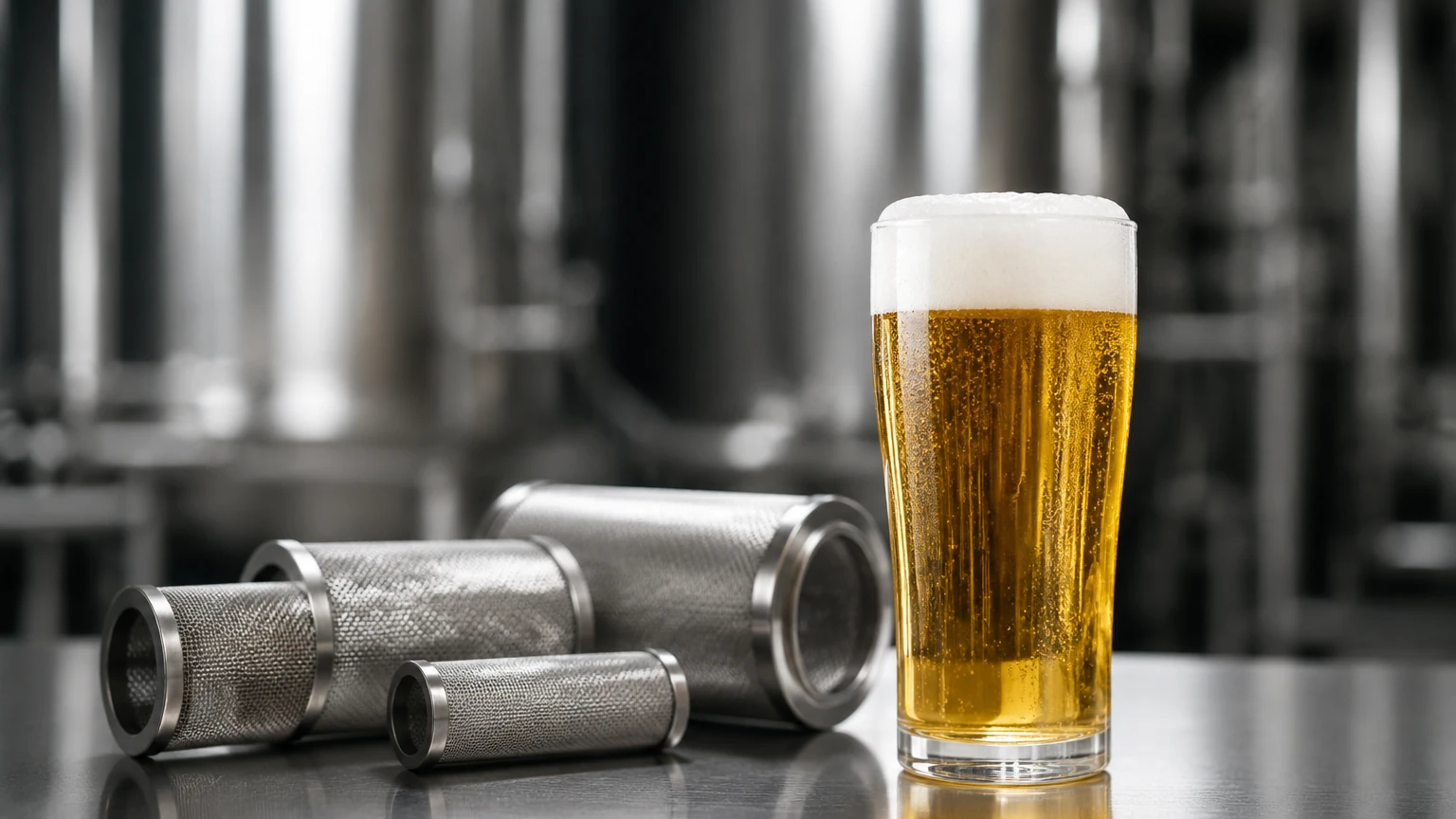
Stainless steel wire mesh filters and precision metal strainers are ideal for this stage. These components are cleanable and reusable, providing a cost-effective barrier that protects the delicate downstream membranes. By utilizing high-quality pre-filters, breweries can extend the time between intensive CIP cycles, reducing chemical consumption and extending the overall lifespan of the primary filtration media.
Total Cost of Ownership and ROI
When evaluating cross flow filtration beer technology, purchasing teams must look beyond the initial capital expenditure (CAPEX) and consider the total cost of ownership (TCO). The return on investment (ROI) is typically driven by:
1. Reduced Consumable Costs: Elimination of DE and paper sheets.
2. Lower Labor Costs: Automated operation reduces the need for dedicated filtration technicians.
3. Increased Yield: Higher recovery rates of finished beer.
4. Utility Savings: Modern systems are designed for energy efficiency, and the reduction in waste disposal fees contributes directly to the bottom line.
For many mid-to-large scale breweries, the transition to cross flow filtration pays for itself within 18 to 36 months, depending on production volumes and previous filtration inefficiencies.
Customization in Filtration Engineering
Every brewery has unique requirements based on their specific recipes, gravity of the beer, and production scale. A one-size-fits-all approach rarely yields the best results. Customization in filtration components allows for the optimization of flow paths, the integration of specific sensor ports for turbidity and pressure monitoring, and the design of skids that fit within existing floor space constraints.
Kaifil specializes in these customized solutions. Whether it is a specific micron rating for a wire mesh pre-filter or a uniquely configured stainless steel filter cartridge for a specialized craft application, our engineering team works to ensure that the filtration hardware supports the brewer’s goals for quality and efficiency. Detailed technical specifications and OEM capabilities can be explored further on our Main Page.
Conclusion
Cross flow filtration beer processing represents the pinnacle of modern brewing clarification. By moving away from the manual, waste-intensive methods of the past, breweries can achieve higher consistency, better product shelf life, and improved operational safety. The success of these systems relies heavily on the quality of the mechanical components that house and support the filtration media.
As the industry continues to evolve toward higher levels of automation and sustainability, the role of precision-engineered stainless steel filtration solutions becomes even more vital. By focusing on durable materials, optimized flow dynamics, and strategic pre-filtration, engineers can ensure their cross flow systems deliver peak performance for years to come.
