


Porous Media Filters
In industrial filtration, the selection of the correct filter medium is a critical engineering decision that directly impacts process efficiency, equipment longevity, and product purity. Porous media filters, particularly those constructed from stainless steel and other metallic alloys, are engineered to provide precise particle retention while maintaining structural integrity under extreme temperatures, high pressures, and corrosive environments. Unlike simple surface filters, porous media filters utilize a complex three-dimensional matrix to trap contaminants, offering a combination of high permeability and significant dirt-holding capacity.
For engineers and procurement teams, understanding the technical nuances of these filters is essential. This guide examines the mechanics, material considerations, and performance evaluation criteria for porous media filters in industrial applications.
The Mechanics of Porous Media Filtration
Porous media filters operate on principles that go beyond simple mechanical sieving. While a standard wire mesh might act as a two-dimensional barrier, porous media—such as sintered metal powder or multi-layer sintered mesh—create a "tortuous path" for the fluid.
Depth Filtration vs. Surface Filtration
Surface filtration occurs when particles larger than the pore size are trapped on the upstream side of the filter element. While effective for certain applications, it can lead to rapid pressure drop as a filter cake builds up. Porous media filters often utilize depth filtration, where particles are captured within the thickness of the medium. This is achieved through several mechanisms:
* Inertial Impaction: Larger particles, unable to follow the fluid streamlines as they curve around the media fibers or grains, strike the media and become trapped.
* Interception: Particles following a streamline come into contact with the media surface and adhere to it.
* Diffusion: Very small particles (sub-micron) exhibit Brownian motion, increasing the likelihood that they will collide with the filter media.
By utilizing the full volume of the filter wall, porous media filters can maintain a lower pressure drop for longer periods compared to surface-only filters.
Engineering Material Selection
The performance of porous media filters is heavily dependent on the material of construction. In industrial settings, stainless steel is the standard due to its mechanical strength and chemical resistance.
Stainless Steel Grades
* 304 Stainless Steel: Suitable for general industrial applications where basic corrosion resistance and high strength are required.
* 316L Stainless Steel: The "L" denotes low carbon content, which improves weldability and resistance to intergranular corrosion. This grade is preferred in chemical processing, pharmaceuticals, and marine environments due to its superior resistance to chlorides and acids.
* Specialty Alloys: For extreme environments, media can be manufactured from Inconel, Monel, or Hastelloy to withstand temperatures exceeding 600°C or highly aggressive chemical reagents.
Manufacturing Methods: Sintered Powder vs. Sintered Mesh
There are two primary forms of metallic porous media filters:
1. Sintered Metal Powder: Created by compacting and heating metal powders until the particles bond at their contact points. This results in a rigid, highly porous structure with a very narrow pore size distribution. It is ideal for high-precision gas and liquid filtration where absolute retention is required.
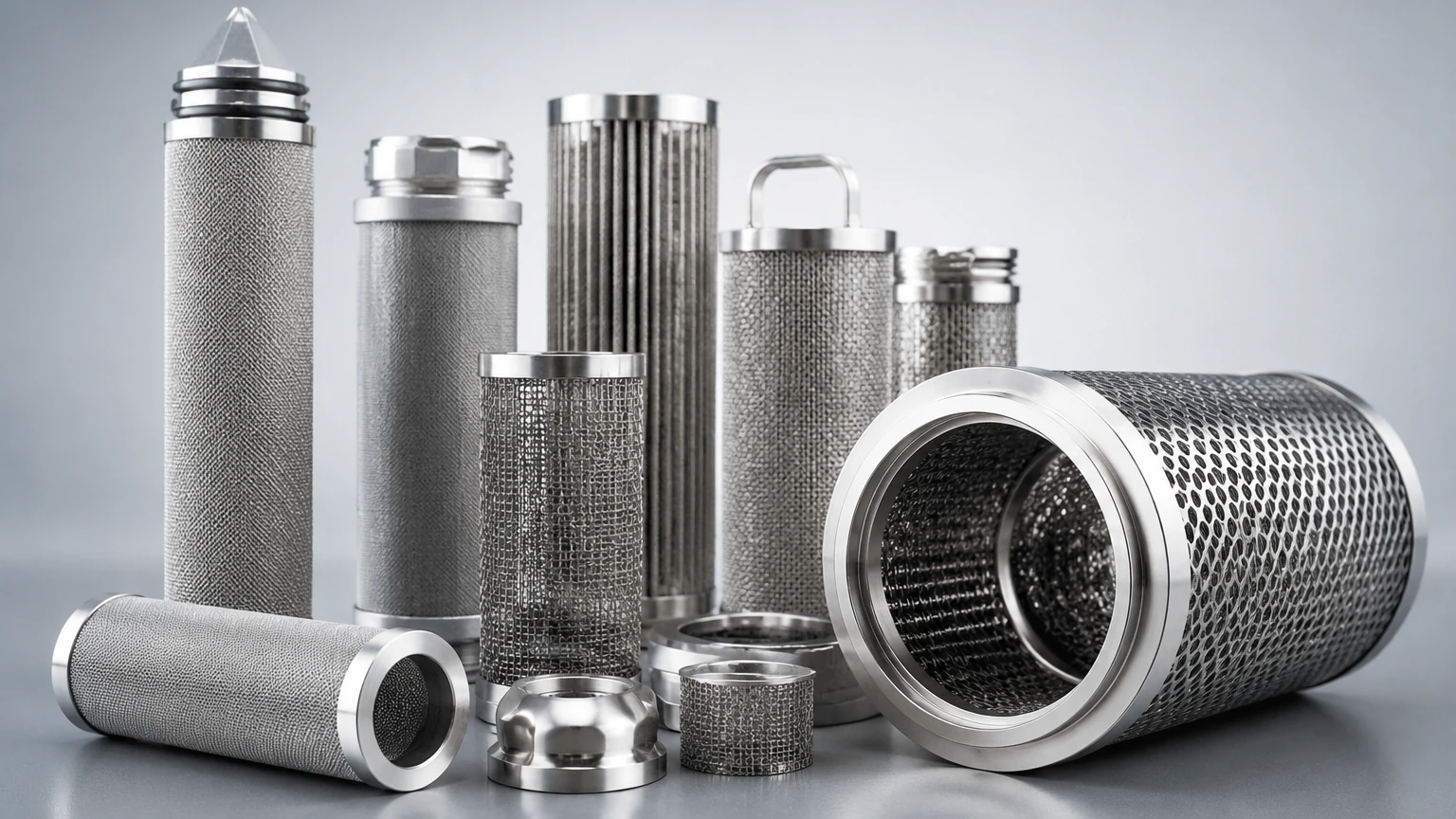
2. Sintered Wire Mesh: Multiple layers of stainless steel wire mesh are laminated and sintered together. This structure combines the high porosity of mesh with the structural rigidity of a solid plate. It is exceptionally durable and can be pleated to increase the effective filtration area.
For those seeking specific configurations for industrial systems, the Main Page provides a comprehensive overview of how these materials are integrated into custom filter cartridges and components.
Key Performance Metrics and Evaluation Criteria
When specifying porous media filters, engineers must evaluate several quantitative metrics to ensure the component meets the application requirements.
Micron Rating: Absolute vs. Nominal
A common point of confusion in procurement is the difference between nominal and absolute ratings.
* Nominal Rating: An arbitrary value indicating the filter's ability to retain a percentage of particles of a certain size (e.g., 90% of 10-micron particles). This is often insufficient for critical processes.
* Absolute Rating: The diameter of the largest hard spherical particle that will pass through the filter under specified test conditions. For high-purity applications, an absolute rating is mandatory.
Permeability and Pressure Drop (ΔP)
Permeability refers to the ease with which a fluid passes through the porous medium. According to Darcy’s Law, the flow rate is proportional to the pressure drop across the media. In industrial design, the goal is to maximize permeability while maintaining the required filtration efficiency. A high initial pressure drop usually indicates that the filter is either too restrictive for the flow rate or that the media thickness is excessive.
Dirt-Holding Capacity (DHC)
DHC is the total mass of a standard contaminant a filter can retain before the pressure drop reaches a terminal limit. A higher DHC translates to longer service intervals and lower total cost of ownership (TCO). Porous media filters generally excel in DHC due to their three-dimensional internal structure.
Common Risks in Porous Media Application
While porous media filters are robust, improper selection or maintenance can lead to operational failures. Engineers should be aware of the following risks:
1. Media Migration
In lower-quality filters, individual fibers or particles of the filter media may break loose and enter the downstream flow. This is particularly dangerous in pharmaceutical or food and beverage applications. Sintered media significantly reduce this risk because the particles or wires are metallurgically bonded.
2. Chemical Incompatibility
Even stainless steel can succumb to corrosion if the fluid chemistry is not properly matched to the alloy. For example, high concentrations of hot chlorides can cause pitting or stress corrosion cracking in 304 stainless steel. Always confirm the pH, concentration, and temperature of the process fluid before finalizing material selection.
3. Fatigue Failure
In systems with high-frequency pressure pulsations (such as hydraulic systems), the filter media can undergo mechanical fatigue. If the porous media is not properly supported by an internal core or external shroud, it may crack or collapse.
Maintenance and Cleaning Protocols
One of the primary advantages of metallic porous media filters over disposable polymer filters is their cleanability. Industrial filters can often be restored to near-original performance through several methods:
* Backpulsing/Backwashing: Reversing the flow of fluid through the filter to dislodge accumulated particles. This is often automated in continuous process systems.
* Ultrasonic Cleaning: Using high-frequency sound waves in a cleaning solvent to vibrate trapped particles out of the deep pores of the media.
* Chemical Cleaning: Using acids, caustics, or surfactants to dissolve specific contaminants that cannot be removed mechanically.
* Burn-off/Pyrolysis: For organic contaminants, heating the filter in a controlled atmosphere can carbonize and remove the blockage.
Understanding the cleaning cycle is vital for calculating the lifecycle cost. While the initial investment in a stainless steel porous media filter is higher than a disposable alternative, the ability to reuse the element hundreds of times often results in a lower TCO over 2–5 years.
Customization and Engineering Support
Industrial filtration is rarely a "one-size-fits-all" scenario. Customization is often required to fit existing housing dimensions, meet specific flow rates, or comply with industry-specific certifications (such as FDA or ASME standards).
When collaborating with a manufacturer like Kaifil, engineers can specify:
* End Cap Configurations: Threaded, flanged, or double open-ended (DOE) designs.
* Support Structures: Internal perforated cores for high-pressure collapse resistance.
* Pleating Geometry: Optimizing the number of pleats to balance surface area with ease of cleaning.
To explore the range of customization options and technical specifications available for these systems, visit the Main Page to review product options and application support.
Technical Confirmation Checklist for Procurement
Before finalizing a purchase order for porous media filters, the following technical details should be confirmed with the manufacturer:
1. Operating Conditions: What is the maximum operating temperature and pressure? Are there pressure spikes?
2. Fluid Characteristics: What is the viscosity of the fluid at operating temperature? What is the chemical composition?
3. Contaminant Profile: What is the nature of the solids being removed (hard, deformable, fibrous)? What is the particle size distribution?
4. Target Efficiency: Is an absolute or nominal micron rating required? What is the allowable downstream particle count?
5. Cleaning Infrastructure: Does the facility have the equipment (ultrasonic baths, backwash headers) to maintain cleanable media?
By addressing these factors, engineering teams can ensure they select a porous media filter that provides reliable performance, minimizes downtime, and optimizes the overall efficiency of the industrial process.
