


Industrial Water Filter
In industrial environments, water serves as a critical medium for cooling, cleaning, chemical processing, and power generation. The reliability of these systems depends heavily on the quality of the water circulating through them. An industrial water filter is not merely a peripheral component; it is a fundamental safeguard for downstream equipment such as heat exchangers, high-pressure pumps, and sensitive nozzles. Selecting the correct filtration solution requires a deep understanding of fluid dynamics, material science, and the specific contaminants present in the process stream.
For engineers and procurement teams, the challenge lies in balancing filtration efficiency with operational continuity. A filter that is too fine may lead to frequent clogging and excessive pressure drops, while one that is too coarse fails to protect the system. This guide examines the technical parameters, material considerations, and engineering criteria essential for selecting and implementing high-performance industrial water filtration systems.
Engineering Fundamentals of Industrial Water Filtration
Effective filtration is governed by several physical principles that dictate how particles are captured and how the fluid behaves as it passes through the filter media. When evaluating an industrial water filter, engineers must prioritize three primary technical factors: flow rate, differential pressure, and particle load.
Flow Rate and Velocity
The flow rate (measured in GPM or m³/h) determines the size of the filter housing and the required surface area of the filter element. High-velocity flow can cause turbulence, which may push contaminants through the mesh or cause structural fatigue in the filter media. To maintain efficiency, the flux (flow per unit area) must be kept within the manufacturer’s recommended limits for the specific media type.
Differential Pressure (ΔP)
Differential pressure is the difference in pressure between the inlet and outlet of the filter. As an industrial water filter captures debris, the ΔP increases. Engineers must design systems with a "clean" pressure drop low enough to allow for a significant "dirt-holding capacity" before the filter requires cleaning or replacement. Exceeding the maximum allowable ΔP can result in media deformation or "breakthrough," where captured particles are forced through the filter.
Particle Load and Distribution
Understanding the nature of the solids—whether they are hard, abrasive sands or soft, organic biofilms—is vital. Particle size distribution (PSD) analysis helps in selecting the appropriate micron rating. For high-load environments, a multi-stage approach (coarse pre-filtration followed by fine polishing) is often more cost-effective than a single-stage fine filter.
Material Selection for Durability and Compatibility
In industrial water applications, the choice of material is often the deciding factor in the filter’s lifespan. While polymer-based filters are common in light-duty applications, heavy industrial processes typically demand the robustness of metal, specifically stainless steel. For comprehensive technical specifications and customized engineering support, please visit our Main Page.
Stainless Steel 304 vs. 316L
Stainless steel is the industry standard for industrial water filters due to its mechanical strength and resistance to corrosion.
- Type 304: Suitable for general industrial water, including cooling towers and basic process water where chloride levels are low.
- Type 316L: Contains molybdenum, providing superior resistance to pitting and crevice corrosion in high-chloride environments or applications involving brackish water and chemical additives. 316L is the preferred choice for pharmaceutical and food-grade water systems due to its superior corrosion resistance and ease of sterilization.
Advanced Alloys
In extreme cases involving highly acidic process water or high-temperature steam filtration, specialty alloys like Monel, Hastelloy, or Inconel may be required. These materials ensure that the industrial water filter maintains its structural integrity even when exposed to aggressive chemical cleaning agents or thermal cycling.
Understanding Filtration Accuracy: Micron Ratings and Weave Types
Filtration accuracy is defined by the micron rating, which indicates the size of particles the filter can effectively remove. However, the distinction between nominal and absolute ratings is critical for engineering precision.
Nominal vs. Absolute Ratings
- Nominal Rating: An approximate value indicating that the filter will retain a majority of particles at that size (e.g., 60-80%). This is often sufficient for general water intake or cooling loops.
- Absolute Rating: A mathematically determined value indicating that 99.9% (or higher) of particles at that micron size are retained. Absolute-rated stainless steel mesh is essential for protecting precision nozzles or sensitive membrane systems (like Reverse Osmosis pre-filtration).
Wire Mesh Weave Structures
The geometry of the filter media significantly impacts performance. Common weaves used in an industrial water filter include:
1. Plain Weave: A simple over-under pattern providing high flow rates and easy cleaning, typically used for coarse filtration.
2. Twill Weave: Allows for thicker wires and finer meshes, offering increased durability for high-pressure applications.
3. Dutch Weave: Features a dense, overlapping structure that provides superior strength and high filtration precision. This is often used in high-pressure hydraulic water systems and fine chemical processing.
Structural Designs: From Wire Mesh to Filter Cartridges
Industrial water filters are manufactured in various configurations to suit different housing types and flow requirements. The structural design must account for the mechanical stresses of the application.
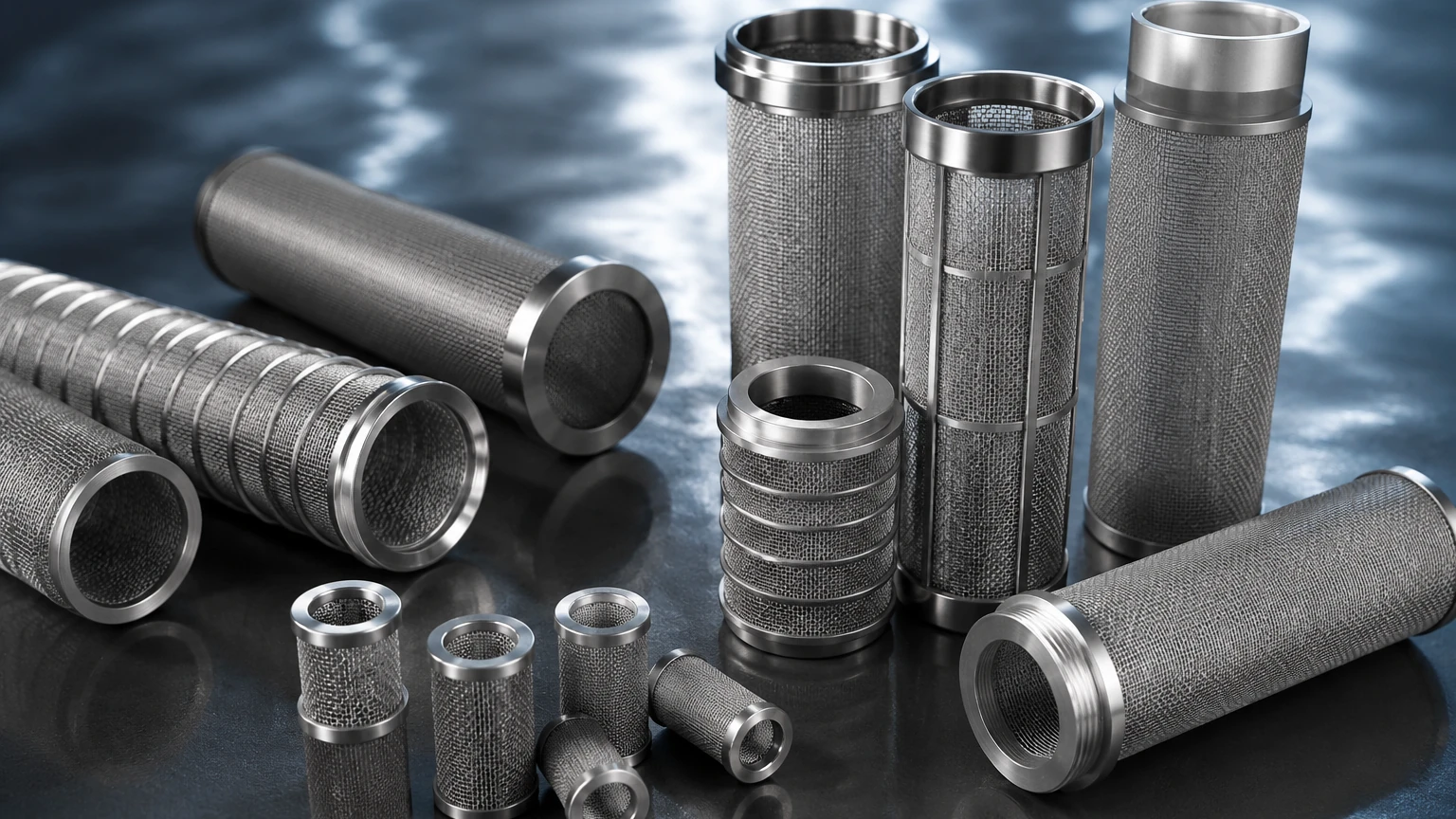
Stainless Steel Filter Cartridges
These are often designed as cylindrical elements that can be retrofitted into existing housings. They may feature a pleated design to maximize surface area, which significantly extends the time between cleaning cycles. Pleated stainless steel cartridges are ideal for high-flow applications where space is limited.
Sintered Metal Filters
Sintering involves bonding multiple layers of wire mesh or metal powder through heat and pressure without melting them. The result is a porous, high-strength filter element that can withstand extreme differential pressures and backwashing. Sintered industrial water filters are often used in steam filtration and high-viscosity fluid processing.
Custom Metal Filter Components
Many industrial systems require non-standard geometries, such as conical strainers, basket filters, or flat discs. Customization allows engineers to integrate filtration directly into equipment manifolds or specialized processing vessels, optimizing space and reducing the number of potential leak points in a system.
Application-Specific Requirements across Industries
The performance expectations for an industrial water filter vary significantly depending on the sector. A "one-size-fits-all" approach rarely succeeds in complex industrial environments.
Chemical Processing
In chemical plants, water filters must resist a wide range of pH levels and temperatures. Filtration is often used to recover catalysts or to ensure that process water does not introduce impurities that could ruin a chemical batch. Here, the cleanability of the filter media is paramount to prevent cross-contamination.
Food and Beverage
Filtration in this sector must comply with strict hygienic standards. Stainless steel filters are preferred because they do not shed fibers (unlike some polymer filters) and can withstand Clean-in-Place (CIP) procedures using hot caustic or acidic solutions. These filters ensure that ingredient water is free of sediment and microorganisms.
Hydraulic and Cooling Systems
Industrial machinery relies on water-glycol fluids or cooling water to manage thermal loads. An industrial water filter in these systems prevents the buildup of scale and silt that can clog small cooling passages, leading to equipment overheating and unplanned downtime.
Pharmaceutical and Water Treatment
High-purity water systems require multi-stage filtration. Stainless steel components are used in the initial stages to protect expensive downstream membranes and UV sterilization units. The ability to autoclave or steam-sterilize the filter elements is a key requirement in these applications.
Operational Maintenance and Total Cost of Ownership (TCO)
When selecting an industrial water filter, the initial purchase price is only one part of the economic equation. Engineers must consider the Total Cost of Ownership (TCO), which includes maintenance, energy consumption, and replacement costs.
Cleanability and Reusability
One of the primary advantages of stainless steel filtration media is that it is often cleanable. Methods such as backpulsing, ultrasonic cleaning, or chemical soaking can restore the filter to its original pressure drop. This eliminates the recurring cost of purchasing and disposing of single-use cartridges, making metal filters a more sustainable and cost-effective choice over the long term.
Energy Efficiency
A filter that operates with a lower average differential pressure requires less pumping power. By selecting a filter with an optimized surface area (such as a pleated design), facilities can reduce their energy consumption, which is a significant factor in large-scale water treatment plants.
Replacement Cycles
While stainless steel filters are durable, they are not infinite. Mechanical fatigue from pressure pulses or erosion from abrasive particles will eventually necessitate replacement. Engineers should establish a monitoring protocol based on ΔP trends to schedule maintenance before a failure occurs.
Conclusion: Confirming Specifications Before Procurement
Selecting the right industrial water filter is a technical process that requires collaboration between the engineering team and the manufacturer. Before finalizing a specification, it is essential to confirm the following:
- Fluid Chemistry: Are there specific ions or chemicals that require 316L or specialty alloys?
- Pressure and Temperature: What are the maximum operating and design limits?
- Micron Requirement: Is an absolute or nominal rating required for downstream protection?
- Connection Type: Does the filter housing require standard NPT, flanged, or custom sanitary connections?
By focusing on these factual engineering boundaries, organizations can ensure they implement a filtration solution that enhances process stability and reduces operational risks. For more information on custom stainless steel filtration solutions and technical guidance, review product options and application support on our Main Page.
