


Temporary Strainers
In the commissioning phase of industrial piping systems, the risk of equipment damage due to construction debris is a primary concern for engineers. Whether it is weld slag, pipe scale, or forgotten tools and rags, foreign particulates can cause catastrophic failure in downstream components such as pumps, valves, flow meters, and heat exchangers. This is where temporary strainers serve as a critical, cost-effective line of defense. Designed for short-term use during system start-up and flushing, these components provide essential protection before a system transitions to its permanent filtration configuration.
As a professional manufacturer specializing in custom stainless steel filtration solutions, Kaifil understands that even "temporary" components must meet rigorous engineering standards. A failure in a start-up strainer can lead to more debris entering the system than if no strainer were present at all. This guide explores the technical specifications, selection criteria, and operational considerations of temporary strainers to help engineering and procurement teams optimize their start-up procedures.
Types of Temporary Strainers and Their Engineering Applications
Temporary strainers are generally categorized by their geometry, which dictates their debris-holding capacity and the pressure drop they introduce into the system. Selecting the correct type depends on the available space within the piping run and the expected volume of contaminants.
Conical Strainers (Witch’s Hat)
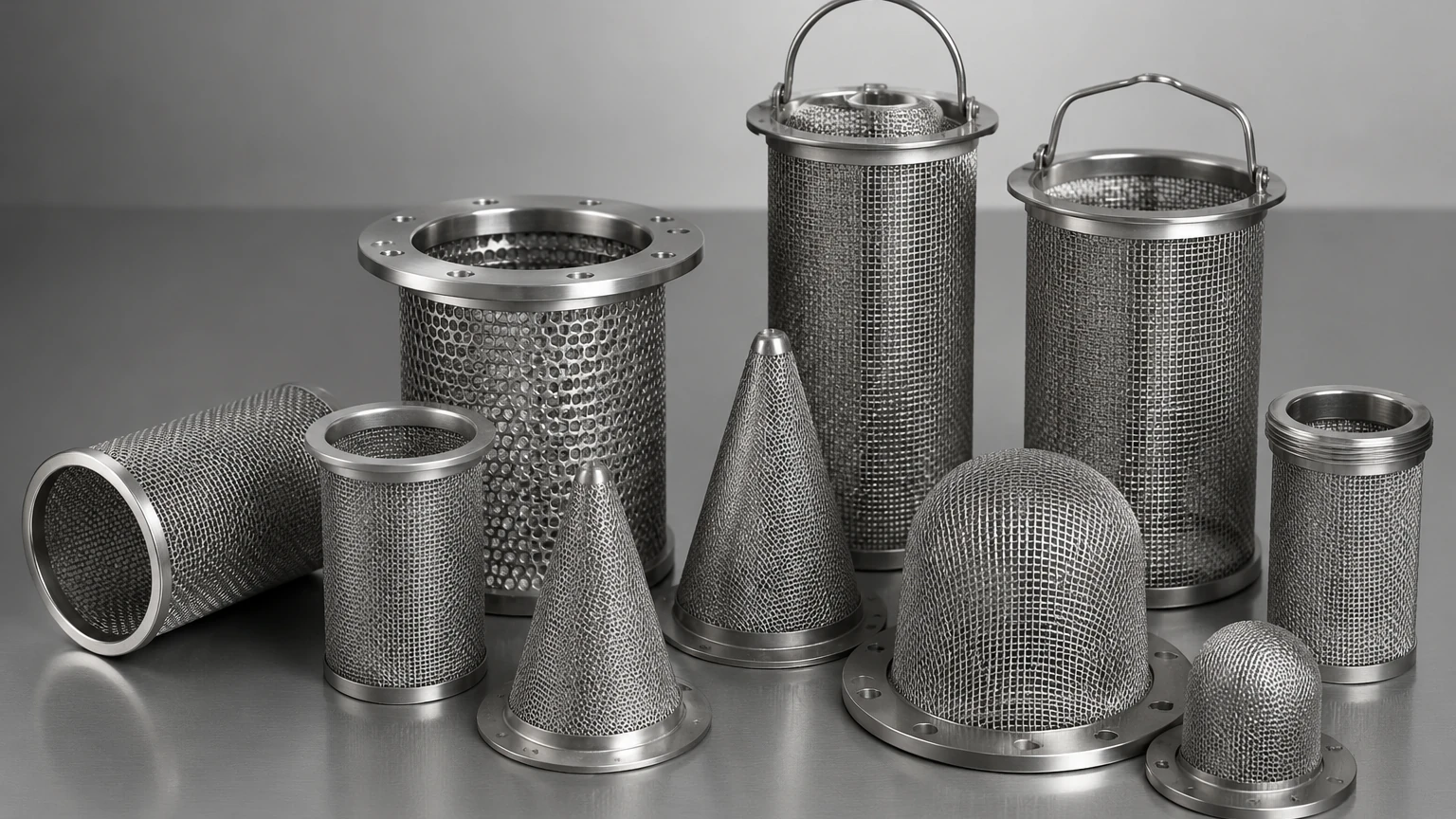
Often referred to as "witch’s hats," conical strainers are the most common variety used in industrial start-ups. They consist of a cone-shaped element made of perforated metal or wire mesh. Their elongated shape provides a large surface area relative to the pipe diameter, which helps maintain lower pressure drops as debris accumulates. Engineers typically specify the length of the cone (e.g., 100%, 150%, or 200% of the pipe diameter) based on the anticipated debris load.
Basket Strainers (Truncated Cones)
Basket-style temporary strainers feature a flat or rounded bottom rather than a point. This design is often utilized when the piping layout does not provide enough straight-run clearance for a long conical strainer. While they may have slightly less surface area than a full-length cone, they offer excellent structural rigidity and are easier to clean if the start-up process requires multiple flushing cycles.
Plate Strainers (Flat Strainers)
Plate strainers are simple perforated discs or mesh screens sandwiched between flanges. These are the most compact option but offer the least amount of surface area. They are typically reserved for systems where space is extremely limited and the expected debris load is minimal. Because they clog quickly, they require constant monitoring of differential pressure to avoid plate deformation or rupture.
Material Selection and Structural Integrity
The choice of material for temporary strainers is dictated by the chemical compatibility of the process fluid and the mechanical stresses of the start-up environment. While these strainers are intended for short-term use, they must withstand the full force of the system flow, especially as they become blinded by debris.
Stainless Steel Grades
Stainless steel is the industry standard for temporary filtration due to its high tensile strength and corrosion resistance.
- Type 304 Stainless Steel: Suitable for most general industrial applications, including water treatment and non-corrosive chemical lines.
- Type 316 Stainless Steel: Recommended for pharmaceutical, food and beverage, and highly corrosive chemical processing environments where even temporary exposure to carbon steel could lead to contamination or localized pitting.
Reinforcement and Construction
For fine filtration requirements, a temporary strainer may utilize a fine wire mesh liner supported by a heavier perforated metal backup. The perforated metal provides the mechanical strength necessary to resist the differential pressure, while the mesh determines the filtration accuracy. At Kaifil, we emphasize the importance of secure welding—typically TIG or spot welding—to ensure that the mesh does not detach under high-velocity flow conditions. On our Main Page, we detail our capabilities in precision metal filter components that meet these exact industrial standards.
Calculating Performance: Pressure Drop and Flow Capacity
One of the most critical engineering considerations when implementing temporary strainers is the "Open Area Ratio" (OAR). The OAR is the relationship between the total open area of the strainer holes and the cross-sectional area of the inlet pipe.
The Importance of the 3:1 Ratio
In most industrial start-up scenarios, a 3:1 open area ratio is considered the benchmark. This means the strainer provides three times the flow area of the pipe itself. A higher ratio allows the system to operate longer before the pressure drop (Delta P) reaches a critical level. If the OAR is too low, the strainer will act as a flow restrictor, causing a significant pressure drop that can lead to pump cavitation or mechanical failure of the strainer element itself.
Monitoring Differential Pressure
During the flushing and start-up phase, engineers must monitor the differential pressure across the strainer. A clean strainer will show a negligible drop, but as weld slag and scale accumulate, the Delta P will rise. It is standard practice to establish a "maximum allowable differential pressure" (often between 5 to 10 psi, depending on the system design) at which point the system must be shut down, and the strainer removed and cleaned.
Installation and Operational Best Practices
Proper installation is vital to ensuring that temporary strainers perform their intended function without introducing new risks to the system.
Flange Compatibility and Orientation
Temporary strainers are designed to be installed between standard ANSI/ASME flanges. They typically feature a "handle" or a protruding tag that extends outside the flange connection. This tag serves two purposes: it provides a location for the gasket to seat and acts as a visual indicator to operators that a temporary strainer is currently in the line.
When installing conical strainers, the orientation—pointing upstream or downstream—is a subject of engineering debate.
- Pointing Upstream: Debris collects around the outside of the cone near the pipe walls. This can be harder to clean but often results in a more stable flow pattern.
- Pointing Downstream: Debris collects in the tip of the cone. This is generally preferred for easier removal of the debris, as the contaminants are concentrated in the center of the strainer.
Removal and Transition
By definition, temporary strainers are not intended for permanent installation. Once the system has been flushed and the differential pressure remains stable for a specified period (often 24 to 48 hours of continuous operation), the strainer should be removed. Leaving a temporary strainer in the line indefinitely is a common cause of long-term operational inefficiency, as these strainers are not designed for the fatigue cycles of multi-year service.
Customization and Procurement: Key Specifications for Engineers
When sourcing temporary strainers, providing vague specifications can lead to components that are either too fragile for the application or provide insufficient filtration. Procurement teams should confirm the following technical data points with their manufacturer:
1. Pipe Size and Schedule: The strainer must fit the internal diameter of the specific pipe schedule being used.
2. Pressure Rating: Ensure the flange thickness and material are compatible with the system’s pressure class (e.g., Class 150, 300, or 600).
3. Micron or Mesh Rating: Determine the size of the smallest particle that must be captured. For example, protecting a fine-tolerance control valve may require a 100-mesh liner, whereas protecting a large centrifugal pump may only require 1/8" perforations.
4. Flow Medium Properties: Viscosity and temperature significantly impact the pressure drop. High-viscosity fluids require a larger open area ratio to maintain flow efficiency.
5. Length Constraints: Measure the available straight pipe run to ensure a conical strainer will not interfere with elbows or valves.
Conclusion: Ensuring System Integrity from Day One
Temporary strainers are a small investment that prevents the massive costs associated with equipment repair and unscheduled downtime during plant commissioning. By selecting the right geometry, material, and open area ratio, engineers can ensure that their systems are cleaned effectively without compromising flow performance.
As a specialist in stainless steel filtration, Kaifil provides the engineering expertise and manufacturing precision required to produce high-performance temporary and permanent filtration components. From initial material selection to the final customized design, our focus remains on delivering reliability for the most demanding industrial environments. For further technical support and to explore our full range of filtration solutions, we invite you to visit our Main Page and consult with our technical team.
