


High Pressure Filter Assembly
In industrial fluid power and process systems, the integrity of downstream components often depends entirely on the efficacy of the filtration system. A high pressure filter assembly is a critical engineering component designed to remove contaminants from fluids—such as hydraulic oils, chemicals, and water—while operating under significant mechanical stress. Unlike standard low-pressure return line filters, high pressure assemblies must function as pressure vessels, maintaining structural integrity while ensuring precise filtration performance. For engineers and procurement specialists, selecting the correct high pressure filter assembly requires a deep understanding of material science, fluid dynamics, and the specific demands of the application environment.
Understanding the Role of High Pressure Filter Assemblies in Industrial Systems
High pressure filter assemblies are typically installed on the discharge side of a pump. Their primary role is to protect sensitive components such as servo valves, actuators, and high-precision nozzles from particulate contamination. In systems where pressures can exceed 3,000 PSI (210 bar) and reach as high as 10,000 PSI (700 bar) or more, even microscopic particles can cause catastrophic failure through abrasive wear or stiction.
The assembly acts as the final line of defense. Because it is located after the pump, it must be capable of handling the full system pressure and any pressure spikes (transients) that occur during valve switching or pump startup. The design of a high pressure filter assembly focuses on three primary objectives: containing the fluid under pressure, providing a high-efficiency filtration medium, and allowing for maintenance without compromising the system's seal.
Material Selection and Structural Integrity for High-Pressure Environments
The choice of materials for a high pressure filter assembly is dictated by the operating pressure, the chemical nature of the fluid, and the environmental conditions. For most demanding industrial applications, stainless steel is the preferred material due to its high tensile strength and excellent corrosion resistance.
Stainless Steel Alloys
* 304 Stainless Steel: Suitable for general industrial applications where basic corrosion resistance and high strength are required.
* 316/316L Stainless Steel: The standard for chemical processing and marine environments. The addition of molybdenum provides superior resistance to chlorides and acidic solutions. The "L" (low carbon) variant is often used for welded components to prevent intergranular corrosion.
* Duplex Stainless Steels: In extreme cases involving high-pressure seawater or highly corrosive chemicals, duplex alloys may be used to provide even higher yield strength and pitting resistance.
Housing Construction
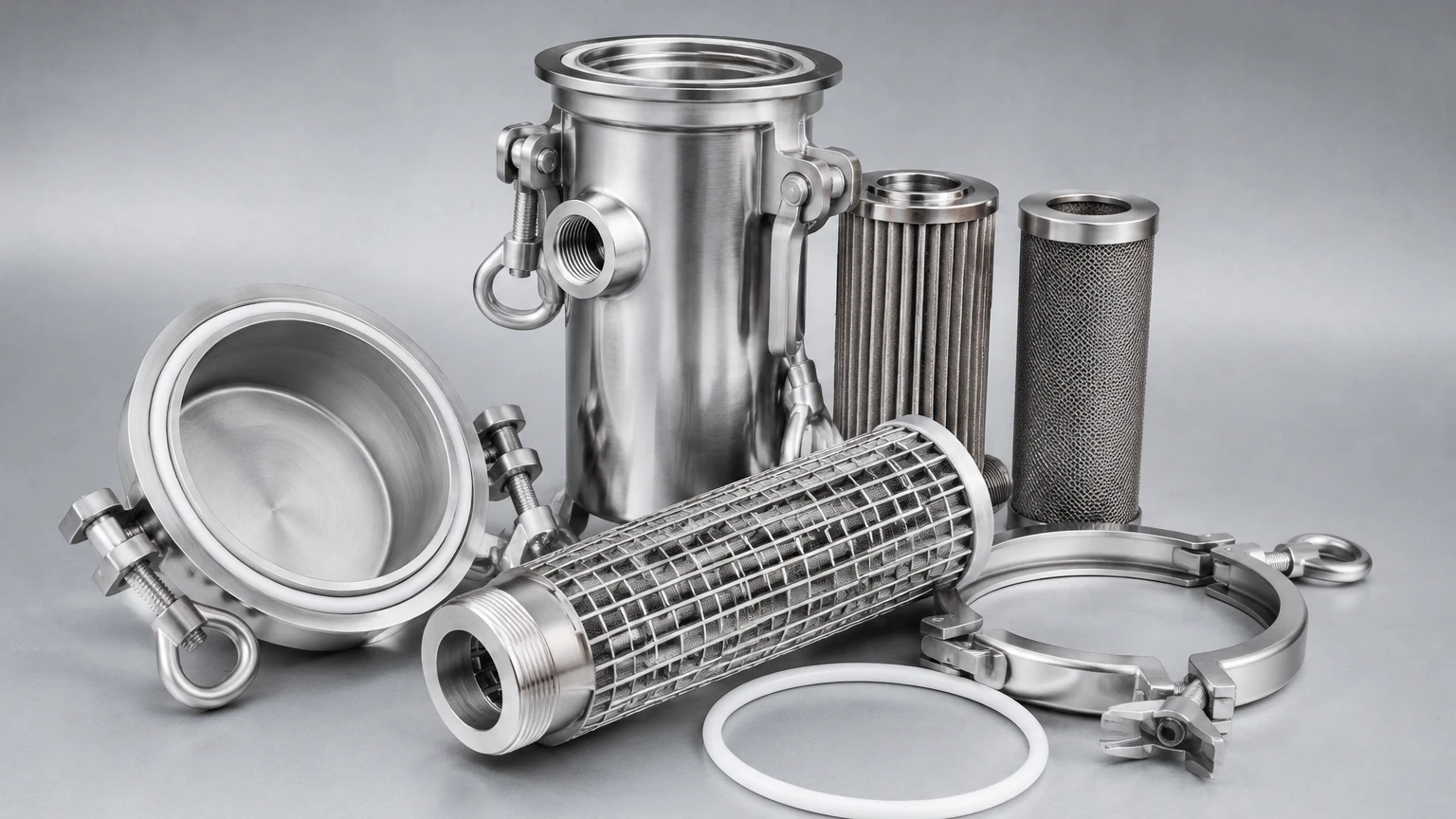
The housing of a high pressure filter assembly is usually manufactured from solid bar stock or heavy-walled castings. Precision machining ensures that the threads and sealing surfaces can withstand the hoop stress generated by internal pressure. Engineers must verify the burst pressure rating of the housing, which typically follows a safety factor of 3:1 or 4:1 relative to the maximum working pressure.
Core Components of a High Pressure Filter Assembly
A complete assembly consists of several engineered sub-components, each playing a vital role in the overall performance of the filtration system.
The Filter Element
The filter element is the heart of the assembly. In high-pressure applications, the element must not only provide the required micron rating but also possess the structural rigidity to resist collapse. Kaifil specializes in manufacturing stainless steel wire mesh and sintered metal filter elements that are specifically designed for these conditions. Unlike disposable cellulose or polymer elements, stainless steel elements offer:
1. High Differential Pressure Resistance: Sintered mesh elements can withstand high pressure drops (ΔP) without deforming.
2. Thermal Stability: They maintain integrity at temperatures that would melt or degrade synthetic materials.
3. Cleanability: Many stainless steel elements can be cleaned and reused, reducing the total cost of ownership.
Sealing Systems
High-pressure seals are critical to prevent external leakage. The choice of O-ring material must be compatible with the fluid. Common materials include Viton (FKM) for high temperatures and chemical resistance, Nitrile (NBR) for standard hydraulic oils, and EPDM for phosphate ester fluids. The seal groove design is equally important, often requiring back-up rings to prevent seal extrusion under high pressure.
Bypass Valves and Indicators
Many high pressure filter assemblies include an internal bypass valve. If the filter element becomes clogged and the differential pressure reaches a set limit, the bypass valve opens to ensure that the downstream system is not starved of fluid, although this allows unfiltered fluid to pass. To prevent this, differential pressure indicators (visual or electrical) are used to alert operators that the element requires cleaning or replacement before the bypass opens.
Technical Performance Metrics: Micron Ratings and Beta Ratios
When evaluating a high pressure filter assembly, engineers must look beyond simple "micron ratings." Understanding the efficiency of the filtration is paramount.
Absolute vs. Nominal Ratings
* Nominal Rating: An arbitrary micrometer value indicated by the manufacturer, often representing a 50% to 90% efficiency at a given particle size. This is generally insufficient for high-pressure protection.
* Absolute Rating: The diameter of the largest hard spherical particle that will pass through the filter under specified test conditions. For high-pressure systems, absolute-rated stainless steel mesh is often required to ensure consistent protection.
The Beta Ratio (β)
The Beta Ratio is the industry standard for measuring filtration efficiency according to ISO 16889. It is the ratio of the number of particles of a given size upstream of the filter to the number of particles of the same size downstream. For example, a β10 = 1000 means that for every 1000 particles of 10 microns entering the filter, only one passes through, representing 99.9% efficiency.
Engineering Challenges: Differential Pressure and Flow Dynamics
The design of the internal flow path within a high pressure filter assembly significantly impacts its efficiency. High velocity fluid entering the housing can cause turbulence, which may lead to "particle migration" or erosion of the filter medium.
Clean Pressure Drop
Every filter assembly introduces a pressure drop (ΔP) into the system. The "clean pressure drop" is the resistance offered by the housing and a fresh filter element at a specific flow rate and viscosity. Engineers must ensure that the total system pressure remains within operational limits after accounting for this drop. As the filter collects contaminants, the ΔP increases. If the initial ΔP is too high, the service life of the element will be unacceptably short.
Fluid Viscosity and Temperature
Viscosity is a major factor in determining pressure drop. Cold startups often result in high viscosity fluids, which can trigger false alarms on differential pressure indicators or cause the bypass valve to open prematurely. High-pressure assemblies must be sized according to the maximum viscosity expected during operation.
Applications Across Key Industries
High pressure filter assemblies are utilized wherever fluid purity is non-negotiable under high-stress conditions.
* Hydraulic Systems: In construction equipment, aerospace, and manufacturing, high-pressure hydraulics power heavy loads. Filters protect expensive piston pumps and servo-proportional valves.
* Chemical and Petrochemical: These assemblies handle aggressive solvents and catalysts at high pressures, requiring 316L stainless steel construction to prevent corrosion and system contamination.
* Oil and Gas: Subsea and topside equipment use high-pressure filtration for chemical injection and hydraulic control lines, where reliability is critical due to the high cost of maintenance in remote locations.
* Water Treatment: High-pressure reverse osmosis (RO) systems use stainless steel filter housings to protect membranes from fine particulates that could cause fouling.
Maintenance, Monitoring, and Replacement Protocols
To maintain the performance of a high pressure filter assembly, a rigorous maintenance schedule is required. Unlike low-pressure systems where a leak might be a minor nuisance, a failure in a high-pressure system can be dangerous and costly.
1. Monitoring Differential Pressure: This is the most effective way to track filter health. Automated systems can trigger a shutdown or alert if the ΔP exceeds a safe threshold.
2. Element Cleaning: For stainless steel mesh elements, ultrasonic cleaning or backflushing can restore performance. However, it is vital to inspect the mesh for signs of fatigue or breakthrough after cleaning.
3. Seal Inspection: Every time the housing is opened to service the element, the seals should be inspected for compression set or chemical degradation and replaced if necessary.
4. Total Cost of Ownership (TCO): While stainless steel assemblies have a higher initial cost than aluminum or plastic alternatives, their durability and the ability to clean the elements often result in a lower TCO over the life of the industrial plant.
Customization and OEM Solutions for Specialized Applications
Standard off-the-shelf filter assemblies do not always meet the unique requirements of specialized industrial equipment. Factors such as unusual mounting footprints, extreme temperature ranges, or specific flow characteristics often necessitate custom-engineered solutions.
Kaifil provides comprehensive OEM and customized filtration solutions, working closely with engineering teams to develop filter components that meet exact application requirements. From selecting the appropriate weave for a wire mesh filter to designing a housing that fits within a compact hydraulic manifold, customization ensures that the filtration system is optimized for both performance and space.
When selecting a partner for high-pressure filtration, it is essential to confirm their manufacturing capabilities, including their experience with precision metal filter components and their ability to provide technical documentation such as material test reports (MTRs) and pressure test certifications. For more information on tailored filtration components and industrial solutions, you can Review product options and application support on the Main Page.
Conclusion
A high pressure filter assembly is a vital investment in the longevity and reliability of industrial machinery. By understanding the technical nuances of material selection, filtration efficiency, and flow dynamics, engineers can specify assemblies that provide maximum protection with minimal maintenance overhead. Whether using standard stainless steel cartridges or custom-designed wire mesh elements, the goal remains the same: ensuring the purity of the fluid under the most demanding conditions. As industrial systems become more sophisticated and tolerances become tighter, the role of high-performance filtration will only continue to grow in importance.
