


Pharmaceutical Dust Collectors
In the pharmaceutical manufacturing sector, the management of airborne particulates is not merely a matter of facility cleanliness; it is a critical requirement for product integrity, worker safety, and regulatory compliance. Pharmaceutical dust collectors are specialized systems designed to capture and contain fine powders generated during processes such as milling, tablet pressing, granulating, and coating. Unlike standard industrial dust collection, the pharmaceutical environment demands higher standards of filtration efficiency, material compatibility, and containment to prevent cross-contamination and ensure adherence to Good Manufacturing Practices (GMP).
For engineers and procurement professionals, selecting the right filtration components for these systems requires a deep understanding of the physical properties of the dust, the chemical nature of the active pharmaceutical ingredients (APIs), and the operational parameters of the production line. This guide examines the technical considerations essential for optimizing pharmaceutical dust collection performance.
Engineering Requirements for Pharmaceutical Dust Collection
Pharmaceutical dust often consists of extremely fine, potent, or even explosive particles. Consequently, the design of a dust collection system must address several engineering challenges simultaneously.
Material Selection and Surface Integrity
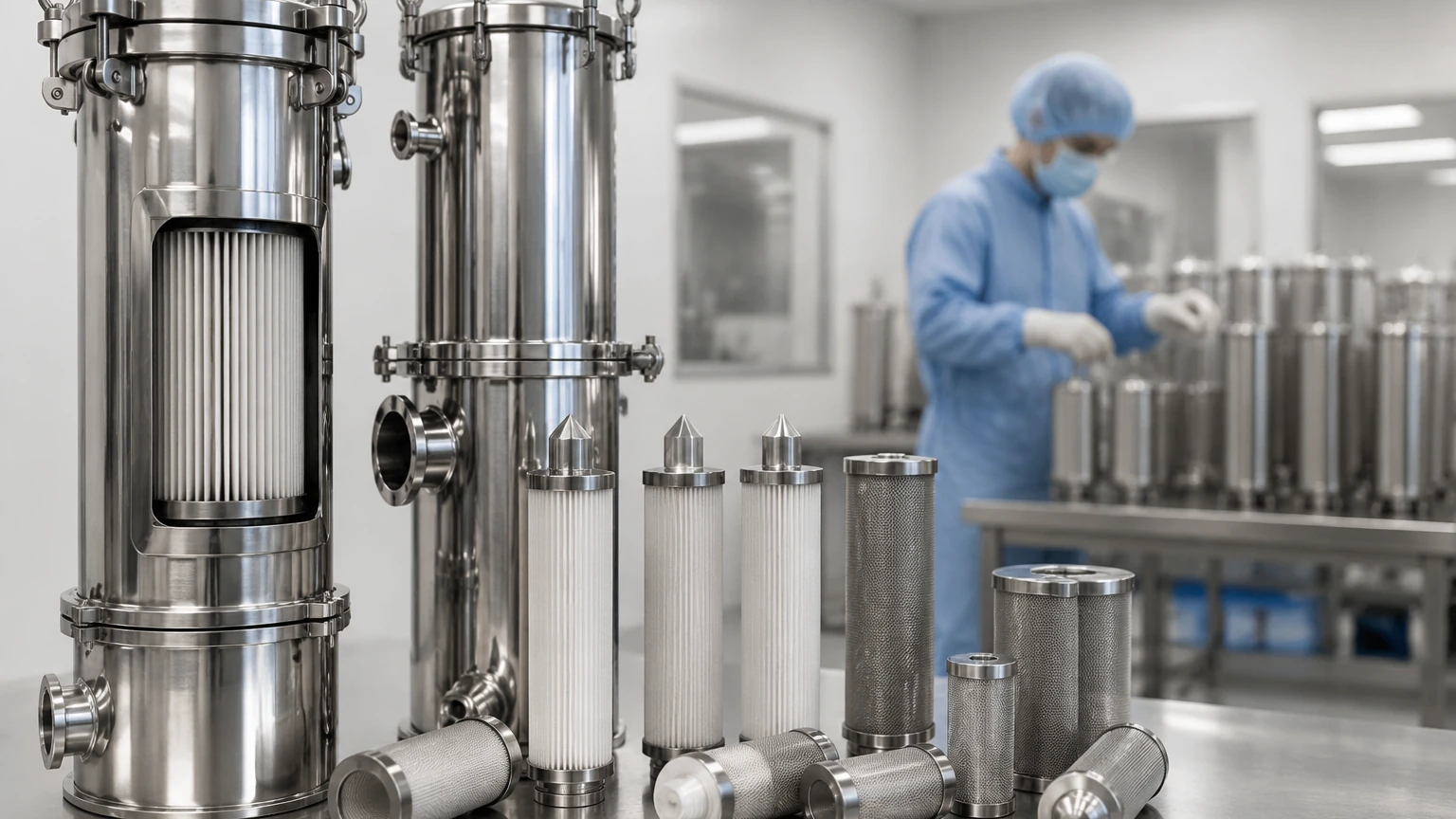
In pharmaceutical applications, the materials used for filter housings and internal components must be non-reactive and easy to sanitize. Stainless steel, particularly grades 304 and 316L, is the industry standard due to its corrosion resistance and ability to withstand rigorous cleaning protocols. The surface finish is equally important; a low surface roughness (measured in Ra) prevents particles from adhering to the metal surfaces, which facilitates complete cleaning and reduces the risk of microbial growth.
Filtration Efficiency and HEPA Integration
Standard dust collectors typically utilize primary filter elements to capture the bulk of the particulate matter. However, in pharmaceutical settings, secondary or tertiary filtration—often involving High-Efficiency Particulate Air (HEPA) filters—is necessary. These filters are rated to capture 99.97% of particles as small as 0.3 microns. Engineering the system to include a "Bag-In/Bag-Out" (BIBO) procedure for filter changes is essential when handling hazardous APIs to protect maintenance personnel from exposure.
Explosion Protection and ATEX Compliance
Many pharmaceutical powders, such as sugar, starch, and certain organic compounds, are combustible. When suspended in air at specific concentrations, they pose a significant explosion risk. Engineers must specify dust collectors equipped with explosion venting, chemical suppression systems, or isolation valves. Ensuring the system is grounded to prevent static discharge is a fundamental safety requirement during the design phase.
Key Evaluation Criteria for Filtration Components
The performance of pharmaceutical dust collectors is largely dictated by the quality and specification of the filter media. When evaluating components, engineers should focus on the following technical criteria:
1. Micron Rating and Capture Efficiency: The filter must be matched to the particle size distribution of the dust. Over-specifying can lead to excessive pressure drops, while under-specifying allows bypass and potential contamination.
2. Permeability and Pressure Drop: High permeability allows for better airflow, which reduces the energy consumption of the system fan. However, this must be balanced against the need for high filtration efficiency. Monitoring the differential pressure across the filter is the primary method for determining when a filter element requires cleaning or replacement.
3. Mechanical Strength and Durability: In systems utilizing pulse-jet cleaning, the filter media is subjected to frequent bursts of compressed air. The media must possess the structural integrity to withstand these mechanical stresses without tearing or deforming.
4. Chemical Compatibility: The filter material must be resistant to the specific chemicals present in the dust, as well as the solvents or detergents used during Clean-in-Place (CIP) or Steam-in-Place (SIP) cycles.
The Role of Stainless Steel Wire Mesh in Dust Collection
While fabric bags and pleated cartridges are common, stainless steel wire mesh and sintered metal filters play an increasingly vital role in pharmaceutical dust collection, particularly in demanding environments.
Advantages of Metal Filter Media
Stainless steel filters offer several advantages over traditional polymer-based media. They provide exceptional thermal stability, allowing them to operate in high-temperature processes where fabric filters would fail. Furthermore, metal mesh filters are permanent or semi-permanent components that can be cleaned and reused multiple times, significantly reducing the total cost of ownership compared to disposable filters.
Precision and Customization
Wire mesh can be manufactured with highly precise pore sizes, ensuring consistent filtration performance. For specialized pharmaceutical applications, custom-designed filter cartridges can be engineered to fit specific housing geometries or to meet unique airflow requirements. As a manufacturer specializing in these solutions, Kaifil provides technical support for engineers looking to optimize their systems. For more detailed technical specifications on custom filtration components, you can visit the Main Page.
Addressing Cross-Contamination and Containment
Cross-contamination is one of the most significant risks in pharmaceutical manufacturing, especially in multi-product facilities. Dust collectors must be designed to prevent the migration of particles from one production area to another.
Containment Strategies
* Source Capture: Utilizing high-velocity hoods at the point of dust generation ensures that the majority of the dust is captured before it can disperse into the room.
* Negative Pressure: Maintaining the dust collector and associated ductwork under negative pressure ensures that any leaks in the system pull air inward rather than blowing dust out into the facility.
* Closed-Loop Systems: In some cases, the air from the dust collector is filtered and recirculated back into the production area. This requires redundant HEPA filtration and continuous monitoring of air quality to ensure safety.
Clean-in-Place (CIP) Considerations
To minimize downtime between product batches, many modern pharmaceutical dust collectors incorporate CIP systems. These systems use internal spray balls to wash down the filter elements and the interior of the housing. The design of the filter media is crucial here; it must be able to drain completely and dry quickly to prevent the risk of mold or bacterial contamination.
Performance Metrics: Efficiency, Pressure Drop, and Air-to-Cloth Ratios
To ensure a dust collector operates at peak efficiency, engineers must calculate and monitor several key performance metrics.
Air-to-Cloth Ratio
The air-to-cloth ratio (or filtration velocity) is the ratio of the volume of air passing through the collector to the total area of the filter media. In pharmaceutical applications, a lower air-to-cloth ratio is generally preferred. This reduces the velocity of the air as it passes through the filter, which improves capture efficiency and extends the life of the filter media by reducing the impact force of the particles.
Differential Pressure Monitoring
Differential pressure is the difference in pressure between the clean-air side and the dirty-air side of the filter. A steady increase in differential pressure indicates that the filter is loading with dust. If the pressure drop becomes too high, the system's airflow will decrease, leading to poor dust capture at the source. Automated pulse-jet cleaning systems are typically triggered by differential pressure sensors to maintain an optimal operating range.
Common Risks and Mitigation in Dust Collection
Even well-designed systems can encounter operational issues. Identifying these risks early allows for the implementation of effective mitigation strategies.
* Filter Bypass: This occurs when dust leaks around the edges of the filter element due to poor sealing or improper installation. Using high-quality gaskets and precision-machined filter seats is essential to prevent bypass.
* Moisture and Caking: If moisture enters the dust collector, it can cause the dust to form a solid "cake" on the filter media, which cannot be removed by pulse-jet cleaning. This is often mitigated by using heated housings or ensuring the compressed air used for cleaning is dry and oil-free.
* Material Fatigue: Repeated cleaning cycles can eventually lead to the degradation of the filter media. Regular inspections and scheduled replacement cycles based on empirical performance data are necessary to avoid catastrophic failure.
Selection and Customization for OEM Integration
For original equipment manufacturers (OEMs) building pharmaceutical processing machinery, the dust collection component must be seamlessly integrated into the overall equipment design. Customization is often required to meet specific spatial constraints or to handle unique powder characteristics.
When sourcing custom filtration components, engineers should confirm the following with their supplier:
1. Technical Documentation: Ensure that all materials come with mill test reports and certificates of compliance for FDA or other relevant standards.
2. Prototyping Capabilities: For unique applications, the ability to produce and test prototypes is invaluable for verifying filtration efficiency and pressure drop before full-scale production.
3. Scalability: The supplier should be able to support both small-batch specialized needs and large-scale production runs.
Kaifil works closely with global customers to develop high-performance filter products that meet these specific application requirements. From material selection to the final filtration accuracy, every component is engineered for durability in demanding industrial environments.
Maintenance and Total Cost of Ownership (TCO)
While the initial purchase price of a dust collector and its filters is a significant consideration, the total cost of ownership (TCO) provides a more accurate picture of the investment. TCO includes the costs of energy, maintenance labor, replacement parts, and potential downtime.
Extending Filter Life
Using high-quality stainless steel or sintered metal filters can significantly lower TCO. Although the upfront cost is higher than fabric filters, the ability to clean and reuse metal media reduces the frequency of purchases and the associated labor costs of filter changes. Additionally, the consistent performance of metal filters can lead to more stable process conditions and fewer quality deviations.
Replacement Cycles
Establishing a data-driven replacement cycle is better than relying on fixed time intervals. By tracking differential pressure trends and conducting periodic visual inspections, maintenance teams can replace filters only when necessary, avoiding both premature replacement and the risks of filter failure.
Conclusion: Confirming the Next Steps
Selecting and maintaining pharmaceutical dust collectors requires a balance of engineering precision and operational practicality. Before finalizing a filtration solution, engineers should confirm the particle characteristics, the required containment levels, and the compatibility of the filter media with both the process and cleaning chemicals.
By focusing on high-quality materials like stainless steel and leveraging customized engineering solutions, pharmaceutical manufacturers can ensure their dust collection systems provide reliable, long-term performance. For technical guidance on selecting the appropriate wire mesh or stainless steel filter components for your pharmaceutical application, reviewing professional product information and application guides is a recommended next step. Accessing these resources through the Main Page can help purchasing teams and engineers achieve efficient, durable, and cost-effective filtration performance.
