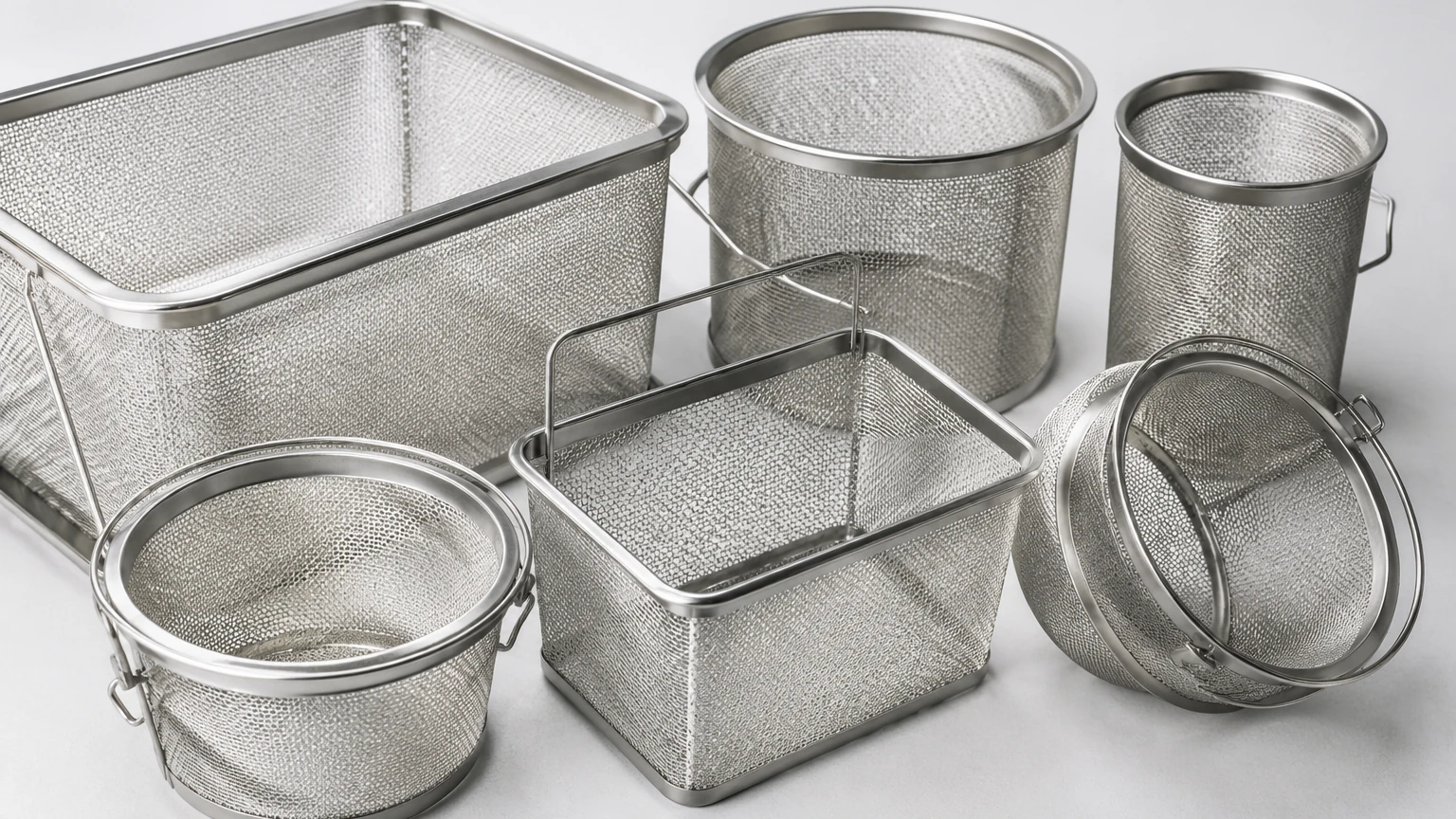
Fine Mesh Basket
In industrial filtration, the fine mesh basket serves as a critical component for high-precision separation tasks. Unlike standard strainers designed for coarse debris, a fine mesh basket is engineered to capture minute particulates while maintaining structural integrity under varying pressure conditions. These components are essential in industries where fluid purity is paramount, such as chemical processing, pharmaceutical manufacturing, and high-end food production. Understanding the technical nuances of these baskets—from weave patterns to material metallurgy—is vital for engineers tasked with optimizing filtration efficiency and reducing system downtime.
Understanding the Engineering Principles of Fine Mesh Baskets
The performance of a fine mesh basket is primarily defined by its ability to balance filtration fineness with flow capacity. The "fine" designation typically refers to wire cloth with high mesh counts, where the openings are measured in microns rather than millimeters. Engineering a basket that utilizes such delicate mesh requires a deep understanding of fluid dynamics and mechanical stress.
One of the primary considerations is the "open area" percentage. As the mesh becomes finer, the wire diameter often decreases to maintain a reasonable open area for fluid passage. However, thinner wires are more susceptible to mechanical failure. Engineers must calculate the expected differential pressure (ΔP) across the mesh. If the pressure drop is too high, the mesh may deforming or "blind" (clog) prematurely. To counter this, fine mesh baskets are rarely used as standalone mesh bags in industrial settings; instead, they are integrated into a rigid support structure, often a perforated metal cylinder or a heavier wire cage, which provides the necessary mechanical strength to withstand the system's operating pressure.
Material Selection and Corrosion Resistance
Material selection is the cornerstone of industrial filter longevity. For a fine mesh basket, stainless steel is the industry standard due to its combination of strength, temperature resistance, and chemical compatibility. The two most common grades utilized are 304 and 316L stainless steel.
* Grade 304 Stainless Steel: This is the standard choice for general industrial applications. It offers excellent strength and good corrosion resistance for water treatment and most food-grade applications. It is cost-effective but may struggle in high-chloride environments or with aggressive acids.
* Grade 316L Stainless Steel: For more demanding environments, 316L is the preferred specification. The addition of molybdenum enhances its resistance to pitting and crevice corrosion, particularly in saline or acidic conditions. The "L" stands for low carbon, which is crucial for components that require welding, as it prevents carbide precipitation and ensures the integrity of the weld joints in the basket assembly.
In specialized chemical processing, even higher-grade alloys like Hastelloy or Monel may be used, though these are typically reserved for environments where standard stainless steel would fail within a short service cycle. For engineers looking to specify the correct material for their specific chemical environment, reviewing technical data on the Main Page of a specialized manufacturer's site can provide the necessary compatibility charts and alloy performance metrics.
Structural Design and Reinforcement Strategies
A fine mesh basket is a multi-layered assembly. Because fine mesh (such as 200, 300, or 400 mesh) is inherently flexible and fragile, the structural design of the basket is as important as the mesh itself.
1. The Support Layer: This is usually a perforated metal sheet with large holes (e.g., 1/8" or 1/4" stagger). It acts as the skeleton of the basket, taking the brunt of the fluid's kinetic energy and the weight of the accumulated solids.
2. The Filtration Layer: The fine mesh is lined inside or wrapped outside the support layer. In high-precision applications, this layer might consist of a "Dutch weave" or a "Twilled weave" to achieve sub-20-micron filtration.
3. The Guard Layer: In some high-flow applications, a coarser mesh is placed over the fine mesh to protect it from large, high-velocity particles that could cause abrasive wear or puncturing.
Joining these layers requires precision welding. Spot welding and TIG (Tungsten Inert Gas) welding are commonly used to ensure that there are no gaps or "bypass" areas where unfiltered fluid could escape. The top flange or ring of the basket must also be engineered to create a perfect seal within the filter housing, often utilizing O-rings or gaskets made of EPDM, Viton, or PTFE to prevent bypass.
Filtration Performance and Micron Rating Precision
The efficacy of a fine mesh basket is measured by its micron rating, which can be categorized as either nominal or absolute.
* Nominal Rating: This indicates the ability of the mesh to retain a majority of particles of a specific size (e.g., 90% of 50-micron particles). This is suitable for general-purpose straining.
* Absolute Rating: This refers to the diameter of the largest hard spherical particle that will pass through the mesh under specified test conditions. This is critical for pharmaceutical and high-purity chemical applications where even a single oversized particle can compromise the end product.
Weave type significantly impacts these ratings. A Plain Weave is the simplest, where each weft wire passes over and under one warp wire. However, for a fine mesh basket requiring higher strength and finer apertures, a Twilled Weave (where wires pass over two and under two) allows for a heavier wire diameter for a given mesh count. Dutch Weaves use different wire diameters for warp and weft, resulting in a dense, tortuous path that provides superior filtration for fine particles while remaining easy to clean.
Maintenance, Cleaning, and Service Life Optimization
One of the primary advantages of a stainless steel fine mesh basket over disposable filter cartridges is its cleanability. However, cleaning a fine mesh requires specific protocols to avoid damaging the delicate wires.
* Ultrasonic Cleaning: This is the most effective method for fine mesh. High-frequency sound waves create cavitation bubbles that dislodge microscopic particles trapped deep within the weave.
* Chemical Soaking: In applications involving resins, oils, or proteins, chemical solvents or caustic baths may be necessary to dissolve the contaminants before mechanical cleaning.
* Backwashing: For automated systems, the basket design must account for reverse flow. If a basket is not designed for backwashing, the pressure of the reverse flow could cause the fine mesh to pull away from its support structure.
Engineers should monitor the differential pressure across the basket. A significant increase in ΔP indicates that the basket is reaching its dirt-holding capacity. If the pressure is allowed to rise beyond the design limit, the mesh can undergo "permanent deformation," where the wires stretch, enlarging the pore sizes and destroying the filtration accuracy. Establishing a regular cleaning cycle based on pressure readings is essential for maintaining consistent performance.
Customization and Integration for Industrial Systems
No two industrial filtration systems are identical, which makes customization a standard requirement for the fine mesh basket. When sourcing these components, engineers must provide detailed specifications beyond just the micron rating.
Key customization factors include:
* Handle Design: Baskets may require heavy-duty handles, folding handles, or even no handles depending on the clearance within the housing.
* Bottom Configuration: Baskets can have flat, conical, or slanted bottoms to facilitate different drainage and solids-collection requirements.
* Gasket Seats: Custom-machined flanges may be needed to ensure compatibility with legacy filter housings or proprietary systems.
For OEM applications, working with a manufacturer like Kaifil allows for the development of bespoke filtration components that meet specific spatial and performance constraints. Whether it is a unique diameter for a hydraulic system or a high-temperature alloy for a chemical reactor, custom-engineered baskets ensure that the filtration system operates at peak efficiency. Professionals seeking to understand the full range of customization possibilities can Review product options and application support to see how different configurations impact flow rates and durability.
Conclusion: Selecting the Right Fine Mesh Basket
Selecting a fine mesh basket is a technical decision that impacts the entire production line's efficiency and product quality. By focusing on the material grade, the structural relationship between the mesh and its support, and the specific requirements of the fluid being filtered, engineers can specify a solution that offers both precision and longevity.
When evaluating potential suppliers, it is important to confirm their ability to maintain tight tolerances and provide documentation on material certifications (MTRs). A well-designed basket not only protects downstream equipment but also provides a sustainable, cleanable alternative to disposable filters, ultimately lowering the total cost of ownership for the facility. For more detailed technical resources and to explore specific filtration solutions, visiting the manufacturer's Main Page is a recommended next step for procurement and engineering teams.