


Sparger Tube
In industrial process engineering, the efficient introduction of gas into a liquid medium is a fundamental requirement for chemical reactions, biological growth, and physical separation. A sparger tube is a specialized component designed to facilitate this gas-liquid contact by dispersing gas into a liquid in the form of discrete bubbles. By increasing the surface area of the gas relative to its volume, these components optimize mass transfer rates, which is critical for the performance of reactors, fermenters, and storage tanks.
For engineers and procurement professionals, selecting the correct sparger tube involves balancing material compatibility, filtration precision, and mechanical durability. As a manufacturer specializing in custom stainless steel filtration and fluid handling solutions, Kaifil provides technical expertise to ensure these components meet the rigorous demands of industrial environments. Detailed information regarding the full range of custom filtration capabilities can be found on our Main Page.
Principles of Gas Sparging and Mass Transfer
The primary function of a sparger tube is to maximize the interface between gas and liquid phases. This process is governed by the principles of mass transfer, specifically Fick's laws of diffusion and the concept of the gas-liquid mass transfer coefficient ($k_L a$). The rate at which a gas dissolves into a liquid is directly proportional to the total surface area of the bubbles generated.
When gas is forced through a sparger tube—particularly those constructed from porous sintered metal or fine wire mesh—it is broken into millions of micro-bubbles. Compared to a simple open pipe or a drilled tube, a porous sparger creates a significantly higher surface-area-to-volume ratio. This high density of small bubbles ensures that the gas spends more time in contact with the liquid (increased residence time) and diffuses more rapidly. In applications such as oxygenation in bioreactors or carbonation in beverage production, this efficiency directly translates to reduced gas consumption and shorter processing times.
Types of Sparger Tube Configurations
Sparger tubes are engineered in several configurations to suit different vessel geometries and flow requirements. The choice of configuration affects the bubble distribution pattern and the turbulence within the tank.
Sintered Porous Spargers
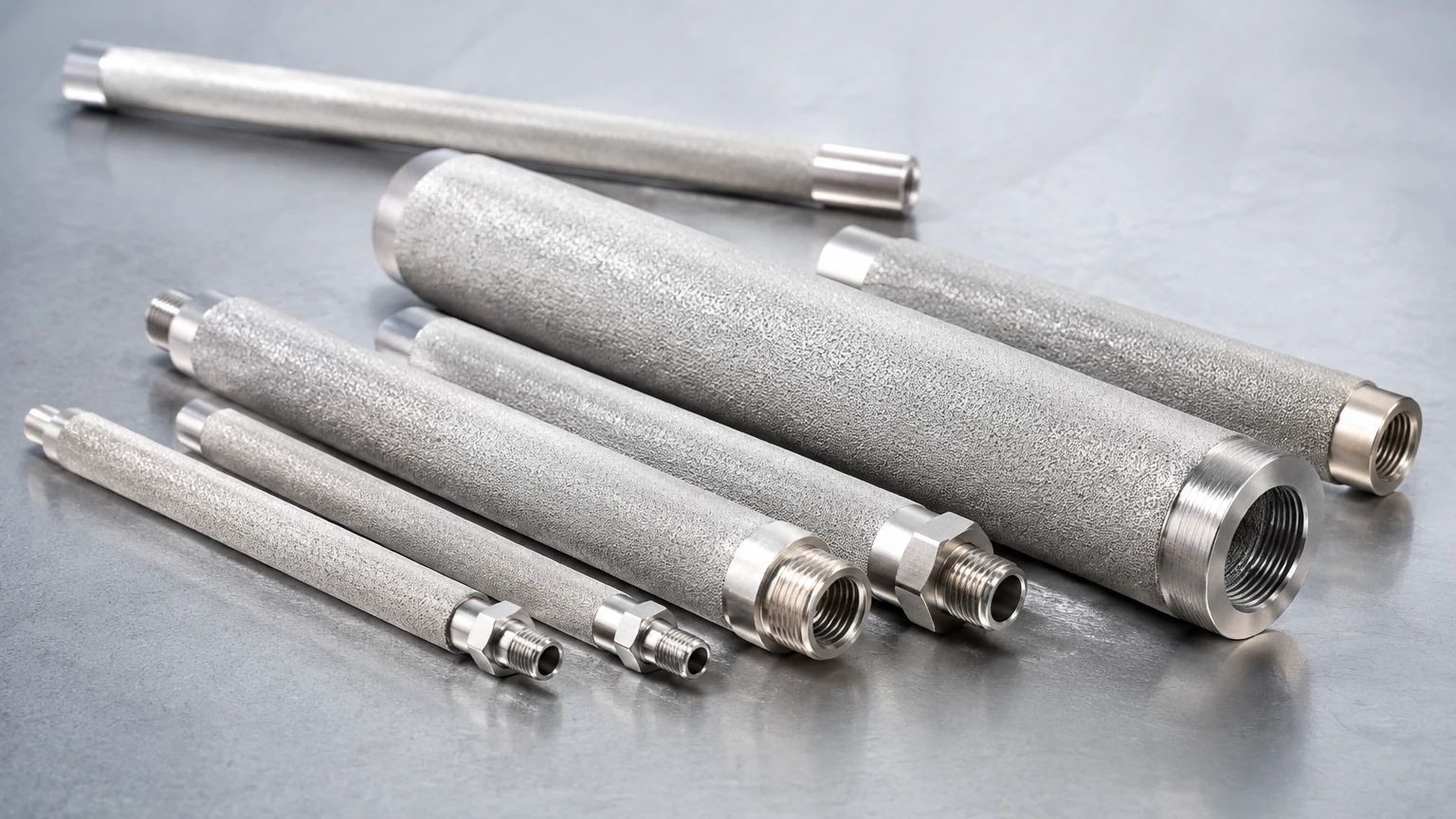
Sintered metal sparger tubes are manufactured by compacting and heating stainless steel powder or multi-layer wire mesh until the particles bond without melting. This creates a rigid, porous structure with highly controlled pore sizes. These are the most effective for creating micro-bubbles (typically ranging from 0.5 to 100 microns). They are widely used in the pharmaceutical and fine chemical industries where maximum mass transfer efficiency is required.
Drilled Pipe Spargers
In applications where large volumes of gas must be introduced quickly and micro-bubbles are not a priority, drilled pipe spargers are used. These consist of a standard stainless steel tube with precision-drilled holes. While they are easier to clean and have a lower pressure drop, they produce larger bubbles and offer lower mass transfer efficiency compared to porous media.
Sparger Bundles and Rings
For large-scale industrial reactors, a single tube may not provide sufficient coverage. In these cases, multiple sparger tubes are arranged in a manifold or a ring configuration. This ensures that gas is distributed evenly across the entire cross-section of the vessel, preventing "dead zones" where the liquid remains untreated.
Material Selection and Engineering Durability
Industrial environments often involve corrosive fluids, high temperatures, and high-pressure differentials. Therefore, the material of construction for a sparger tube is paramount to its longevity and performance.
1. Stainless Steel 316L: This is the industry standard for most B2B applications, including food, beverage, and pharmaceutical sectors. It offers excellent corrosion resistance and can withstand high-temperature sterilization processes (SIP).
2. Nickel Alloys (Hastelloy, Inconel): For highly aggressive chemical environments, such as those involving hot acids or chlorides, specialized alloys are utilized to prevent pitting and stress corrosion cracking.
3. Titanium: Titanium spargers are preferred in applications involving seawater or highly oxidizing environments where stainless steel might fail.
Beyond chemical compatibility, the mechanical design must account for the "blow-off" pressure—the pressure required to initiate bubble formation—and the structural integrity of the tube under the weight of the liquid column and the internal gas pressure.
Engineering Considerations for Selection
When specifying a sparger tube for a new or existing system, engineers must evaluate several technical parameters to ensure the component performs as intended.
Pore Size and Micron Rating
The micron rating of a porous sparger tube determines the initial bubble size. While smaller pores create more surface area, they also result in a higher pressure drop across the media. Engineers must calculate the available gas pressure to ensure it can overcome both the liquid head pressure and the resistance of the sparger material.
Gas Flow Velocity
The velocity at which gas exits the sparger surface is critical. If the velocity is too high, small bubbles may coalesce into larger bubbles immediately upon exit, defeating the purpose of the porous media. Conversely, if the velocity is too low, the gas may not be distributed evenly across the entire length of the tube. This is often managed by calculating the "exit velocity" and ensuring it stays within recommended limits for the specific gas-liquid pair.
Connection Types
Sparger tubes must be securely integrated into the piping system. Common connections include NPT or BSP threaded ends, flanged connections for high-pressure vessels, and sanitary Tri-Clamp fittings for the food and pharmaceutical industries. The seal integrity at the connection point is vital to prevent gas bypass, which would result in large, inefficient bubbles.
Industrial Applications Across Sectors
The versatility of the sparger tube makes it a staple in various industrial sectors. Each application has unique requirements regarding cleanliness, precision, and durability.
Biotechnology and Pharmaceuticals
In fermentation processes, aerobic microorganisms require a constant supply of dissolved oxygen. Sintered sparger tubes are used to provide high-efficiency aeration while maintaining sterile conditions. The ability of stainless steel spargers to undergo Clean-in-Place (CIP) and Steam-in-Place (SIP) cycles is essential here.
Food and Beverage
Carbonation (adding $CO_2$) and nitrogenation (adding $N_2$) are common uses for sparger tubes in beverage production. In the edible oil industry, nitrogen sparging is used to strip oxygen from the oil, preventing oxidation and extending shelf life.
Chemical Processing and Refining
Spargers are used to introduce hydrogen in hydrogenation reactors or to strip volatile organic compounds (VOCs) from process streams. In these environments, the robustness of the stainless steel construction ensures the sparger can withstand the turbulent forces inside a stirred-tank reactor.
Water Treatment
Ozone sparging is a powerful method for disinfecting water and breaking down contaminants. Because ozone is a highly reactive gas, the sparger tube must be made of high-grade materials like 316L or titanium to resist oxidative degradation.
Maintenance, Cleaning, and Longevity
One of the primary concerns for maintenance engineers is the potential for clogging. Over time, particulates in the gas stream or precipitates from the liquid phase can block the pores of a sparger tube. This leads to increased backpressure and decreased mass transfer efficiency.
Cleaning Protocols
* Backwashing: Reversing the flow of gas or liquid through the sparger can often dislodge surface contaminants.
* Chemical Cleaning: Soaking the sparger in compatible acids, bases, or detergents can dissolve mineral scales or organic buildup.
* Ultrasonic Cleaning: For porous sintered spargers, ultrasonic baths are highly effective at removing deep-seated particles that chemical soaking cannot reach.
Replacement Cycles
While stainless steel sparger tubes are designed for long-term use, they are considered wear components in some aggressive environments. Regular inspection of the bubble pattern (if visible) and monitoring of the pressure drop are the best ways to determine when a sparger requires cleaning or replacement. A well-maintained sparger can operate for several years, providing a low total cost of ownership.
Customization and OEM Solutions
Standard off-the-shelf spargers rarely meet the exact needs of specialized industrial equipment. Customization is often necessary to optimize performance. At Kaifil, we work with engineers to design sparger tubes that fit specific vessel dimensions and process requirements.
Customization options include:
* Adjustable lengths and diameters to fit existing tank nozzles.
* Variable pore sizes across the length of the tube to ensure uniform gas distribution in horizontal installations.
* Integrated check valves to prevent liquid backflow into the gas lines when the system is shut down.
* Reinforced internal structures for spargers subjected to high mechanical vibration or high-velocity liquid flows.
By focusing on precision manufacturing and material integrity, Kaifil ensures that every sparger tube provides reliable, repeatable performance in the most demanding B2B applications. For more information on our custom metal filtration components and industrial solutions, please visit our Main Page.
