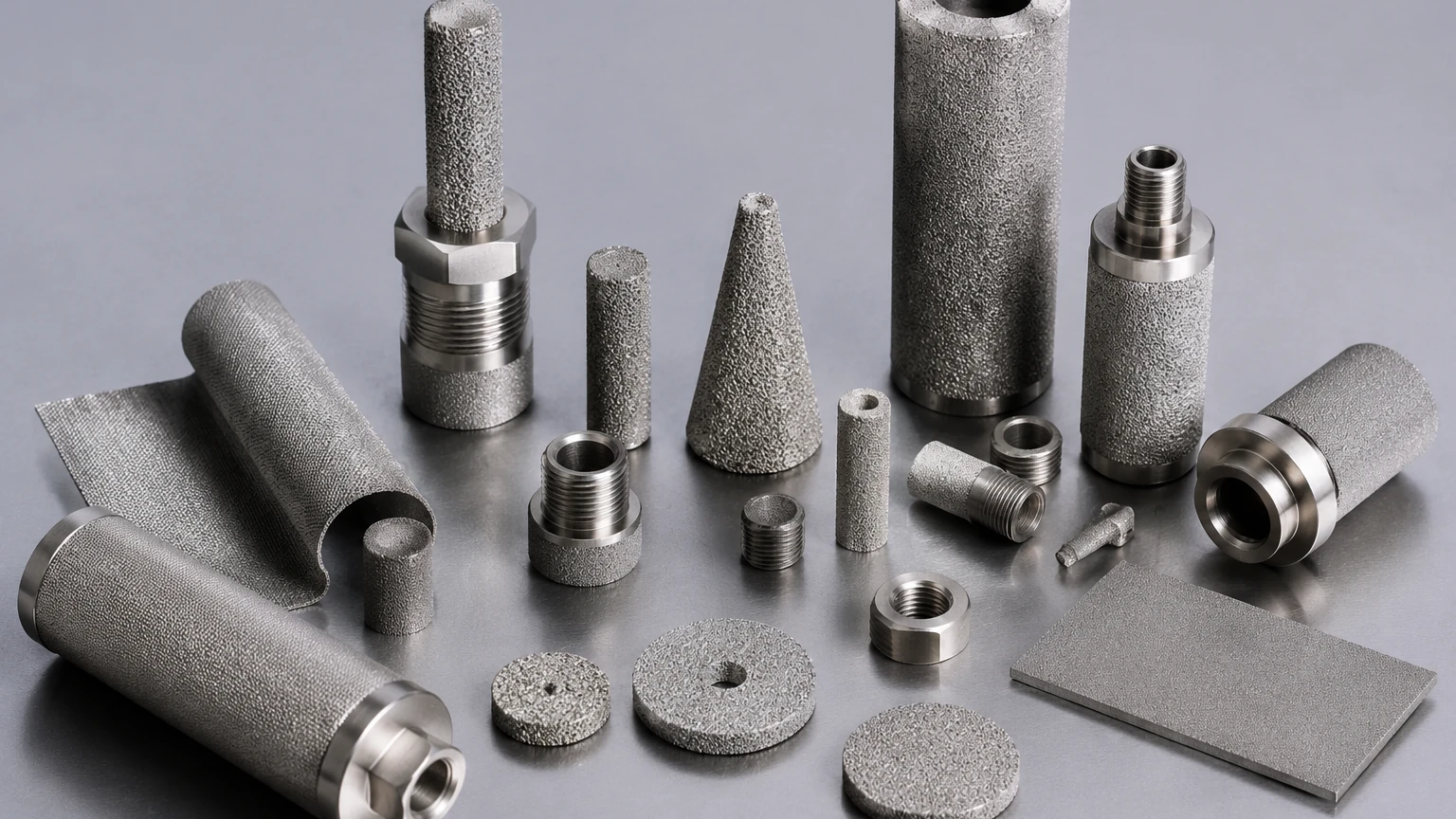
Sintering Filter
In the landscape of industrial separation technology, the sintering filter represents a pinnacle of structural integrity and filtration precision. Unlike traditional fabric or disposable polymer filters, sintered metal media are engineered to withstand extreme temperatures, high-pressure differentials, and chemically aggressive environments. For engineers and procurement specialists in sectors such as chemical processing, pharmaceuticals, and aerospace, understanding the technical nuances of sintering technology is essential for optimizing process efficiency and reducing the total cost of ownership.
The Science of Sintering: Manufacturing for Structural Integrity
The fundamental value of a sintering filter lies in its manufacturing process. Sintering is a thermal treatment that bonds metallic particles, fibers, or wire mesh layers together at temperatures just below their melting point. This process, often referred to as diffusion bonding, creates molecular-level connections at the contact points of the material.
From an engineering perspective, this results in a porous structure that is mechanically rigid. Unlike non-sintered mesh, where individual wires may shift under pressure—leading to pore enlargement and "media migration"—a sintered structure remains dimensionally stable. This stability ensures that the micron rating remains constant throughout the filter's service life, even when subjected to high-velocity flow or hydraulic shock.
At Kaifil, the manufacturing of these components involves precise control over temperature, atmosphere, and pressure. By manipulating these variables, manufacturers can produce filters with specific porosity levels, ranging from high-permeability coarse filters to ultra-fine media capable of gas-solid separation at sub-micron levels.
Comparative Analysis: Sintered Powder vs. Sintered Wire Mesh
When selecting a sintering filter, engineers must choose between different media types based on the specific requirements of the application. The two most common forms are sintered metal powder and sintered wire mesh.
Sintered Metal Powder
Sintered powder filters are created by compacting spherical or irregular metal powders (typically stainless steel 316L, Bronze, or Hastelloy) into a mold and then sintering them. These filters are characterized by a tortuous path through the media, which provides excellent depth filtration. They are ideal for applications requiring high filtration accuracy and the removal of hard, irregular particles. However, they generally exhibit a higher pressure drop compared to mesh-based designs due to lower overall porosity.
Sintered Wire Mesh
Sintered wire mesh filters consist of multiple layers of woven wire cloth (usually 2 to 7 layers) that are laminated and sintered together. The layers often include a fine filtration layer, a protective layer, and several support layers for mechanical strength. This structure provides a high percentage of open area, resulting in low initial pressure drops and excellent backwashing characteristics. It is the preferred choice for liquid-solid separation where surface filtration and ease of cleaning are prioritized.
Sintered Metal Fiber Felt
For applications requiring the highest possible permeability, sintered metal fiber felt is utilized. This media is composed of non-woven stainless steel fibers that are sintered into a web. It offers a porosity of up to 80%, significantly higher than powder or mesh, allowing for higher flow rates and longer intervals between cleaning cycles.
Key Performance Metrics for Industrial Filtration
Evaluating a sintering filter requires a deep dive into several technical metrics that define its suitability for a given process. Engineers should prioritize the following criteria during the selection phase:
1. Micron Rating (Absolute vs. Nominal): It is critical to distinguish between nominal and absolute ratings. A sintered filter typically offers an absolute rating, meaning it will stop 99.9% of particles at the specified size. This is essential in pharmaceutical and semiconductor applications where even minor bypass can lead to batch failure.
2. Permeability and Pressure Drop: The relationship between flow rate and pressure drop (often calculated using Darcy’s Law for porous media) determines the sizing of the filter housing and the energy requirements of the pump system. A well-designed sintering filter balances fine filtration with the lowest possible resistance to flow.
3. Dirt Holding Capacity: This refers to the amount of contaminant the filter can retain before the pressure drop reaches a critical terminal limit. Depth-type sintered powder filters often excel here, while surface-type sintered mesh filters rely on their ability to be cleaned frequently.
4. Mechanical Strength: Sintered filters must resist collapse or burst pressures. In high-pressure hydraulic systems or steam filtration, the structural support provided by the sintering process prevents the media from deforming under load.
Chemical and Thermal Compatibility
One of the primary reasons engineers specify a sintering filter is the need for resistance to harsh environments. Material selection is the most significant factor in ensuring long-term compatibility.
* Stainless Steel 316L: The industry standard for general chemical resistance and food-grade applications. It offers excellent durability up to 400°C (752°F) in oxidizing environments.
* Hastelloy C276: Reserved for highly corrosive environments involving wet chlorine gas, ferric chlorides, or strong mineral acids.
* Inconel 600: Used in high-temperature applications (up to 800°C+) where oxidation resistance is paramount.
* Titanium: Preferred for lightweight applications and environments involving seawater or highly oxidizing acids.
By matching the alloy to the process fluid, facilities can avoid pitting corrosion and stress corrosion cracking, which are common failure modes in lower-grade filtration components.
Maintenance Strategies: Maximizing the Lifespan of Sintered Media
Unlike disposable cartridges, a sintering filter is a capital investment designed for multi-year use. The total cost of ownership is significantly lower than disposables when a proper cleaning regimen is implemented.
Cleaning Methods
* Backpulsing/Backwashing: This is the most common in-situ cleaning method. By reversing the flow of clean fluid or gas through the filter, the accumulated "filter cake" is dislodged from the surface. This is highly effective for sintered wire mesh.
* Ultrasonic Cleaning: For deeply embedded particles in sintered powder filters, ultrasonic baths use high-frequency sound waves to create cavitation bubbles that scrub the internal pores of the media.
* Chemical Cleaning: Soaking the filter in specialized solvents, acids, or caustic solutions can dissolve organic or inorganic scaling that mechanical cleaning cannot reach.
* Thermal Burn-off: In applications involving polymers or heavy oils, the filter can be heated in a controlled furnace to carbonize and remove organic contaminants.
Determining the replacement cycle depends on the "permanent pressure drop"—the baseline pressure measured after a cleaning cycle. Once this baseline begins to rise significantly, it indicates that the internal pore structure is becoming permanently blinded, and a replacement is necessary.
Engineering Custom Solutions for OEM Applications
Every industrial process has unique constraints, from space limitations in a hydraulic manifold to specific flow profiles in a chemical reactor. Standard off-the-shelf filters often fall short of these specialized requirements. This is where custom manufacturing becomes vital.
At Kaifil, we specialize in developing bespoke filtration components. Customization options include:
* Geometric Tailoring: Manufacturing filters in the form of discs, cylinders, conical shapes, or complex pleated structures to maximize surface area within a restricted footprint.
* Integrated Fittings: Sintering filters directly onto NPT, BSP, or flange fittings to eliminate potential leak paths and simplify installation.
* Layer Optimization: Designing a specific stack of mesh layers to achieve a precise balance between filtration fineness and structural rigidity.
Engineers should work closely with manufacturers to confirm the chemical composition of the fluid, the nature of the contaminants (slimy vs. crystalline), and the operating pressure spikes before finalizing a design. For more technical resources and product specifications, you can visit the Main Page to review product options and application support.
Conclusion: Strategic Considerations for Procurement
Investing in a high-quality sintering filter is a strategic decision that impacts the reliability of the entire production line. While the initial acquisition cost of a sintered metal filter is higher than that of a polymer or paper alternative, the durability, cleanability, and precision of the sintered media provide a much lower cost per gallon filtered over the long term.
When evaluating suppliers, technical teams should look for manufacturers who provide comprehensive material certifications, bubble point test data, and engineering support. By focusing on the structural integrity of the media and the specific demands of the application, industrial operators can ensure consistent product quality, protect downstream equipment, and minimize costly downtime.