


Oil Lube Filter
In industrial machinery, the lubrication system is often compared to the circulatory system of a living organism. Its primary function is to reduce friction, dissipate heat, and transport contaminants away from critical moving parts. At the heart of this system is the oil lube filter, a precision-engineered component designed to maintain the integrity of the lubricant and, by extension, the longevity of the equipment. For engineers and maintenance professionals, selecting the correct filtration solution is not merely a matter of part numbers; it is a technical decision based on fluid dynamics, material science, and operational reliability.
Industrial applications—ranging from high-speed turbines and large-scale compressors to hydraulic power units and heavy-duty gearboxes—demand filtration that can withstand high pressures, varying temperatures, and aggressive chemical environments. As a professional manufacturer, Kaifil specializes in providing high-performance stainless steel filtration solutions that address these rigorous requirements. For more information on our complete range of industrial filtration components, visit our Main Page.
The Role of Oil Lube Filters in Industrial Lubrication Systems
The primary objective of an oil lube filter is to capture and retain particulate matter that could otherwise cause abrasive wear, surface fatigue, or catastrophic component failure. Contaminants in a lubrication system generally fall into three categories: built-in (leftover from manufacturing or assembly), generated (wear debris from gears and bearings), and external (ingested through breathers or seals).
Effective lubrication filtration ensures that the oil meets specific ISO 4406 cleanliness codes. These codes define the quantity of particles per milliliter of fluid at three specific sizes: 4 µm, 6 µm, and 14 µm. For high-precision components like servo valves or high-speed bearings, maintaining a low ISO code is essential. An optimized oil lube filter prevents the "chain reaction of wear," where one particle generates several more through abrasion, leading to exponential increases in system contamination.
Material Considerations: Why Stainless Steel is Superior for Heavy-Duty Lube Filtration
While cellulose and synthetic fiber filters are common in light-duty applications, industrial environments often require the robustness of metal media. Stainless steel wire mesh, particularly 304 and 316L grades, offers several distinct advantages for oil lube filter construction:
1. Thermal Stability: Industrial lubricants can operate at elevated temperatures, sometimes exceeding 150°C. Unlike organic fibers that may degrade or lose structural integrity, stainless steel maintains its mechanical properties across a wide temperature range.
2. Chemical Compatibility: Modern lubricants contain complex additive packages, including detergents, anti-wear agents, and corrosion inhibitors. Stainless steel is inert to most of these chemicals, ensuring that the filter media does not leach contaminants into the system or become brittle over time.
3. Pressure Resistance: In high-pressure hydraulic or lubrication circuits, the filter must withstand significant differential pressures ($ΔP$), especially during cold starts when oil viscosity is high. Metal mesh filters, often supported by internal perforated cores, provide the necessary collapse strength to prevent media rupture.
4. Cleanability and Reusability: One of the most significant advantages of stainless steel oil lube filters is that they are often cleanable. Through ultrasonic cleaning or backflushing, these filters can be restored to near-original performance, significantly reducing the environmental impact and long-term procurement costs associated with disposable elements.
Technical Selection Criteria for Engineers
When specifying an oil lube filter, engineers must look beyond simple dimensions. Several technical parameters dictate the performance and suitability of the filter for a specific application.
Filtration Rating: Absolute vs. Nominal
A nominal rating indicates the filter's ability to retain a majority of particles of a certain size, but it does not guarantee 100% efficiency. In contrast, an absolute rating (often defined by the Beta Ratio) indicates the particle size at which the filter achieves a specific efficiency level. For critical lubrication paths, absolute-rated stainless steel mesh is preferred to ensure consistent protection.
Beta Ratio (β)
The Beta Ratio is the industry standard for measuring filtration efficiency. It is calculated by dividing the number of particles upstream of the filter by the number of particles downstream. For example, a $β_{10} = 200$ means that for every 200 particles of 10 µm size entering the filter, only one passes through (99.5% efficiency). High-performance oil lube filters typically target Beta ratios of 200 or 1000 for their target micron size.
Pressure Drop and Flow Rate
Every filter introduces a restriction to flow, resulting in a pressure drop. This drop is influenced by the oil's viscosity, the flow rate, and the filter's surface area. It is critical to select a filter that provides the required cleanliness without exceeding the system's maximum allowable $ΔP$. Pleated designs are frequently used in stainless steel filters to maximize surface area within a compact footprint, effectively lowering the initial pressure drop and extending the service life.
Customization and OEM Integration for Lubrication Systems
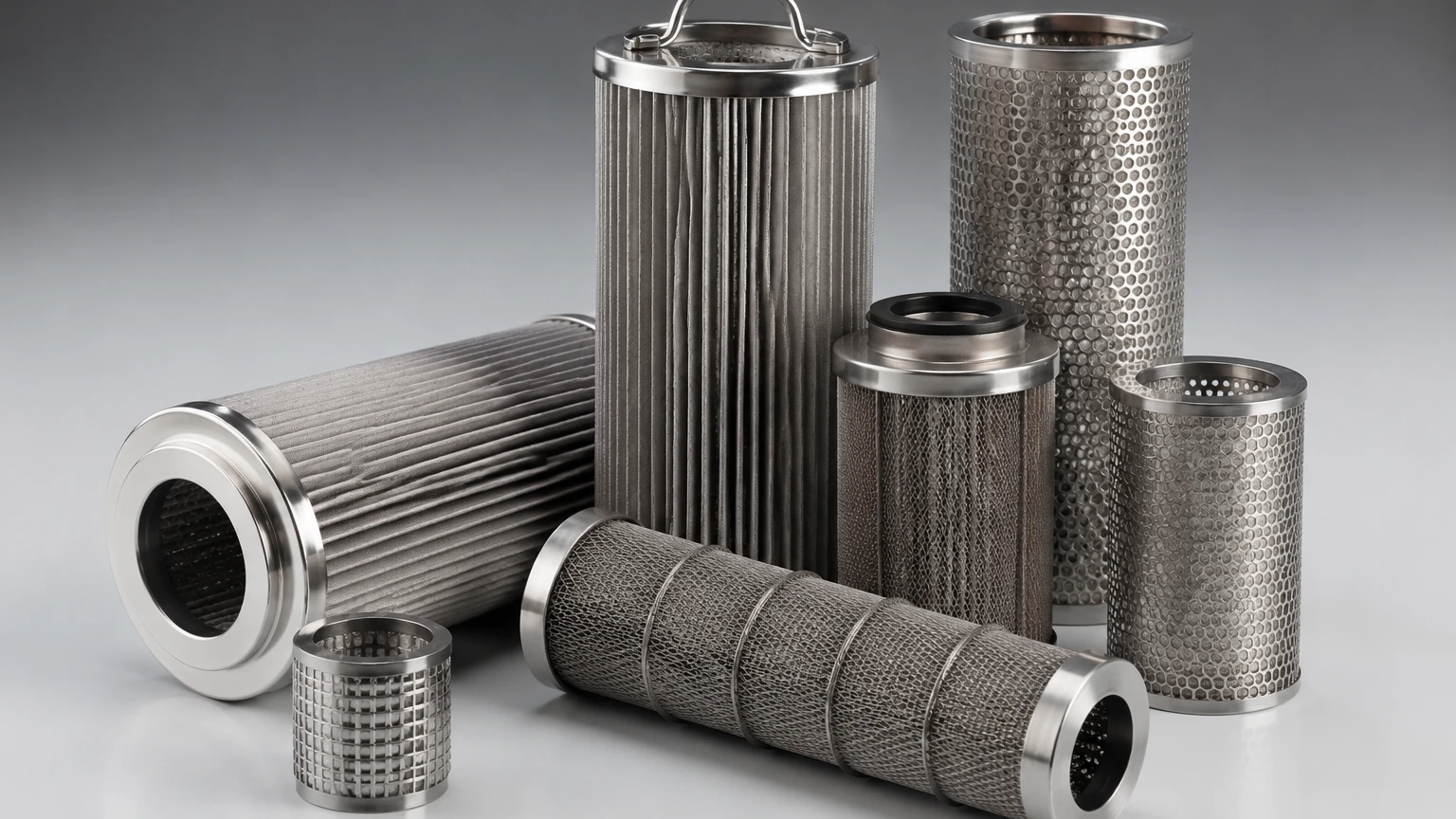
Standard off-the-shelf filters often fail to meet the unique spatial or performance constraints of specialized industrial machinery. Customization is a core component of effective filtration engineering. Kaifil works closely with OEM partners to develop bespoke oil lube filter solutions that integrate seamlessly into existing equipment designs.
Customization options include:
* End Cap Configurations: Threaded, flanged, or O-ring seal designs to match specific housing requirements.
* Reinforced Structures: For systems prone to pressure spikes or high-vibration environments, filters can be manufactured with heavy-duty center tubes and outer support cages.
* Multi-Layer Media: Combining different mesh counts (e.g., a fine filtration layer protected by coarser support layers) allows for optimized dirt-holding capacity and structural rigidity.
* Specific Micron Gradations: Tailoring the mesh weave (plain, twill, or dutch weave) to achieve precise filtration targets ranging from 1 µm to over 500 µm.
Evaluating Total Cost of Ownership (TCO) and Maintenance Cycles
The initial purchase price of an oil lube filter is only a fraction of its total cost of ownership. For purchasing teams and plant managers, the focus should be on the long-term economic impact of the filtration strategy.
Disposable filters require frequent replacement, leading to recurring procurement costs, inventory management overhead, and waste disposal fees. Furthermore, the labor costs associated with frequent filter changes and the potential for system downtime during maintenance can be substantial.
In contrast, a high-quality stainless steel oil lube filter represents a higher initial investment but offers a lower TCO over the life of the machine. Because these filters can be cleaned and returned to service, the frequency of replacement is drastically reduced. Additionally, the superior protection provided by precision metal mesh can extend the intervals between oil changes and major component overhauls, providing significant savings in both lubricant costs and maintenance labor.
To optimize maintenance cycles, it is recommended to install differential pressure indicators across the filter housing. These devices alert operators when the filter is reaching its dirt-holding capacity, allowing for scheduled maintenance before the bypass valve opens and unfiltered oil begins to circulate through the system.
Common Risks and Failure Modes in Lubrication Filtration
Understanding how an oil lube filter can fail is essential for preventing equipment damage. Engineers should be aware of several common failure modes:
* Media Migration: In low-quality fiber filters, the filter material itself can sometimes break off and enter the downstream flow. Stainless steel mesh eliminates this risk due to its metallic construction.
* Channeling: High differential pressure can cause "channels" to form in some media types, allowing contaminants to pass through unfiltered. Robust metal mesh designs resist channeling even under high stress.
* Bypass Leakage: If the filter is not properly seated or if the seals fail, oil will take the path of least resistance around the filter element. Precision-machined end caps and high-quality elastomeric seals are vital to preventing this.
* Fatigue Failure: In systems with frequent flow pulsations, the filter media can undergo cyclic stress. Proper pleat support and wire diameter selection are necessary to prevent fatigue cracking in the mesh.
Conclusion: Selecting a Reliable Filtration Partner
The selection of an oil lube filter is a critical engineering decision that directly impacts the reliability and efficiency of industrial operations. By choosing stainless steel filtration solutions, organizations can achieve superior contamination control, withstand harsh operating conditions, and reduce long-term operational costs.
As a specialist in custom stainless steel filtration, Kaifil provides the technical expertise and manufacturing precision required to meet the most demanding industrial standards. From material selection to custom structural design, we ensure that every filtration component is optimized for its specific application. For technical consultations or to explore our full product catalog, please visit our Main Page.
