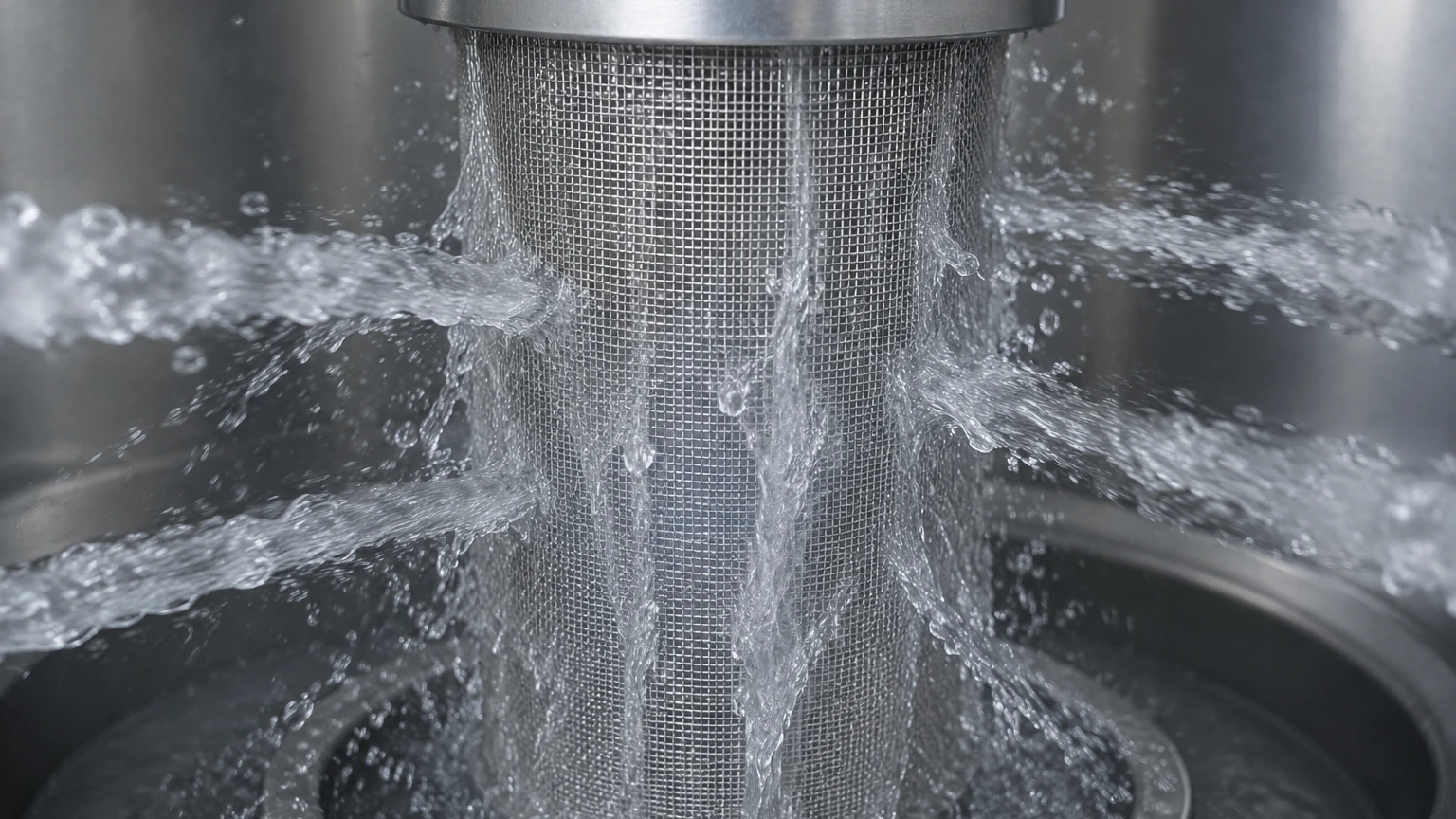
Filtration Backwash
In industrial filtration, the ability to maintain continuous operation while managing solid load accumulation is critical for process efficiency. Filtration backwash is a regenerative cleaning technique used to remove accumulated contaminants from a filter medium without requiring the disassembly of the system. By reversing the flow of the filtrate or introducing a secondary cleaning fluid, the "filter cake" or trapped particles are dislodged and flushed away. For engineers and plant managers, understanding the mechanics, material requirements, and system design of backwashable filters is essential for optimizing the lifespan of filtration components and reducing total cost of ownership.
The Mechanics of Filtration Backwash
Filtration backwash operates on the principle of flow reversal. During the normal filtration cycle, fluid passes through the filter medium from the upstream side to the downstream side. As particles are captured, they form a layer on the surface (surface filtration) or become trapped within the pores (depth filtration). This accumulation increases the resistance to flow, which is measured as a rise in differential pressure ($ΔP$).
When the differential pressure reaches a predetermined set point, or after a specific time interval, the backwash cycle is initiated. The flow direction is reversed, or a high-pressure pulse of air or liquid is directed from the downstream side toward the upstream side. This reverse force lifts the accumulated solids off the media surface. In many industrial applications, such as water treatment or chemical processing, the backwash fluid is then directed to a waste discharge or a recovery system.
Effective backwashing relies on several physical factors:
1. Velocity: The reverse flow must have sufficient velocity to overcome the adhesive forces between the particles and the filter medium.
2. Volume: Enough fluid must be used to ensure that the dislodged particles are completely flushed out of the filter housing to prevent re-deposition.
3. Expansion: In granular media or certain flexible mesh systems, the backwash flow causes the media bed to expand or "fluidize," allowing particles trapped deep within the structure to be released.
Material Considerations for Backwashable Systems
Not all filter media are suitable for filtration backwash. The process subjects the filter element to significant mechanical stress, including pressure reversals and potential abrasion from moving particles. Disposable media, such as polymer-based melt-blown cartridges or paper-based elements, often lack the structural integrity to survive multiple backwash cycles.
Stainless steel is the preferred material for backwashable industrial filters due to its mechanical strength and corrosion resistance. Specifically, 304 and 316L stainless steel are industry standards for their ability to withstand high temperatures and aggressive chemical environments. Within the category of metal filters, several structures are commonly employed:
* Sintered Wire Mesh: This material consists of multiple layers of woven wire mesh that are bonded together through a heat-treatment process called sintering. This creates a robust, porous structure that maintains its pore size even under high-pressure backwash cycles. Sintered mesh is highly effective for surface filtration, making it relatively easy to clean via backwashing.
* Wedge Wire: Constructed from V-shaped profiles welded onto support rods, wedge wire screens offer a smooth surface and a non-clogging design. The V-shaped opening widens inwardly, meaning any particle that passes the initial gap will not get stuck, which significantly enhances backwash efficiency.
* Sintered Metal Fiber: For applications requiring high dirt-holding capacity and fine filtration, sintered metal fibers provide a high-porosity depth medium. While more challenging to backwash than surface media, they offer superior protection for downstream equipment.
Engineers looking for specific material grades and custom configurations can find detailed specifications on the Main Page of the Kaifil website, which outlines the manufacturing capabilities for these precision components.
Engineering Selection Criteria for Backwash Systems
When designing or specifying a system that utilizes filtration backwash, several engineering parameters must be evaluated to ensure the system performs reliably over thousands of cycles.
Particle Characteristics
The nature of the solids being filtered dictates the ease of backwashing. Spherical, non-deformable particles are generally easier to remove than fibrous, sticky, or gelatinous materials. If the particles are deformable, they may become "wedged" into the pores of the mesh under high pressure, a phenomenon known as blinding. In such cases, a specialized surface treatment or a specific weave pattern (such as Dutch weave) may be required to facilitate release.
Differential Pressure ($ΔP$) Management
The trigger for a backwash cycle is almost always the differential pressure. A clean filter starts with a baseline $ΔP$. As the filter loads, the $ΔP$ increases. It is vital to set the backwash trigger point below the level where the pressure could cause structural damage to the filter element or force contaminants through the media (breakthrough). Typically, industrial systems are designed to initiate backwash when the $ΔP$ reaches 0.5 to 1.0 bar, depending on the housing design and media strength.
Flux Rate and Recovery
The flux rate (flow per unit area) during filtration must be balanced against the recovery rate. If the filtration flux is too high, the particles may be packed so tightly against the mesh that the backwash flow cannot penetrate the cake. Conversely, the backwash flux must be high enough to ensure a clean sweep of the media. A successful backwash should return the filter to nearly its original baseline differential pressure.
Types of Backwash Configurations
There are two primary methods of integrating backwash functionality into an industrial process: internal and external.
1. Internal Backwash (Self-Cleaning)
In an internal backwash system, a portion of the filtered liquid (the filtrate) is used to clean the filter. This is often achieved through a rotating backwash arm or by isolating individual sections of a multi-element housing. The advantage of this system is that it does not require an external fluid source, and the process can often continue uninterrupted. However, it does result in a loss of a small percentage of the final product.
2. External Backwash
This method uses an external fluid—such as clean water, steam, or compressed air—to flush the filter. External backwashing is common when the process fluid is too valuable to waste or when the process fluid itself is not effective at cleaning the media (e.g., high-viscosity liquids). Air-assisted backwash, or "air scouring," is particularly effective at breaking up tough filter cakes before the liquid flush begins.
Common Risks and Troubleshooting
While filtration backwash is a highly efficient way to extend filter life, it is not without risks. Improperly managed backwash cycles can lead to premature failure of the filtration system.
* Media Blinding: If the backwash cycle is not frequent enough or the pressure is insufficient, a residual layer of particles may remain on the mesh. Over time, these particles harden, leading to a permanent increase in the baseline differential pressure. This is known as blinding and eventually requires chemical cleaning or physical replacement of the element.
* Fatigue and Mechanical Failure: Repeated pressure reversals can cause metal fatigue in the filter mesh. This is why the quality of the welds and the support structure of the filter cartridge are so important. High-quality manufacturers like Kaifil focus on the structural integrity of the support cores to prevent the mesh from collapsing or tearing during high-pressure pulses.
* Short-Cycling: If the backwash cycle is triggered too frequently, it may indicate that the filter media is too fine for the application or that the solid loading in the influent has increased beyond the system's design capacity. Short-cycling leads to excessive wear on valves and high consumption of backwash fluid.
Total Cost of Ownership (TCO) Analysis
For purchasing teams, the decision to invest in a backwashable stainless steel filtration system involves a comparison between higher initial capital expenditure (CAPEX) and lower long-term operational expenditure (OPEX).
Disposable filters have a low initial cost but require ongoing purchases, labor for replacement, and disposal costs for contaminated media. In contrast, a stainless steel backwashable system requires a higher upfront investment in the filter elements and the automated valve/control system. However, because the stainless steel media can last for years, the cost per gallon of filtrate processed is significantly lower over the life of the equipment. Furthermore, backwashable systems reduce the risk of process downtime associated with frequent filter changes.
Confirming Specifications Before Purchase
Before finalizing a filtration backwash solution, engineers should confirm several key pieces of information with their manufacturer:
1. Chemical Compatibility: Ensure the stainless steel grade (304, 316L, or exotic alloys like Hastelloy) is compatible with both the process fluid and the backwash fluid.
2. Micron Rating vs. Absolute Rating: Clarify whether the filtration requirement is nominal or absolute, as this affects the mesh selection and its subsequent backwashability.
3. Maximum Allowable $ΔP$: Determine the structural limits of the filter element to set safe operating parameters for the backwash trigger.
4. Customization Requirements: Many industrial housings require specific end-cap configurations (e.g., 222, 226, or NPT threads) to ensure a leak-proof seal during pressure reversals.
By focusing on these technical details, organizations can implement a filtration backwash strategy that maximizes uptime and ensures consistent product quality. For those in the planning stages of a filtration project, reviewing professional manufacturing capabilities and available mesh types is a critical first step. More information on customized metal filtration components can be found on the Main Page of the Kaifil website, providing a foundation for selecting the right hardware for demanding industrial environments.