


Woven Wire Mesh Uk
In the landscape of industrial manufacturing and process engineering, the selection of filtration media is a critical decision that impacts system efficiency, product purity, and long-term operational costs. For technical professionals and procurement teams seeking woven wire mesh uk solutions, understanding the intersection of material science, weave geometry, and application-specific requirements is essential.
Woven wire mesh serves as a foundational component in diverse sectors, from chemical processing and pharmaceuticals to food production and hydraulic systems. This guide provides a technical deep dive into the specifications, selection criteria, and engineering considerations necessary to optimize filtration performance using stainless steel woven wire mesh.
The Fundamentals of Woven Wire Mesh in Industrial Filtration
Woven wire mesh is a precision-engineered material created by weaving individual wires of specific diameters into structured patterns. Unlike synthetic filters or non-woven media, metal wire mesh offers superior mechanical strength, thermal stability, and chemical resistance. These attributes make it the preferred choice for demanding industrial environments where pressure differentials and temperature fluctuations are common.
The primary function of the mesh is to create a physical barrier that allows the passage of fluids or gases while retaining solid particles. The effectiveness of this barrier is determined by the mesh count (the number of openings per linear inch) and the wire diameter, which together define the aperture size and open area percentage.
Material Selection: SS304 vs. SS316L
For the UK industrial market, material integrity is often the first point of evaluation. Most high-performance filtration applications utilize austenitic stainless steel grades due to their corrosion resistance and durability.
* Grade 304: This is the standard "18/8" stainless steel. It provides excellent resistance to atmospheric corrosion and is widely used in general industrial applications, including water treatment and basic mechanical screening. However, it may be susceptible to pitting in high-chloride environments.
* Grade 316L: Containing molybdenum, 316L offers significantly enhanced resistance to chlorides and acids. The "L" denotes low carbon content, which improves weldability and prevents sensitization in the heat-affected zone. This grade is the industry standard for pharmaceutical, marine, and chemical processing applications where hygiene and chemical stability are paramount.
Comparing Weave Types: Performance and Application
The geometry of the weave determines the mesh's filtration characteristics, including its micron rating, flow rate, and structural rigidity. When sourcing woven wire mesh uk, engineers must choose between several standard weave patterns based on their specific process needs.
Plain Weave
The most common and straightforward pattern, the plain weave follows an "over one, under one" sequence. It provides uniform openings and is ideal for light-to-medium filtration tasks. Because of its high open area, it offers excellent flow rates and low pressure drops. However, it is generally limited to coarser filtration (above 50-70 microns) because very fine wires in a plain weave may lack the stability required for high-pressure applications.
Twill Weave
In a twill weave, each weft wire passes over and under two warp wires in a staggered pattern. This allows for the use of heavier wires for a given mesh count, or a higher mesh count for a given wire diameter. Twill weaves are often used when a finer mesh is required than can be achieved with a plain weave, providing increased strength and finer filtration capabilities.
Dutch Weave (Plain and Twill)
Dutch weaves utilize warp and weft wires of different diameters. Typically, the warp wires are heavier and spaced further apart, while the weft wires are finer and driven closely together. This creates a "tortuous path" for the fluid, resulting in high-strength mesh with very fine aperture sizes.
* Plain Dutch Weave: Offers a high flow rate and is relatively easy to clean (backwash). It is commonly used in fuel and hydraulic filters.
* Twill Dutch Weave: Provides the finest filtration levels, often down to 5-10 microns absolute. The overlapping wires create a robust structure capable of withstanding significant pressure drops, making it ideal for critical pharmaceutical and chemical filtration.
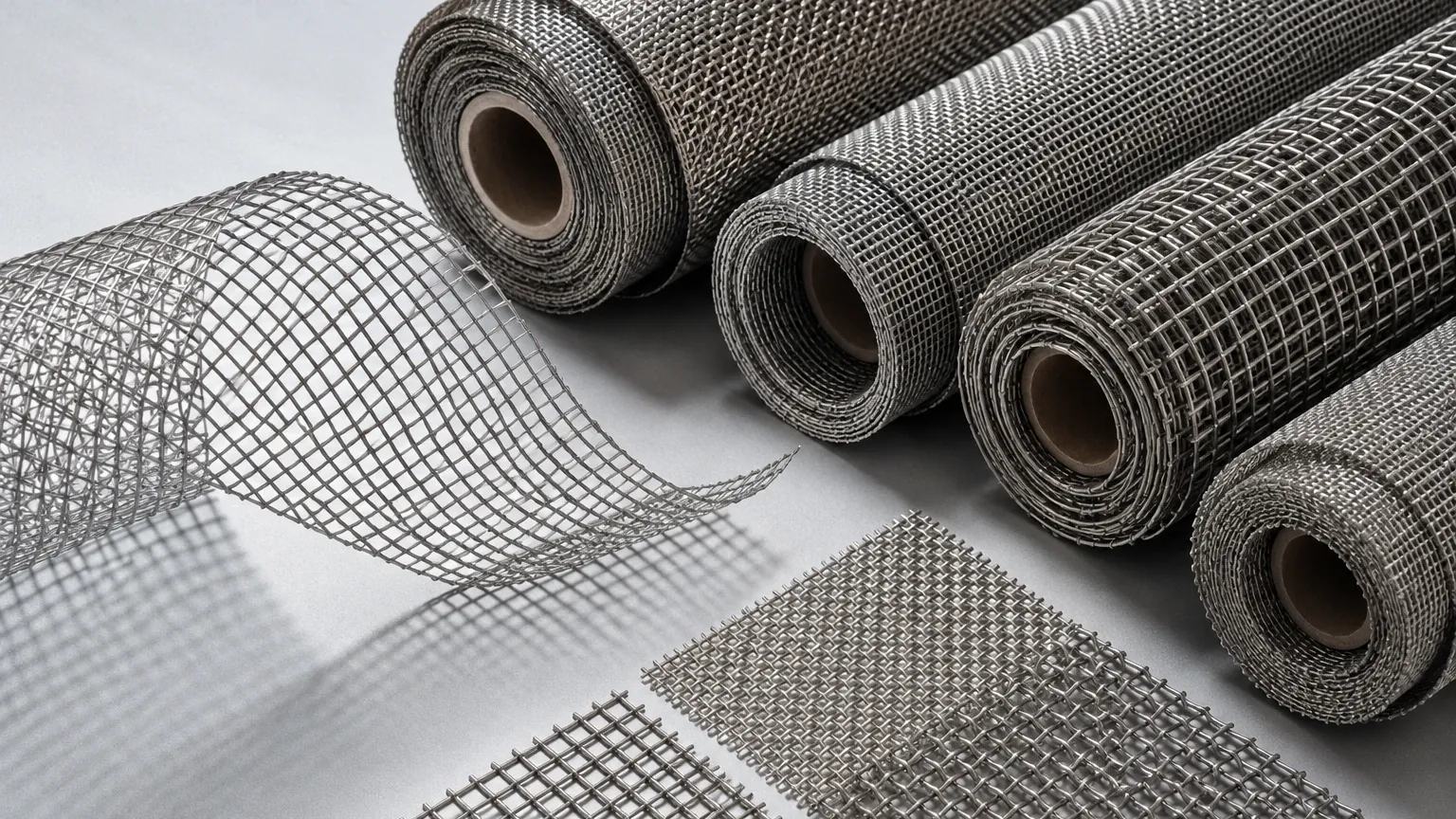
For those evaluating specific technical requirements, Plain, twill and dutch woven wire mesh in SS304/316L — rolls, cut mesh and framed panels. Send mesh count or micron target for a technical quote. provides a comprehensive starting point for material selection and customization.
Critical Selection Criteria for Engineers and Procurement
Selecting the right mesh involves more than just identifying a micron rating. To ensure the longevity of the filtration system, several engineering factors must be confirmed before procurement.
1. Micron Rating: Absolute vs. Nominal
It is vital to distinguish between nominal and absolute filtration ratings. A nominal rating refers to the ability of the mesh to retain a certain percentage of particles of a specific size (e.g., 90% of 20-micron particles). An absolute rating indicates the size of the largest spherical particle that can pass through the mesh under laboratory conditions. For critical applications like sterile pharmaceutical filtration, an absolute rating is typically required.
2. Open Area and Flow Velocity
The "open area" is the percentage of the total mesh surface that consists of openings. A higher open area results in a lower pressure drop (ΔP) and higher flow rates. However, increasing the open area often requires using thinner wires, which can reduce the mechanical strength and service life of the filter element. Engineers must balance the need for throughput with the structural demands of the system.
3. Mechanical Strength and Pressure Differential
In high-pressure systems, such as hydraulic circuits or polymer melt filtration, the mesh must withstand significant differential pressures without deforming. In these cases, single-layer mesh may be insufficient. Solutions include using heavier wire diameters, choosing a Dutch weave, or employing multi-layer sintered mesh where the filtration layer is bonded to coarser support layers.
4. Chemical and Thermal Compatibility
While stainless steel is highly versatile, certain processes involve aggressive chemicals or extreme temperatures that may require specialty alloys like Hastelloy, Inconel, or Monel. Engineers should confirm the pH levels, presence of halides, and peak operating temperatures of the process fluid to ensure the chosen mesh grade will not suffer from stress corrosion cracking or oxidation.
Quality Assurance and Compliance in the UK Market
For UK-based projects, adherence to international quality standards is non-negotiable. When sourcing woven wire mesh uk, procurement teams should verify that the manufacturer complies with recognized standards such as ISO 9001 for quality management and ISO 4783 for industrial wire screens and woven wire cloth.
Material Traceability is another critical factor. In industries like food and beverage or pharmaceuticals, Mill Test Reports (MTRs) are required to prove the chemical composition of the stainless steel. This ensures that the material meets the specific requirements for Grade 304 or 316L and is free from contaminants that could leach into the product stream.
Furthermore, for food-contact applications, the mesh must comply with FDA (Food and Drug Administration) or equivalent EU/UK food safety regulations regarding the use of stainless steel in processing equipment. This includes ensuring the mesh is free from manufacturing oils and burrs that could compromise food safety.
The Role of Customization in Optimizing Filtration Systems
Off-the-shelf mesh rolls are often just the starting point. Most industrial applications require some level of customization to integrate the mesh into existing machinery or to meet specific performance targets.
Custom Fabricated Components
Beyond raw mesh, many projects require fabricated components such as:
* Filter Cartridges: Cylindrical elements often used in liquid filtration, featuring pleated or wrapped mesh to increase surface area.
* Mesh Discs and Screens: Precision-cut circles or shapes used in extruders, centrifuges, and laboratory equipment.
* Framed Panels: Mesh tensioned over a metal frame for use in vibrating screens or architectural applications.
Engineering Collaboration
Working with a manufacturer like Kaifil allows engineers to leverage OEM expertise. This collaboration can involve optimizing the mesh count for a specific viscosity, designing custom reinforcement structures for high-vibration environments, or selecting specialized coatings to improve cake release in solid-liquid separation processes.
Procurement and Supply Chain Considerations for the UK
When searching for woven wire mesh uk, the choice between local stockists and global manufacturers often comes down to the balance of lead time, technical support, and cost.
* Technical Support: Industrial filtration is rarely a "one size fits all" purchase. Access to engineering support that understands the nuances of Dutch weaves or micron-to-mesh conversions is invaluable during the design phase.
* Lead Times: For maintenance and repair operations (MRO), immediate availability of standard mesh counts is essential to minimize downtime. However, for large-scale OEM projects or specialized custom designs, the ability of a manufacturer to scale production while maintaining tight tolerances is more critical.
* Total Cost of Ownership: While the initial purchase price is a factor, the total cost of ownership includes the filter’s service life, cleaning frequency, and the cost of replacement. High-quality stainless steel mesh that can be ultrasonically cleaned or backwashed multiple times often proves more cost-effective than cheaper, less durable alternatives.
Conclusion
Woven wire mesh remains a cornerstone of industrial filtration due to its precision, durability, and versatility. For engineers and buyers in the UK, the key to a successful filtration outcome lies in the rigorous evaluation of material grades, weave patterns, and mechanical requirements. By focusing on technical specifications—such as absolute micron ratings, pressure drop tolerances, and material certifications—organizations can ensure their filtration systems operate at peak efficiency.
Whether you are designing a new chemical processing line or optimizing a food production facility, selecting the right woven wire mesh is a technical investment in the reliability and quality of your final product. For those requiring specific configurations or technical guidance on stainless steel filtration solutions, consulting with a manufacturer experienced in custom industrial applications is the recommended next step.
