


304 Woven Wire Mesh
In the landscape of industrial filtration and separation, Woven Wire Mesh serves as a fundamental component for ensuring process purity and equipment protection. Among the various alloys available, 304 woven wire mesh is the most widely utilized due to its balance of mechanical strength, corrosion resistance, and cost-effectiveness. For engineers and procurement teams, selecting the correct mesh involves more than just identifying a material; it requires a deep understanding of weave geometries, aperture precision, and the specific environmental stressors of the application.
As a professional manufacturer, Kaifil specializes in translating these technical requirements into high-performance filtration solutions. Whether the application involves chemical processing, food production, or hydraulic systems, the choice of 304 stainless steel provides a versatile foundation for both standard and custom filter components.
The Role of 304 Woven Wire Mesh in Industrial Filtration
Industrial filtration relies on the predictability of the filter media. 304 woven wire mesh is categorized as a surface filtration medium, where particles larger than the pore size are captured on the upstream side of the mesh. Unlike depth media, woven mesh offers a precise, two-dimensional pore structure that can be easily cleaned and reused, making it an essential choice for systems requiring low maintenance and high durability.
In sectors such as pharmaceutical manufacturing and food and beverage processing, the material must not only filter effectively but also withstand rigorous cleaning cycles, including Clean-in-Place (CIP) procedures. The inherent stability of the 304 alloy ensures that the mesh maintains its structural integrity under pressure and during thermal cycling. Furthermore, the ability to manufacture this mesh in various weave patterns allows engineers to fine-tune the balance between filtration fineness and flow capacity.
Material Properties: Why AISI 304 is the Industry Standard
AISI 304 is an austenitic stainless steel characterized by its "18/8" composition—typically 18% chromium and 8% nickel. This chemical makeup is critical for the performance of 304 woven wire mesh in industrial environments.
Corrosion Resistance and Chemical Stability
Chromium provides the alloy with a passive oxide layer that protects the underlying metal from oxidation and atmospheric corrosion. In most water treatment, food processing, and general industrial applications, 304 offers sufficient resistance to organic chemicals and a wide range of inorganic chemicals. However, it is important for engineers to note that while 304 is robust, it can be susceptible to pitting in high-chloride environments. In such cases, a transition to 316L may be necessary, but for the vast majority of standard industrial tasks, 304 remains the optimal economic and technical choice.
Mechanical Strength and Fabricability
The austenitic structure of 304 provides excellent toughness, even at cryogenic temperatures. This strength allows the mesh to be woven into very fine counts without the wires becoming brittle. From a manufacturing perspective, 304 is highly fabricable; it can be easily cut, formed, and welded into complex shapes such as pleated cartridges, conical strainers, or framed panels. Kaifil leverages these properties to produce precision metal filter components that meet tight tolerances for OEM equipment.
Engineering the Weave: From Plain to Dutch Patterns
The performance of Woven Wire Mesh is dictated largely by the weave pattern. The way the warp (vertical) and weft (horizontal) wires intersect determines the pore size, the mechanical stability of the mesh, and the pressure drop across the filter.
Plain Weave
This is the most common weave pattern where each weft wire passes over and under one warp wire. It provides the highest open area and the lowest pressure drop, making it ideal for high-flow applications where the particle size is relatively large. Plain weave 304 mesh is often used in primary strainers and protective screens.
Twill Weave
In a twill weave, each weft wire passes over and under two warp wires. This allows for the use of heavier wire diameters for a given mesh count, resulting in a stronger and more durable mesh. Twill weaves are often employed when the mesh must support a high differential pressure or when a finer mesh count is required than can be achieved with a plain weave.
Dutch Weave (Plain and Twilled)
Dutch weaves utilize different wire diameters for the warp and weft. Typically, the weft wires are driven closer together, creating a "tortuous path" for the fluid. This results in much finer filtration ratings (down to the micron level) and superior mechanical strength. Dutch weave 304 woven wire mesh is the standard for high-pressure hydraulic filters and fine chemical filtration.
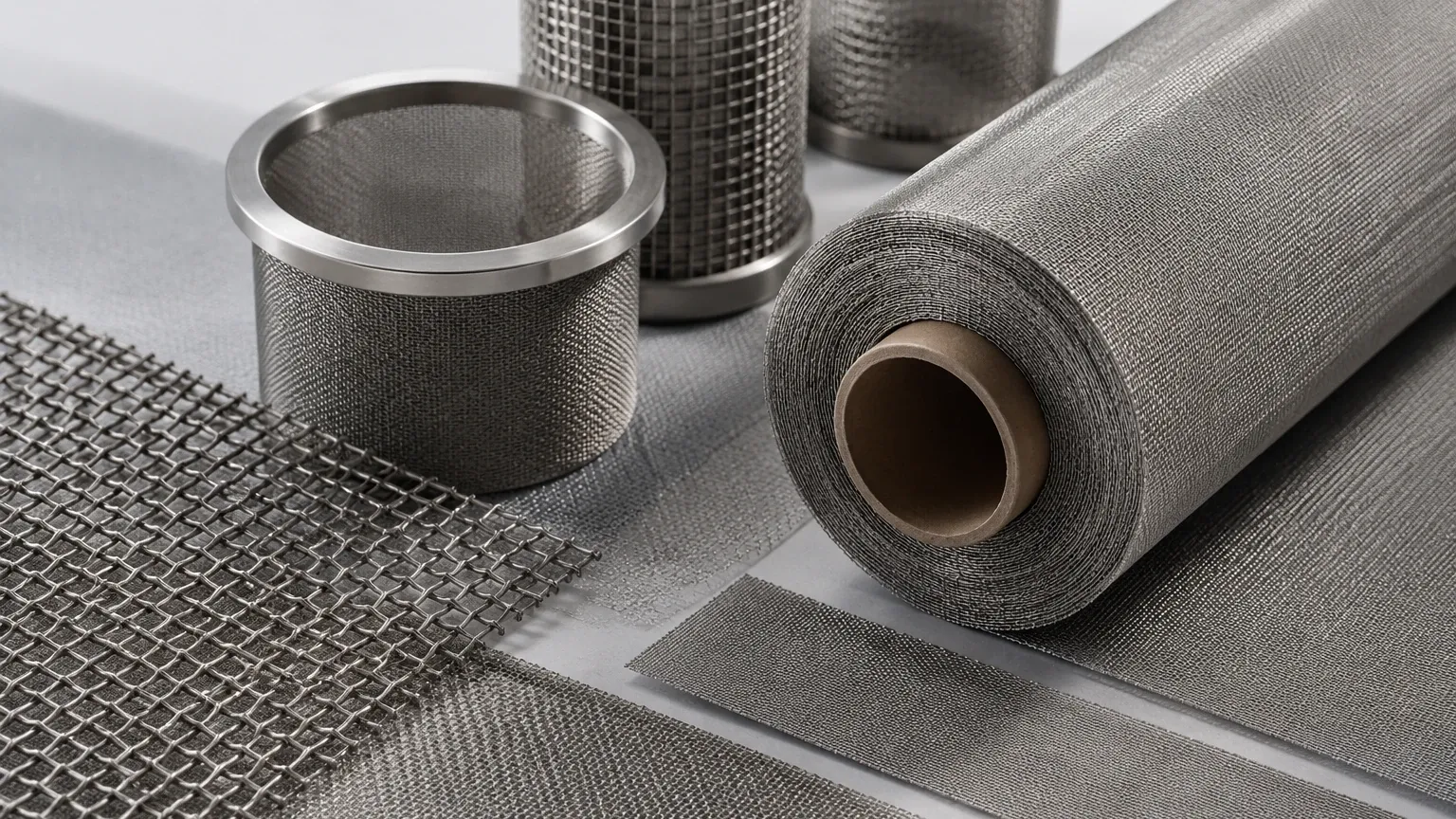
For those seeking specific configurations, Kaifil provides Plain, twill and dutch woven wire mesh in SS304/316L — rolls, cut mesh and framed panels. Send mesh count or micron target for a technical quote.
Critical Specification Parameters for Engineers
When specifying 304 woven wire mesh, engineers must look beyond the alloy and focus on the geometry of the mesh. Accurate specification is the only way to ensure the filter performs as expected in a live system.
1. Mesh Count: This refers to the number of openings per linear inch. A higher mesh count indicates a finer mesh. However, mesh count alone does not define the filtration rating; the wire diameter must also be considered.
2. Wire Diameter: The thickness of the wire affects both the strength of the mesh and the size of the openings. Thicker wires increase durability but reduce the percentage of open area.
3. Aperture (Pore Size): This is the clear distance between two adjacent wires. It defines the maximum particle size that can pass through the mesh. For precision applications, the aperture must be uniform across the entire surface of the mesh.
4. Percentage of Open Area: Calculated as the ratio of the total area of the openings to the total area of the mesh. This parameter is vital for calculating the flow rate and the initial pressure drop (ΔP).
5. Micron Rating: Often used for Dutch weaves, this indicates the particle size the mesh is capable of retaining. It can be expressed as "absolute" (100% retention) or "nominal" (a specific percentage of retention).
Evaluating Performance: Durability and Chemical Compatibility
The longevity of a filter element depends on how the 304 woven wire mesh interacts with the process fluid and the operating conditions. Engineers must evaluate the following risks before finalizing a selection:
Pressure Drop and Flow Fatigue
As a filter accumulates debris, the pressure drop across the media increases. If the mesh is not properly supported or if the wire diameter is too thin for the application, the mesh may deform or "blind" (where particles become permanently lodged in the pores). In high-cycle applications, such as pulse-jet cleaning systems, the mesh must resist fatigue failure at the wire intersections.
Temperature Limits
304 stainless steel maintains its mechanical properties up to approximately 800°F (427°C) in continuous service. Beyond this, oxidation can occur, and the structural integrity of the mesh may be compromised. For high-temperature exhaust filtration or molten polymer processing, understanding these thermal boundaries is essential.
Cleaning and Regeneration
One of the primary advantages of 304 woven wire mesh is its ability to be cleaned. Ultrasonic cleaning, backwashing, and chemical solvents are all effective methods for regenerating the mesh. However, the cleaning method must be compatible with the weave type. For instance, fine Dutch weaves may require more intensive ultrasonic cleaning compared to simple plain weaves.
Customization and OEM Integration for Filtration Systems
Many industrial applications require more than just a roll of mesh. Integrated filtration systems often demand custom-engineered components that fit specific housings or meet unique flow profiles. Kaifil provides extensive OEM capabilities, transforming raw 304 woven wire mesh into finished products such as:
* Stainless Steel Filter Cartridges: Pleated or cylindrical designs that maximize surface area and extend the time between cleaning cycles.
* Precision Metal Filter Components: Custom-shaped discs, cones, and baskets designed for seamless integration into existing industrial machinery.
* Framed Panels: Mesh tensioned and secured within stainless steel frames for use in vibrating screens or architectural applications.
By working closely with global customers, Kaifil ensures that the material selection, filtration accuracy, and structural design are optimized for the specific demands of the chemical, pharmaceutical, and hydraulic industries.
Pre-Purchase Checklist: Confirming Technical Requirements
Before initiating a procurement or design phase for 304 woven wire mesh, engineers should confirm the following technical details to ensure the final product meets the application's needs:
* What is the target particle size for retention? (Define in microns or mesh count).
* What is the maximum allowable pressure drop (ΔP) at the start of the cycle?
* What are the chemical constituents of the process fluid? (Check for high chloride levels or extreme pH values).
* What are the operating and peak temperatures?
* Does the application require specific certifications? (e.g., FDA compliance for food contact or specific ISO standards for hydraulic fluids).
* Will the mesh be subjected to mechanical stress or vibration?
By addressing these questions, technical professionals can avoid common pitfalls such as premature filter failure, insufficient flow rates, or material incompatibility. 304 woven wire mesh remains a cornerstone of industrial filtration, providing a reliable, cleanable, and high-performance solution for a vast array of demanding environments. Through precise engineering and quality manufacturing, Kaifil supports these industries with dependable filtration components that optimize process efficiency and protect critical assets.
