


304 Stainless Steel Woven Wire Mesh Screen: An Engineering Guide to Selection and Performance
In industrial filtration and separation processes, the selection of media is a critical engineering decision that impacts throughput, product purity, and equipment longevity. Among the various materials available, the 304 stainless steel woven wire mesh screen remains the industry standard for general-purpose applications. Its balance of mechanical strength, corrosion resistance, and cost-effectiveness makes it a primary choice for engineers across the chemical, food and beverage, and pharmaceutical sectors.
Understanding the technical nuances of Woven Wire Mesh is essential for optimizing filtration systems. This guide explores the material properties, weave structures, and performance criteria necessary for specifying the correct mesh for demanding industrial environments.
Material Properties of Type 304 Stainless Steel
Type 304 stainless steel is a T-300 series austenitic alloy, containing approximately 18% chromium and 8% nickel. This chemical composition provides the foundational characteristics required for most industrial screening applications.
Corrosion Resistance
The chromium content in 304 stainless steel facilitates the formation of a passive oxide layer, which protects the substrate from oxidation and atmospheric corrosion. While 316 stainless steel (which includes molybdenum) is preferred for marine or high-chloride environments, 304 is highly effective against most oxidizing acids and common industrial chemicals. It is particularly well-suited for applications involving fresh water, sterilized equipment, and food-grade processing.
Temperature Stability
304 stainless steel maintains its structural integrity across a wide temperature range. It can withstand continuous service temperatures up to approximately 800°C (1472°F) in oxidizing atmospheres. However, for filtration processes involving extreme thermal cycling or cryogenic temperatures, engineers must account for the alloy's thermal expansion coefficient to prevent mesh deformation or frame failure.
Mechanical Strength and Fabricability
One of the primary reasons for the widespread use of the 304 stainless steel woven wire mesh screen is its excellent workability. It can be easily formed, welded, and integrated into complex filter housings or pleated cartridges without losing its tensile strength. This ductility allows for the creation of high-count meshes that remain durable under high-pressure differentials.
Understanding Weave Patterns and Their Impact on Filtration
The performance of a Woven Wire Mesh is largely determined by its weave pattern. The arrangement of warp (longitudinal) and shute (transverse) wires dictates the aperture size, flow rate, and mechanical stability of the screen.
Plain Weave
The plain weave is the most common and straightforward pattern. Each shute wire passes alternately over and under each warp wire. This results in square openings and is ideal for general screening and low-pressure filtration. Plain weave screens offer high open area percentages, which minimizes pressure drop across the media.
Twill Weave
In a twill weave, each shute wire passes alternately over and under two warp wires. This allows for the use of heavier wire diameters than a plain weave of the same mesh count. Twill weaves are often specified when the mesh must withstand higher mechanical loads or when a finer mesh count is required that would be too fragile in a plain weave configuration.
Dutch Weave (Plain and Twill)
Dutch weaves utilize different wire diameters for the warp and shute. Typically, the shute wires are smaller and driven closer together, creating a dense, wedge-shaped opening rather than a square one.
- Plain Dutch Weave: Provides a high flow rate and is effective for heavy-duty filtration.
- Twill Dutch Weave: Allows for the finest filtration ratings, often down to the micron level, by layering the wires to create a tortuous path for particles. This is the preferred weave for high-precision liquid and gas filtration.
Technical Specifications: Mesh Count vs. Micron Rating
When specifying a 304 stainless steel woven wire mesh screen, engineers must distinguish between mesh count and micron rating to ensure the media meets the required separation efficiency.
Mesh Count
Mesh count refers to the number of openings per linear inch. For example, a 100-mesh screen has 100 openings per inch in both directions. While mesh count is a standard industry term, it does not account for wire diameter. Two 100-mesh screens can have different aperture sizes if their wire diameters differ.
Micron Rating
The micron rating defines the size of the particles that the mesh will effectively retain.
- Nominal Rating: Indicates the ability of the mesh to retain the majority of particles of a specified size (e.g., 90%).
- Absolute Rating: The diameter of the largest hard spherical particle that will pass through the mesh under specified test conditions. For critical pharmaceutical or hydraulic applications, absolute ratings are generally required to prevent downstream contamination.
Percentage of Open Area
The open area is the ratio of the total area of the apertures to the total area of the mesh. It is calculated as:
`Open Area % = (Aperture / (Aperture + Wire Diameter))^2 × 100`
A higher open area increases flow capacity and reduces the frequency of cleaning cycles, but it may compromise the structural rigidity of the screen.
Engineering Considerations for Industrial Application
Selecting the right 304 stainless steel woven wire mesh screen involves more than just picking a micron size. Engineers must evaluate the total operational environment.
Pressure Drop and Flow Velocity
Every filter media introduces a resistance to flow, known as pressure drop (ΔP). As the mesh captures contaminants, the ΔP increases. It is vital to select a mesh with sufficient open area to maintain the required flow velocity without exceeding the pump's capacity or causing the mesh to collapse. In high-viscosity fluids, the impact of the weave structure on turbulence and flow resistance becomes even more pronounced.
Mechanical Loading and Support
In high-pressure systems, a single layer of woven wire mesh may lack the necessary strength. In these cases, the mesh is often sintered to a coarser support layer or integrated into a perforated metal core. This multi-layer construction provides the fine filtration of the mesh with the structural integrity of heavier materials.
Chemical Compatibility and Cleaning
While 304 stainless steel is robust, certain cleaning agents or process fluids (such as high-concentration chlorides) can cause pitting or stress corrosion cracking. Engineers should confirm that the cleaning protocols—whether ultrasonic, backwashing, or chemical CIP (Clean-In-Place)—are compatible with both the 304 alloy and the specific weave type. Dutch weaves, for instance, can be more challenging to clean than plain weaves due to their dense structure.
Applications of 304 Stainless Steel Woven Wire Mesh
Due to its versatility, the 304 stainless steel woven wire mesh screen is utilized across diverse industrial sectors:
* Chemical Processing: Used for catalyst recovery, resin traps, and the filtration of intermediate chemical products where corrosion resistance is required.
* Food and Beverage: Employed in juice straining, sugar processing, and dairy filtration. 304 SS is favored for its ease of sterilization and compliance with food safety standards.
* Pharmaceuticals: Used in fluid bed dryers, granulators, and sterile filtration assemblies. The precision of high-count Dutch weaves ensures the removal of fine particulates without leaching contaminants into the product.
* Hydraulics and Oil Filtration: Acts as a primary or secondary filter to protect sensitive valves and pumps from particulate wear.
* Water Treatment: Utilized in intake screens and fine-particle filtration for industrial process water and wastewater treatment.
Customization and OEM Solutions
In many industrial scenarios, off-the-shelf mesh rolls do not meet specific design requirements. Customization is often necessary to optimize performance. Kaifil specializes in providing tailored filtration solutions, ranging from specific mesh geometries to fully fabricated components.
When sourcing a 304 stainless steel woven wire mesh screen, engineers should consider the following customization options:
1. Edge Treatments: Hemmed edges, welded borders, or framed panels to prevent fraying and ensure a secure fit in the housing.
2. Layering and Sintering: Combining multiple mesh layers to achieve specific permeability and strength profiles.
3. Forming and Shaping: Custom-cut discs, cylinders, or pleated elements designed to fit proprietary equipment.
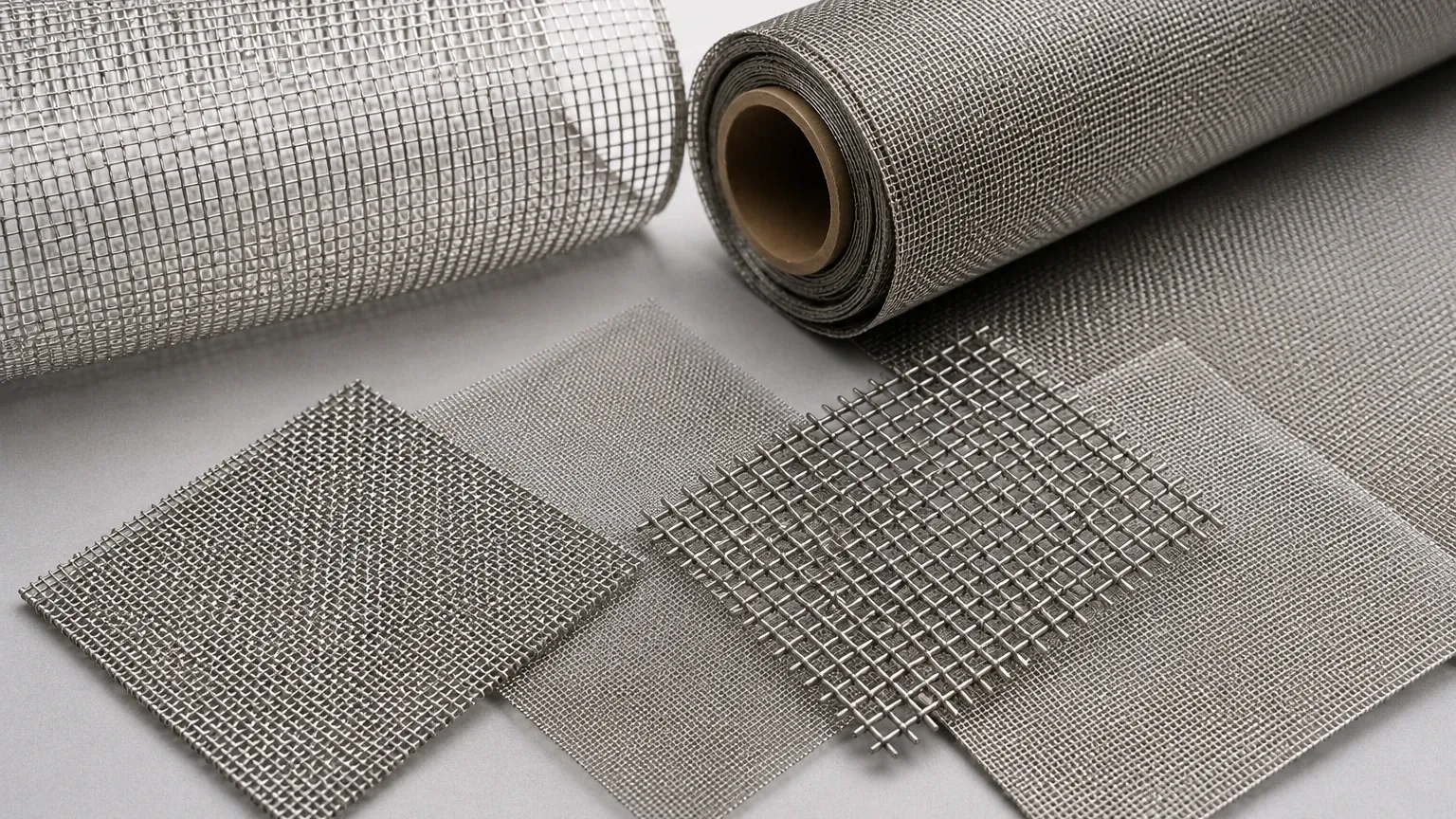
For those seeking specific configurations, Kaifil offers Plain, twill and dutch woven wire mesh in SS304/316L — rolls, cut mesh and framed panels. Send mesh count or micron target for a technical quote.
Quality Assurance and Procurement Checklist
To ensure the reliability of the filtration system, procurement teams and engineers should verify several factors before finalizing a mesh selection:
* Material Certification: Ensure the supplier provides Mill Test Reports (MTRs) confirming the chemical composition of the 304 stainless steel.
* Dimensional Accuracy: Verify that the mesh count and wire diameter adhere to international standards (such as ASTM E2016).
* Flatness and Uniformity: For automated screening equipment, the mesh must be free of curls, waves, or inconsistent apertures that could lead to bypass or mechanical failure.
* Total Cost of Ownership: Beyond the initial purchase price, consider the lifespan of the mesh, the ease of cleaning, and the potential downtime associated with frequent replacements. High-quality 304 mesh often provides a lower total cost of ownership through extended service life.
Conclusion
The 304 stainless steel woven wire mesh screen is a fundamental component in modern industrial filtration. By carefully considering the weave pattern, technical specifications, and mechanical requirements of the application, engineers can significantly improve process efficiency and product quality. Whether used as a simple strainer or a high-precision micron filter, the 304 SS mesh offers a dependable and scalable solution for the most demanding industrial challenges.
Download 304 Stainless Steel Woven Wire Mesh Screen as a PDF
