


Woven Wire Fence 5
In industrial environments, the term "woven wire fence 5" often refers to specialized 5-foot high containment, partitioning, or security screening solutions that utilize high-tensile woven wire mesh. While standard agricultural fencing focuses on basic perimeter control, industrial-grade woven wire products are engineered for durability, corrosion resistance, and precise aperture control. For engineers and facility managers, selecting the right woven wire configuration involves understanding material science, mechanical loads, and the specific environmental stressors of the application site.
Whether used for equipment guarding, chemical storage partitioning, or integrated into complex filtration systems, woven wire mesh provides a unique combination of structural integrity and transparency. This guide explores the technical specifications, material considerations, and engineering benchmarks necessary for implementing high-performance woven wire solutions in industrial settings.
Understanding the Specifications of Woven Wire Fence 5
When discussing a "5-foot" or "Type 5" woven wire configuration, the primary focus is on the physical dimensions and the mechanical properties of the wire itself. In B2B procurement, these specifications are rarely off-the-shelf; they require alignment with safety standards and process requirements.
Height and Structural Stability
A 5-foot height is a standard benchmark for industrial safety partitions and perimeter barriers. At this height, the center of gravity and the tensioning requirements of the mesh become critical. Unlike shorter screens, a 5-foot panel requires robust vertical supports and often a top rail or tension wire to prevent sagging over time. For filtration-adjacent applications, such as large-scale intake screens or debris barriers, this height ensures sufficient surface area to handle high flow rates without excessive pressure drops.
Wire Gauge and Mesh Count
The strength of the woven wire is determined by the wire diameter (gauge) and the mesh count (the number of openings per linear inch). In industrial fencing and heavy-duty screening, a lower mesh count with a thicker wire gauge is typically preferred to resist impact and environmental wear. Conversely, if the "fence" is actually a fine-mesh screen used for secondary containment or filtration, the mesh count will be much higher, requiring precision weaving techniques to maintain aperture uniformity.
Material Selection: The Role of Stainless Steel
In demanding industrial sectors such as chemical processing, food and beverage, and pharmaceuticals, the material composition of the woven wire is the single most important factor in determining the total cost of ownership. While galvanized steel is common in commercial fencing, it often fails to meet the longevity requirements of harsh industrial environments.
SS304 vs. SS316L
Stainless steel is the gold standard for industrial woven wire mesh.
* SS304: This is the most widely used stainless steel for general industrial applications. It provides excellent resistance to atmospheric corrosion and is suitable for most indoor and mild outdoor environments. It is often used for machinery guards and internal partitions.
* SS316L: For applications involving exposure to chlorides (such as coastal environments) or aggressive chemical cleaning agents (common in food and pharmaceutical plants), SS316L is required. The addition of molybdenum and a lower carbon content enhances its resistance to pitting and intergranular corrosion.
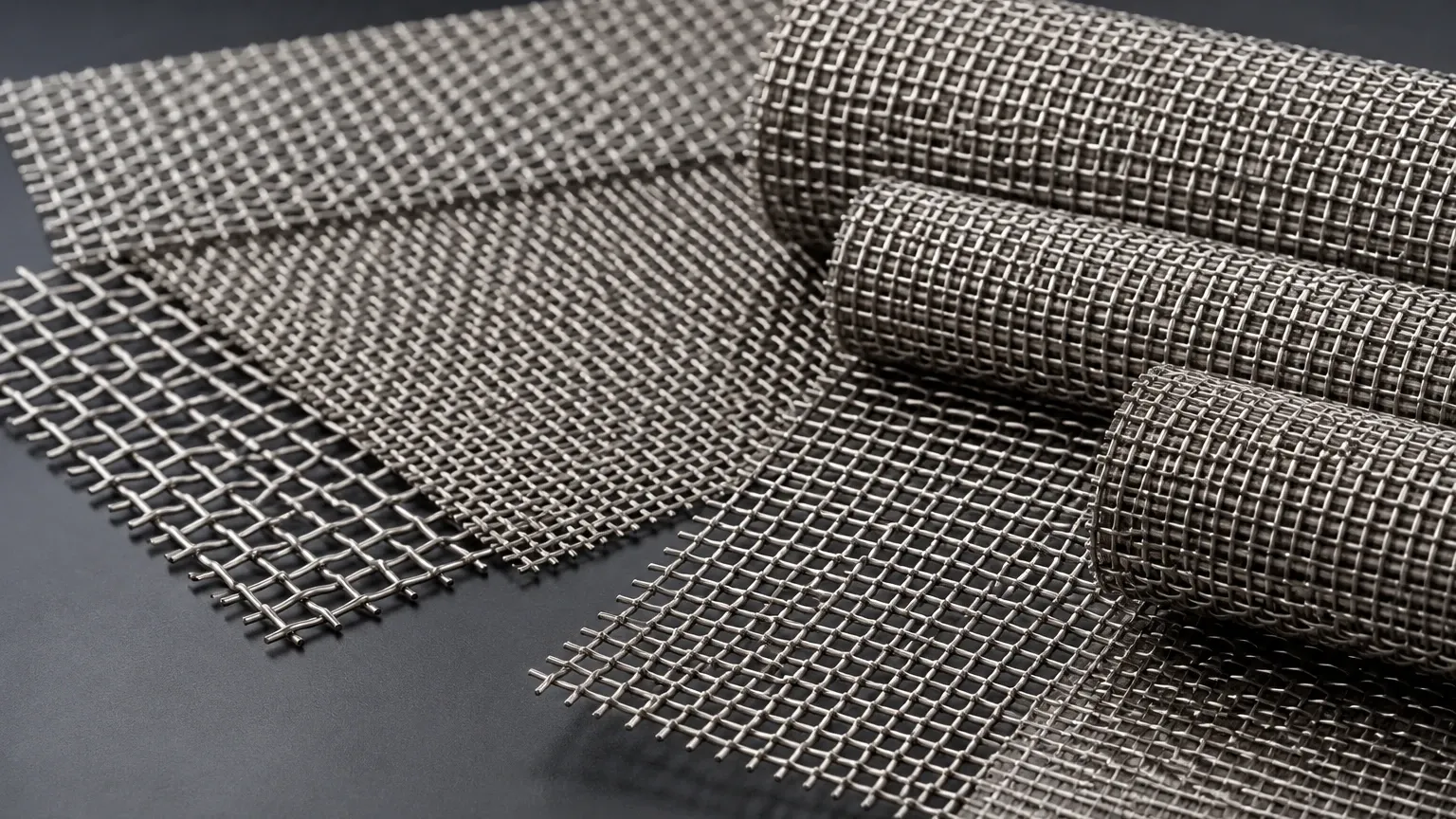
Using high-quality materials ensures that the Plain, twill and dutch woven wire mesh in SS304/316L — rolls, cut mesh and framed panels. Send mesh count or micron target for a technical quote. maintains its structural integrity and aesthetic appearance throughout its service life, reducing the need for frequent replacements.
Engineering Considerations for Industrial Partitioning and Filtration
Integrating woven wire mesh into an industrial facility requires more than just mounting panels. Engineers must consider the fluid dynamics (if used in filtration), mechanical impact resistance, and the method of attachment.
Open Area and Airflow
In many industrial settings, woven wire fences or screens must allow for adequate airflow or light transmission while providing a physical barrier. The "open area" percentage is a critical calculation. A mesh with a high open area reduces wind load on outdoor fences and ensures that ventilation systems in indoor partitions are not compromised. Engineers must balance the need for a small aperture (to keep out debris or fingers) with the need for high permeability.
Tensioning and Framing
For a 5-foot woven wire fence to remain effective, it must be properly tensioned. In industrial applications, this is often achieved through the use of framed panels. Framing the mesh in stainless steel angles or channels provides a rigid structure that can be easily bolted to existing infrastructure. This modular approach allows for easier maintenance and replacement of individual sections without disturbing the entire installation.
Comparing Weave Types: Plain, Twill, and Dutch
The method of weaving significantly impacts the performance characteristics of the mesh. While "woven wire fence 5" typically implies a standard plain weave, other configurations may be necessary depending on the application's technical requirements.
Plain Weave
This is the most common weave where each warp wire crosses over and under each weft wire. It provides a consistent aperture size and is ideal for standard security screening and coarse filtration. It offers the highest open area for a given wire diameter.
Twill Weave
In a twill weave, each warp wire passes over and under two weft wires. This allows for a heavier wire diameter to be used with a finer mesh count, resulting in a more robust and flexible mesh. Twill weave is often used when the mesh must withstand higher mechanical loads or when a smoother surface is required.
Dutch Weave
Dutch weaves use different wire diameters for the warp and weft. This results in a very dense mesh with small, triangular openings. While not typically used for "fencing" in the traditional sense, Dutch woven wire mesh is essential for high-pressure filtration applications where the mesh must act as a barrier for microscopic particles while maintaining structural strength.
Installation and Maintenance for Longevity
To maximize the lifespan of an industrial woven wire installation, proper installation and a consistent maintenance schedule are required. Even the highest quality stainless steel can suffer from surface contamination if not handled correctly.
Avoiding Cross-Contamination
During installation, it is vital to use stainless steel tools and fasteners. Using carbon steel tools can leave microscopic iron particles on the surface of the stainless mesh, leading to localized "tea staining" or rusting. This is a common failure point in industrial projects that can be easily avoided through proper site management.
Cleaning Cycles
In food processing or pharmaceutical environments, the mesh must be cleaned regularly to prevent the buildup of organic matter or chemical residues. The smooth surface of high-quality Woven Wire Mesh allows for efficient CIP (Clean-In-Place) or manual pressure washing. Engineers should specify a mesh finish (such as electropolishing) if the application requires ultra-high levels of hygiene.
Customization and OEM Solutions
Every industrial facility has unique requirements. A standard 5-foot fence may need to be modified with specific cutouts for piping, integrated sensors for security, or specialized coatings for extreme chemical resistance. Working with a manufacturer like Kaifil allows for the development of customized filtration and partitioning components that fit exactly into the intended space.
Custom Mesh Counts and Micron Ratings
For applications where the woven wire serves a dual purpose—such as a debris fence that also acts as a primary filter—specifying the exact micron rating is essential. Custom manufacturing ensures that the mesh count is precise, providing predictable performance in separation tasks. This level of customization is particularly important in hydraulic systems, water treatment plants, and chemical reactors where filtration accuracy directly impacts process efficiency.
Total Cost of Ownership and Selection Advice
When evaluating woven wire fence 5 options, purchasing teams should look beyond the initial price per square foot. The total cost of ownership (TCO) includes installation labor, maintenance costs, and the projected lifespan of the material.
Investing in stainless steel woven wire mesh may have a higher upfront cost than galvanized alternatives, but the reduction in downtime and replacement frequency offers a significantly better return on investment (ROI). For engineers, the priority should be confirming the material grade, the weave type, and the structural requirements of the frame before proceeding with a purchase.
Key Questions for Engineers to Confirm:
1. Environmental Exposure: Will the mesh be exposed to salt spray, high humidity, or caustic chemicals?
2. Mechanical Load: Does the fence need to withstand impact from moving equipment or high-pressure fluid flows?
3. Filtration Requirements: Is there a specific particle size that must be contained or excluded?
4. Compliance: Does the material meet industry-specific standards such as FDA (for food contact) or ASTM (for material quality)?
By addressing these technical parameters, procurement teams can ensure they select a woven wire solution that provides reliable performance in even the most demanding industrial environments.
