


Cylindrical Wire Mesh
In industrial filtration, the geometry of a filter component is as critical as the material from which it is constructed. Cylindrical wire mesh serves as a fundamental architectural choice for liquid and gas separation systems, offering a high surface area-to-volume ratio that optimizes flow dynamics and structural stability. These components are engineered to withstand significant differential pressures while maintaining precise filtration ratings, making them indispensable in sectors ranging from petrochemical processing to pharmaceutical manufacturing.
Selecting the appropriate cylindrical wire mesh requires a deep understanding of metallurgy, weave patterns, and mechanical reinforcement. For engineers and procurement specialists, the goal is to balance filtration efficiency with the total cost of ownership, ensuring that the chosen component can withstand the rigors of the specific operating environment without premature failure or media migration.
Engineering Fundamentals of Cylindrical Wire Mesh
The primary function of a cylindrical filter is to provide a barrier that allows the passage of fluids or gases while capturing solid particulates. The cylindrical shape is inherently stronger than flat panels when subjected to internal or external pressure. This structural advantage allows for the use of finer wires and more complex weave patterns without compromising the integrity of the filter element.
When designing or specifying Wire Mesh Filter Cylinders & Tubes, technical teams must consider the direction of flow. In "outside-to-inside" flow configurations, the particulate is captured on the exterior surface, and the cylinder must resist collapsing forces. Conversely, "inside-to-outside" flow requires the cylinder to resist bursting. These forces dictate whether the mesh requires an internal support core (such as a perforated metal tube) or an external shroud.
Material Science: Selecting Alloys for Industrial Environments
The longevity of a cylindrical wire mesh component is largely determined by its chemical compatibility with the process media. Stainless steel is the industry standard due to its corrosion resistance and mechanical strength at varying temperatures.
* AISI 304/304L: This is the most common grade for general industrial applications. It offers excellent strength and good corrosion resistance in mildly corrosive environments. However, it is susceptible to chloride-induced pitting.
* AISI 316/316L: Containing molybdenum, 316L provides superior resistance to chlorides and acids. It is the preferred choice for marine environments, chemical processing, and pharmaceutical applications where strict hygiene and corrosion prevention are mandatory.
* Specialty Alloys: For extreme conditions, materials like Inconel, Monel, or Hastelloy may be employed. These are reserved for high-temperature applications or environments involving highly aggressive chemicals where standard stainless steels would fail rapidly.
Choosing the "L" (low carbon) versions of these alloys, such as 316L, is particularly important for cylindrical filters that require extensive welding. The lower carbon content minimizes carbide precipitation during the welding process, preserving the corrosion resistance of the heat-affected zone (HAZ).
Mesh Weave Patterns and Micron Rating Precision
The performance of a cylindrical wire mesh is defined by its weave. The weave pattern determines the pore size (micron rating), the open area percentage, and the mechanical flexibility of the mesh during the forming process.
Plain Weave
In a plain weave, each shute wire passes over and under one warp wire. This creates a simple, square opening. It is ideal for high-flow applications where low pressure drop is a priority. However, plain weave is generally limited to coarser filtration tasks because the wire diameter restricts how small the openings can be.
Twill Weave
Twill weaves allow for heavier wires in a given mesh count. Each shute wire passes over and under two warp wires, resulting in a more flexible mesh that can be formed into tight cylindrical shapes without stressing the metal. This is often used for finer filtration than plain weave can provide.
Dutch Weave (Plain and Twill)
Dutch weaves utilize different diameters for warp and shute wires. The wires are driven closely together to create a "zero-open-area" appearance, where the fluid must pass through the triangular openings created by the overlapping wires. This provides excellent depth filtration and is capable of reaching very fine micron ratings (down to 5-10 microns) while maintaining high mechanical strength.
Structural Integrity: Reinforcement and Support Layers
Single-layer cylindrical wire mesh is often sufficient for low-pressure strainers. However, in high-pressure hydraulic systems or high-viscosity fluid processing, the mesh requires reinforcement to prevent deformation.
Sintered Mesh Structures
Sintering involves diffusion-bonding multiple layers of wire mesh together using heat and pressure. A typical 5-layer sintered mesh might include a fine filtration layer protected by drainage layers and supported by heavy-duty reinforcement layers. When rolled into a cylinder, this structure provides the precision of fine mesh with the rigidity of a solid plate.
Perforated Metal Cores
For many industrial applications, the mesh is wrapped around or inserted into a perforated stainless steel tube. This core acts as the primary structural member, bearing the pressure load, while the wire mesh provides the actual filtration. The bond between the mesh and the core is usually achieved through spot welding or seam welding, ensuring the two components act as a single unit.
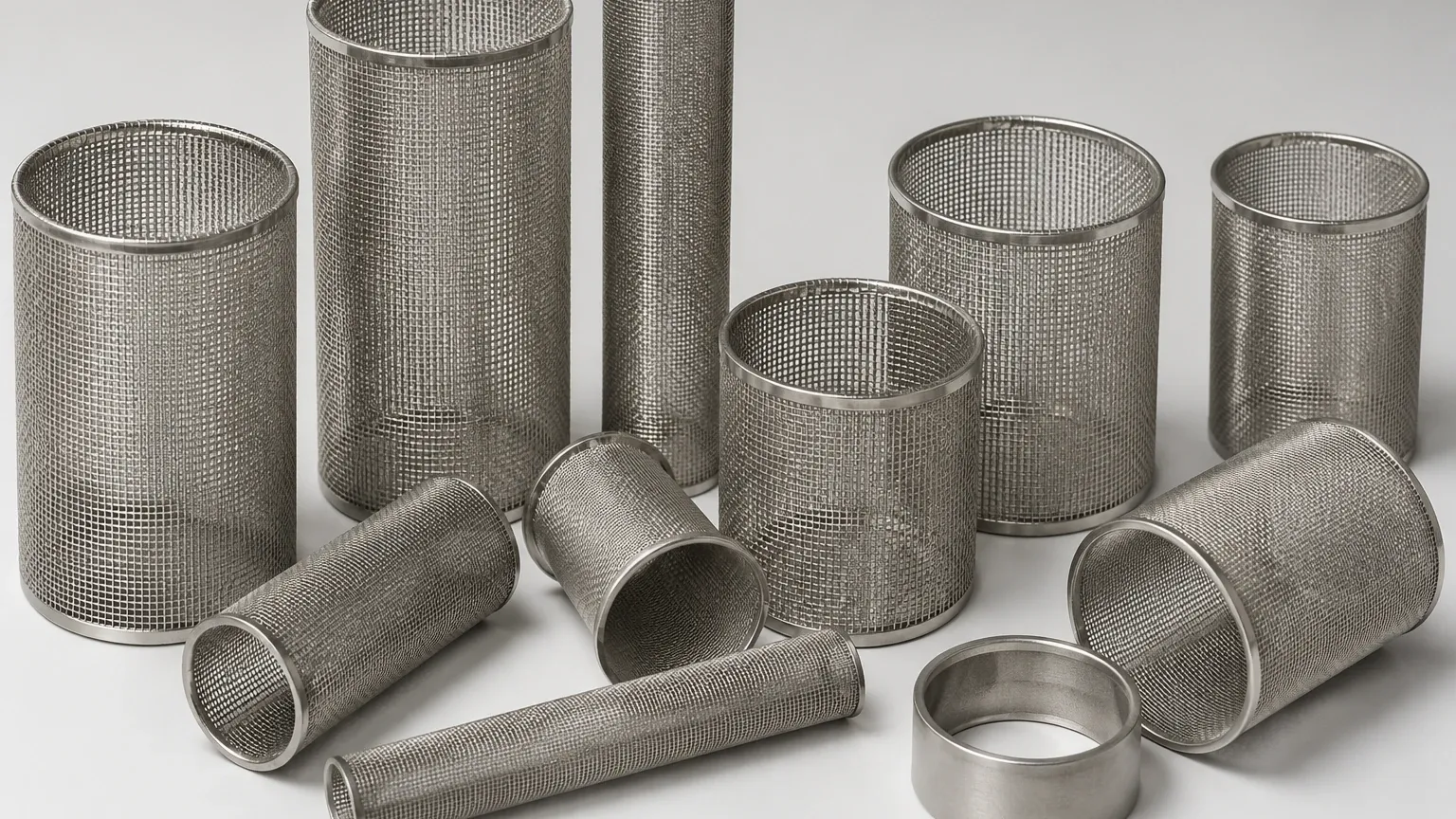
Customization Parameters for Wire Mesh Filter Cylinders & Tubes
Standardized filters rarely meet the precise needs of specialized industrial machinery. Customization is often necessary to ensure a perfect fit and optimal performance. When ordering custom components, engineers should confirm several key specifications:
1. Dimensions: Outside diameter (OD), inside diameter (ID), and overall length. Tolerances must be clearly defined, especially for filters that must seat into precision-machined housings.
2. End Configurations: Options include open ends, closed ends with metal caps, threaded fittings, or flanged ends. The method of attachment (e.g., TIG welding vs. epoxy bonding) should be selected based on temperature and chemical exposure.
3. Seam Construction: The longitudinal seam of the cylinder is a potential point of failure. High-quality filters utilize plasma or laser welding to create a butt-weld seam that is as strong as the parent material and maintains a consistent profile to prevent bypass.
4. Layering: Determining if a single layer is sufficient or if a multi-layer composite is required for added strength or graduated filtration (capturing larger particles on the outer layers to prevent blinding of the inner fine layer).
Performance Evaluation: Flow Rate and Pressure Drop
A critical aspect of filter selection is the relationship between flow rate and pressure drop ($ΔP$). As the pore size of the cylindrical wire mesh decreases, the resistance to flow increases. If the pressure drop is too high from the start, the operational life of the filter before cleaning is significantly shortened.
Engineers must calculate the effective filtration area (EFA). In a cylindrical design, the EFA is the surface area of the mesh minus the area blocked by support structures, welds, and end caps. Maximizing the EFA through pleated designs—where the mesh is folded before being formed into a cylinder—can increase the surface area by 3 to 5 times compared to a smooth-walled cylinder of the same dimensions. This reduces the face velocity of the fluid, lowers the initial pressure drop, and increases the dirt-holding capacity.
Maintenance and Cleaning Protocols for Longevity
One of the primary advantages of stainless steel cylindrical wire mesh over disposable polymer filters is cleanability. Depending on the contaminant, these filters can be rejuvenated through several methods:
* Backwashing: Reversing the flow of the fluid to dislodge particles from the surface of the mesh. This is common in automated self-cleaning systems.
* Ultrasonic Cleaning: Using high-frequency sound waves in a cleaning solution to remove fine particulates trapped deep within the mesh pores, particularly effective for Dutch weaves and sintered materials.
* Chemical Cleaning: Using solvents or acids to dissolve organic or mineral scale. The material selection (e.g., 316L) must be compatible with the cleaning agents used.
* Burn-off/Pyrolysis: In applications like plastic extrusion, the filter may be heated to high temperatures to burn off polymer residue. This requires the mesh and support structures to be made of alloys that can withstand thermal cycling without losing their temper.
Understanding the replacement cycle is also vital. While stainless steel is durable, repeated cleaning and pressure cycles can eventually lead to fatigue or permanent blinding. Establishing a baseline for "terminal pressure drop"—the point at which the filter must be cleaned or replaced—is essential for preventing system downtime.
Conclusion
Cylindrical wire mesh remains a cornerstone of industrial filtration due to its versatility, strength, and precision. By carefully considering the interplay between material grade, weave pattern, and structural reinforcement, technical teams can implement filtration solutions that protect sensitive downstream equipment and ensure product purity. Whether the application involves simple straining or complex multi-stage separation, the correct specification of wire mesh components is a prerequisite for operational efficiency and long-term reliability.
