


Cutting Expanded Metal
In industrial manufacturing and filtration engineering, the precision with which components are fabricated directly impacts the efficiency, longevity, and structural integrity of the final system. Expanded metal, a versatile material created by simultaneously slitting and stretching metal sheets, presents unique challenges during the fabrication phase. Unlike solid sheets, the three-dimensional geometry and interconnected strand-and-bond structure of expanded metal require specific technical approaches when performing secondary operations.
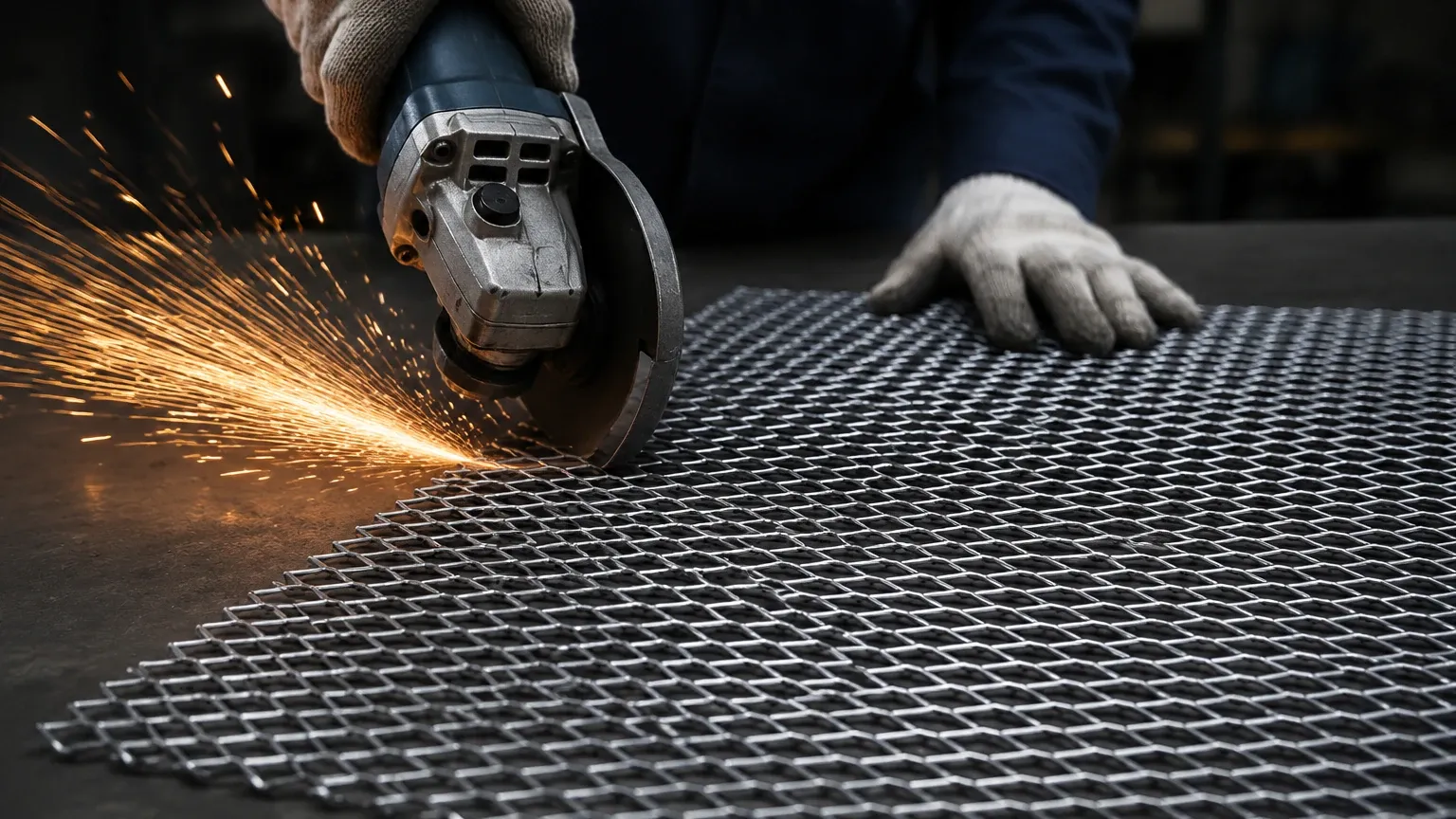
Understanding the nuances of cutting expanded metal is essential for engineers and procurement teams involved in the development of Perforated & Expanded Metal solutions. This guide examines the mechanical and thermal methods used in industrial settings, the engineering considerations for maintaining dimensional accuracy, and the selection criteria for achieving optimal edge quality in stainless steel filtration components.
1. The Structural Mechanics of Expanded Metal
Before selecting a cutting method, it is necessary to understand the mechanical properties of the material. Expanded metal is defined by its LWD (Long Way of Design) and SWD (Short Way of Design). The points where the strands intersect are called "bonds," and the angled metal strips are "strands."
Standard vs. Flattened Expanded Metal
There are two primary forms of expanded metal, each reacting differently to cutting tools:
* Standard (Raised) Expanded Metal: This material retains the original angularity of the strands after the expanding process. It offers high strength-to-weight ratios and excellent grip. However, its uneven surface makes it more difficult to cut with traditional mechanical shears, as the blade may deflect or cause the mesh to deform.
* Flattened Expanded Metal: This version is passed through a cold-rolling mill to flatten the strands and bonds into a single plane. It is roughly 5% to 10% thinner than the original sheet but provides a smooth, consistent surface that is much easier to cut accurately using mechanical or automated methods.
When cutting expanded metal for high-precision filtration applications, engineers must account for the "spring-back" effect and the potential for the mesh to shift if not properly secured, particularly in standard raised configurations.
2. Mechanical Cutting Methods for Industrial Applications
Mechanical cutting is often the most cost-effective solution for high-volume production or straight-line requirements. However, the choice of equipment depends heavily on the gauge of the material and the required edge finish.
Industrial Shearing
Power shearing is the standard method for cutting large sheets of expanded metal into rectangular or square blanks. For optimal results, the shear blades must be sharp and the clearance adjusted according to the material thickness.
One critical engineering consideration during shearing is the alignment of the cut relative to the diamond pattern. A "random cut" occurs when the shear passes through the diamonds at any point, resulting in open, jagged edges. A "bond cut" (or "center-of-bond cut") is executed precisely through the center of the bonds, providing a closed-edge finish that is safer to handle and easier to weld into frames. Achieving a bond cut requires precise indexing and an understanding of the specific mesh dimensions.
Cold Sawing and Circular Saws
For thicker gauges of stainless steel expanded metal, cold saws with carbide-tipped blades are preferred. Cold sawing generates minimal heat, which prevents the discoloration or metallurgical changes often associated with thermal cutting. This is particularly important for stainless steel alloys used in chemical processing, where maintaining the material's corrosion resistance is paramount.
Nibbling
Industrial nibblers are effective for cutting irregular shapes or curves in expanded metal. A nibbler removes small pieces of metal in a rapid punching motion. While this method is slower than shearing, it minimizes distortion because the tool does not exert significant lateral pressure on the mesh structure.
3. Precision Thermal and Non-Thermal Cutting
When the application requires complex geometries, tight tolerances, or intricate patterns—common in custom filter cartridges and precision metal components—automated cutting technologies are employed.
Laser Cutting
Laser cutting offers the highest degree of precision for cutting expanded metal. Fiber lasers are particularly effective for stainless steel. The primary advantage of laser cutting is the ability to follow complex CAD paths with extreme accuracy.
However, engineers must consider the "kerf" (the width of the cut) and the potential for small dross accumulation on the underside of the strands. For filtration components, nitrogen is often used as the assist gas to ensure a clean, oxide-free edge that requires minimal post-processing.
Waterjet Cutting
Waterjet cutting is a non-thermal process that uses a high-pressure stream of water mixed with abrasive particles. This is often the preferred method for very thick expanded metal or when the material's temper and molecular structure must remain completely unchanged. Since there is no Heat Affected Zone (HAZ), waterjet cutting eliminates the risk of warping or localized hardening, making it ideal for high-performance hydraulic and aerospace filtration parts.
Plasma Cutting
Plasma cutting is a faster, more economical thermal method for thicker sections of expanded metal. While it is highly efficient, it produces a larger HAZ than laser cutting and may result in a slightly tapered edge. In industrial filtration, plasma is typically reserved for heavy-duty support structures rather than fine mesh components.
4. Engineering Considerations for Edge Quality
The quality of the cut edge is not merely an aesthetic concern; it impacts the safety, assembly, and performance of the filter. When specifying expanded metal components, engineers must define the desired edge condition:
* Open Edges: These occur when the cut passes through the strands, leaving sharp, pointed protrusions. While this is the most common result of bulk shearing, it requires careful handling and usually necessitates a frame or U-edging to protect the user and the surrounding equipment.
* Closed Edges (Matched Diamonds): A closed edge is achieved by cutting through the bonds. This provides a continuous perimeter that increases the structural rigidity of the piece and facilitates easier TIG or MIG welding.
* Tolerance Accumulation: Because expanded metal is a flexible material, tolerances are typically wider than those for solid sheet metal. Standard industrial tolerances for expanded metal blanks are often +/- 1/8 inch, though precision laser cutting can achieve much tighter specifications.
5. Material Specifics: Cutting Stainless Steel Expanded Metal
For industries such as food and beverage, pharmaceutical, and chemical processing, stainless steel (typically Grades 304, 316, or 316L) is the material of choice due to its durability and resistance to aggressive media. Cutting expanded metal made of stainless steel requires specialized knowledge:
1. Work Hardening: Stainless steel tends to work-harden quickly. Tools must maintain a constant feed rate and sharp cutting edges to prevent the material from becoming excessively hard and difficult to process.
2. Contamination Prevention: When cutting stainless steel, it is vital to use dedicated tools that have not been used on carbon steel. Cross-contamination can lead to localized rusting (pitting corrosion), compromising the integrity of a filtration system.
3. Surface Finish: For pharmaceutical-grade filters, the cut edges must be completely burr-free. Post-cutting processes like electropolishing or ultrasonic cleaning are often employed to ensure the component meets stringent hygiene standards.
6. Common Challenges and Risk Mitigation
Several risks are associated with the fabrication of expanded metal that can lead to material waste or component failure if not addressed during the design phase.
* Distortion and Bowing: The internal stresses released during the expansion process can cause the sheet to bow when it is cut into smaller pieces. This is particularly prevalent in long, narrow strips. Flattening the material prior to cutting or using stress-relieving techniques can mitigate this.
* Strand Fracture: If the cutting tool is dull or the clearance is incorrect, the impact can cause the strands to fracture at the bond. This weakens the mesh and can lead to the release of metallic particles into the process stream—a critical failure in filtration applications.
* Burr Formation: All mechanical cutting methods produce some level of burr. In industrial filtration, these burrs can trap contaminants or damage filter media. Deburring via vibratory finishing or manual grinding is a necessary secondary step for high-quality components.
7. Selecting the Right Cutting Strategy
Choosing the optimal method for cutting expanded metal involves balancing cost, precision, and application requirements. Engineers should ask the following questions before finalizing a fabrication plan:
* What is the final environment? If the part is for a food-grade application, a clean, non-thermal cut (like waterjet) or a nitrogen-assisted laser cut followed by deburring is essential.
* How will it be mounted? If the expanded metal needs to be welded into a circular housing, precision laser cutting to a "closed diamond" specification will significantly reduce assembly time and improve weld strength.
* What are the volume requirements? For simple rectangular guards, high-speed shearing is the most economical. For complex, low-volume OEM components, CNC-based cutting methods provide the necessary flexibility.
Conclusion
Precision in cutting expanded metal is a foundational requirement for high-performance industrial filtration and structural components. By understanding the interaction between the mesh geometry and various cutting technologies, manufacturers can ensure that every component meets the rigorous demands of the chemical, pharmaceutical, and hydraulic sectors.
At Kaifil, we combine advanced manufacturing expertise with deep engineering knowledge to provide customized filtration solutions. Whether your project requires intricate stainless steel mesh or robust structural components, our team ensures that every cut is executed with the precision required for your specific application.
For technical assistance with material selection or to discuss your custom fabrication needs, Review product options and application support to see how our capabilities can optimize your filtration performance.
