


Perforated Metal Edging
In the realm of industrial filtration and structural component design, the boundary of a material is often as critical as the pattern within it. Perforated metal edging refers to the specific configuration of the perimeter of a perforated sheet, determining how the component integrates into a larger assembly, its structural stability, and its safety during handling. For engineers and procurement teams sourcing Perforated & Expanded Metal, understanding the technical nuances of edge finishing is essential to ensure long-term performance and cost-effective manufacturing.
Whether a project requires a simple screen or a complex multi-layered filter cartridge, the choice of edging affects everything from welding efficiency to the prevention of fluid bypass. This guide explores the engineering considerations, material behaviors, and selection criteria for perforated metal edging in industrial applications.
The Role of Edging in Industrial Filtration
In filtration systems, the edge of a perforated or expanded metal sheet is rarely just a cutoff point. It serves as the primary interface between the filtration media and the housing or support structure. If the edging is not specified correctly, it can lead to several technical failures:
1. Fluid Bypass: In liquid or gas filtration, an uneven or "unfinished" edge may prevent a tight seal against a gasket or housing, allowing unfiltered media to bypass the element.
2. Structural Weakness: Perforations inherently reduce the cross-sectional area of a metal sheet. Without a solid margin or reinforced edge, the sheet may buckle under high differential pressure or mechanical stress.
3. Assembly Complications: Sharp, jagged edges (known as "unfinished" or "broken" patterns) can complicate the welding process, leading to inconsistent joints or the need for excessive filler material.
By specifying the correct perforated metal edging, engineers can optimize the component for its specific mechanical environment, whether it is a high-vibration hydraulic system or a corrosive chemical processing tank.
Standard Edge Configurations: Margins and Patterns
When ordering perforated metal, the most fundamental decision regarding edges involves the "margin." The margin is the unperforated area that runs along the perimeter of the sheet. There are four primary ways to handle these boundaries:
1. Safe Margins (Standard)
Safe margins are unperforated strips along the sides or ends of the sheet. These are typically required for components that will be clamped, bolted, or welded into a frame. Providing a solid metal border increases the rigidity of the piece and provides a clean surface for secondary operations. In industrial filtration, a safe margin is often necessary to provide a seating surface for O-rings or flat gaskets.
2. No Margins (Full Pattern)
In this configuration, the perforation pattern continues all the way to the edge of the sheet. This results in "broken" holes where the punch has cut through the edge. While this maximizes the open area of the sheet, it creates sharp points and a structurally weaker perimeter. This is generally avoided in applications requiring frequent handling or high-pressure seals unless the edge is subsequently encased in a U-binding or frame.
3. Finished Ends
For cylindrical filter cartridges, "finished ends" are crucial. This means the perforation pattern is calculated so that the sheet ends with a complete row of solid metal or a symmetrical pattern. This allows for a cleaner longitudinal seam weld when the sheet is rolled into a tube, ensuring the structural integrity of the filter core.
4. Custom Margins
Many industrial applications require asymmetrical margins—for example, a large margin on one side for mounting holes and no margin on the other for fluid flow. Customizing perforated metal edging allows for the integration of mounting flanges directly into the filter media, reducing the number of parts in an assembly.
Engineering Considerations for Perforated & Expanded Metal
While perforated metal is created by punching holes, expanded metal is produced by slitting and stretching the material. This difference significantly impacts how perforated metal edging is handled compared to expanded metal edging.
Structural Integrity and Stress Distribution
In perforated sheets, the "ligament" (the metal between the holes) carries the load. At the edge, if the pattern is broken, the load distribution becomes uneven. For high-load applications, such as support baskets for filter bags, a substantial solid margin is required to prevent tearing at the stress concentration points near the holes.
Welding and Fabrication
Welding perforated metal edging requires precision. If the edge has a solid margin, TIG (Tungsten Inert Gas) or laser welding can be performed easily. However, if the edge is a "full pattern" with thin ligaments, the heat from welding can easily melt the small sections of metal, leading to burn-through. Engineers must specify the margin width based on the intended welding method to ensure a robust joint.
Safety and Handling
In B2B industrial environments, worker safety is a priority. Unfinished perforated metal edging can be extremely sharp. If a component does not require a solid margin for functional reasons, it may still require a deburring process or a protective edge trim to prevent injury during installation and maintenance cycles.
Material Selection and Environmental Resistance
The choice of material for perforated metal edging is largely dictated by the operating environment. Kaifil specializes in stainless steel solutions, which are preferred in demanding industrial sectors due to their durability.
* Stainless Steel 304/304L: The standard for general industrial use, providing excellent formability and weldability at the edges. It is suitable for most water treatment and food-grade applications.
* Stainless Steel 316/316L: Specified for chemical processing and marine environments. The molybdenum content provides superior resistance to pitting corrosion, which often starts at the edges or weld points where the protective oxide layer might be compromised during fabrication.
* Specialty Alloys: For high-temperature or highly acidic environments, alloys like Hastelloy or Monel may be used. The edging of these materials requires specialized tooling to prevent work-hardening during the punching or shearing process.
Advanced Finishing: U-Binding and Welded Frames
For many heavy-duty applications, the edge of the perforated sheet itself is not sufficient. In these cases, secondary edging solutions are applied:
U-Binding (U-Channel)
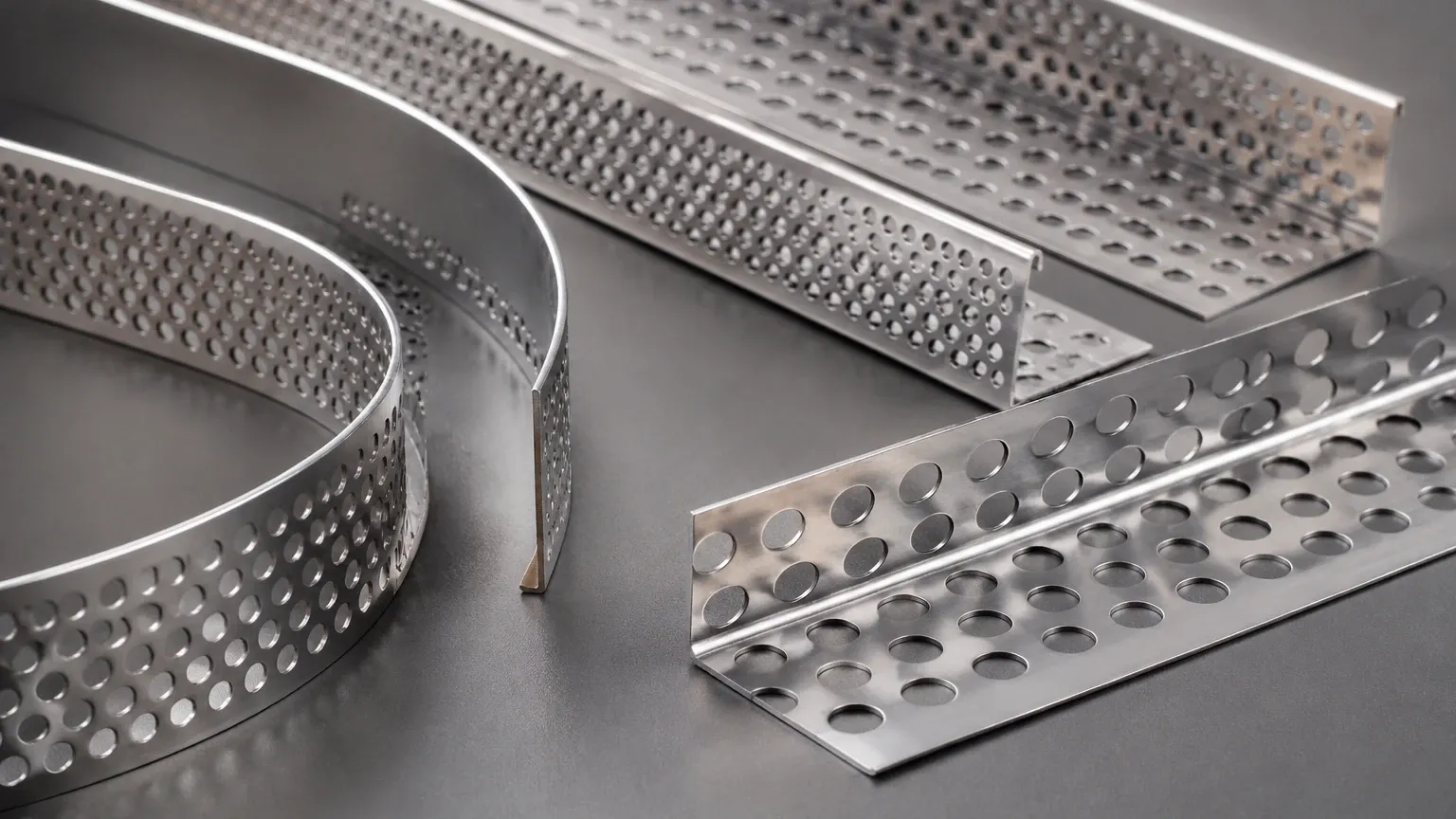
U-binding involves fitting a U-shaped metal strip over the edge of the perforated or expanded metal and spot-welding it into place. This serves three purposes: it covers sharp edges, significantly increases the stiffness of the panel, and provides a uniform thickness for mounting. This is common in architectural screens and heavy-duty industrial guards.
Welded Angle or Flat Bar Frames
In large-scale filtration systems, such as intake screens for water treatment, the perforated metal is often welded into a frame made of angle iron or flat bar. The perforated metal edging must be precisely calculated to fit within the inner dimensions of the frame to ensure a flush fit and a continuous weld bead.
Selection Criteria: What Engineers Should Confirm
Before finalizing a specification for perforated or expanded metal components, purchasing teams and engineers should confirm the following technical details with their manufacturer:
1. Margin Dimensions: Specify the exact width of the margin on all four sides. Do not assume "standard" margins, as these can vary by machine and sheet size.
2. Hole Realignment: If the sheet is to be rolled into a cylinder, confirm that the pattern will be "matched" at the seam to avoid a solid vertical strip that could disrupt flow or create a weak point.
3. Tolerances: Edging dimensions are subject to manufacturing tolerances. For precision filtration, specify if +/- 0.5mm or tighter tolerances are required for the unperforated borders.
4. Burr Direction: In the punching process, one side of the edge will have a slight burr. For applications involving delicate filter membranes or high-velocity flow, the direction of this burr (or its complete removal) must be specified.
5. Total Cost of Ownership: While a "no margin" sheet may have a lower initial material cost, the added labor for deburring or the risk of assembly failure often makes a custom-margined sheet more cost-effective in the long run.
Conclusion
Perforated metal edging is a fundamental aspect of industrial component design that directly impacts the performance, safety, and longevity of filtration systems. By moving beyond generic specifications and focusing on the technical requirements of the edge—such as margin width, material integrity, and welding compatibility—engineers can ensure that their Perforated & Expanded Metal solutions meet the rigorous demands of modern industrial processing.
As a professional manufacturer, Kaifil provides the technical expertise and OEM capabilities necessary to deliver customized filtration components with precision-engineered edging. Whether your application involves chemical processing, hydraulic systems, or food and beverage production, selecting the right edge configuration is the first step toward a reliable and efficient filtration solution.
