


Perforated Metal Enclosure
In the landscape of industrial engineering and filtration, a perforated metal enclosure serves as a critical structural and functional component. These enclosures are designed to provide a balance between mechanical protection, airflow, and fluid permeability. For engineers and procurement specialists, selecting the right enclosure involves a deep understanding of material properties, geometric configurations, and the specific demands of the operating environment. Whether utilized as a protective housing for sensitive electronics, a support structure for fine wire mesh filters, or a primary guard in heavy machinery, the technical specifications of the perforated metal determine the system's overall efficiency and longevity.
At its core, a perforated metal enclosure is a sheet of metal—typically stainless steel—that has been mechanically punched or laser-cut to create a pattern of holes. This process transforms a solid plate into a versatile medium capable of managing sound, light, air, and liquid. Within the context of Kaifil’s manufacturing expertise, these components are engineered to meet the rigorous standards of industries ranging from chemical processing to food and beverage production.
Engineering Specifications: Material Selection and Durability
The performance of a perforated metal enclosure begins with material selection. In industrial filtration and protective applications, the choice of alloy is dictated by the chemical composition of the fluids involved and the atmospheric conditions of the site.
Stainless Steel 304 vs. 316
Stainless steel is the industry standard due to its inherent strength and resistance to oxidation.
* Grade 304: This is the most common grade used for general industrial enclosures. It offers excellent formability and welding characteristics. It is suitable for applications where the enclosure is exposed to fresh water or standard atmospheric conditions.
* Grade 316/316L: For more demanding environments, such as chemical processing plants or marine applications, Grade 316 is preferred. The addition of molybdenum enhances resistance to chloride-induced pitting and crevice corrosion. In filtration systems where the enclosure acts as a support cage for acidic or high-salinity fluids, 316L (low carbon) is often specified to prevent carbide precipitation during welding.
Specialty Alloys and Coatings
Beyond standard stainless steel, certain applications may require duplex stainless steels for higher tensile strength or specialized coatings like powder coating or galvanization to provide an extra layer of barrier protection. However, in high-purity industries like pharmaceuticals, a raw, passivated stainless steel surface is usually required to ensure no contaminants are introduced into the process stream.
Design Parameters: Hole Patterns and Open Area Calculations
The functional utility of a perforated metal enclosure is defined by its "open area." This is the percentage of the sheet that is occupied by holes versus solid metal. Engineers must calculate this carefully to ensure that the enclosure does not create an excessive pressure drop in filtration systems or impede necessary airflow in cooling applications.
Common Hole Patterns
1. Round Holes: The most popular and economical choice. Round holes provide the best structural integrity and are available in staggered or straight configurations. Staggered patterns (usually at 60 degrees) maximize the open area while maintaining the strength of the metal bridges between holes.
2. Square Holes: Often selected for aesthetic reasons or when a higher open area is required for maximum visibility or airflow. However, square holes can create stress concentrations at the corners, making them less ideal for high-pressure environments compared to round holes.
3. Slotted Holes: These are typically used for specific screening and sorting applications where elongated particles must be filtered or retained.
Calculating Open Area
For a standard 60-degree staggered round hole pattern, the open area percentage is calculated using the formula:
Open Area % = (D² × 90.69) / P²
Where D is the hole diameter and P is the center-to-center pitch. A higher open area reduces the weight of the enclosure and increases permeability but decreases the mechanical load-bearing capacity. Finding the "sweet spot" is a primary task for the design engineer.
Perforated vs. Expanded Metal: Choosing the Right Substrate
When specifying a Perforated & Expanded Metal solution, it is vital to distinguish between the two manufacturing methods, as they offer different physical properties for an enclosure.
Perforated Metal Characteristics
Perforated metal is created by removing material. This allows for extremely precise hole sizes and placements. It is the preferred choice for filtration enclosures where a specific micron rating or exact flow rate is required. The margins (the unperforated areas at the edges of the sheet) can be customized to facilitate easier welding and assembly into a final enclosure shape.
Expanded Metal Characteristics
Expanded metal is produced by slitting and stretching a single sheet of metal simultaneously. This process creates diamond-shaped openings. Because no material is lost during production, it is often more cost-effective. Expanded metal is exceptionally strong and rigid because the strands and bonds are set at a sharp angle. For heavy-duty protective enclosures where high-impact resistance is more important than precise filtration, expanded metal is frequently the superior option.
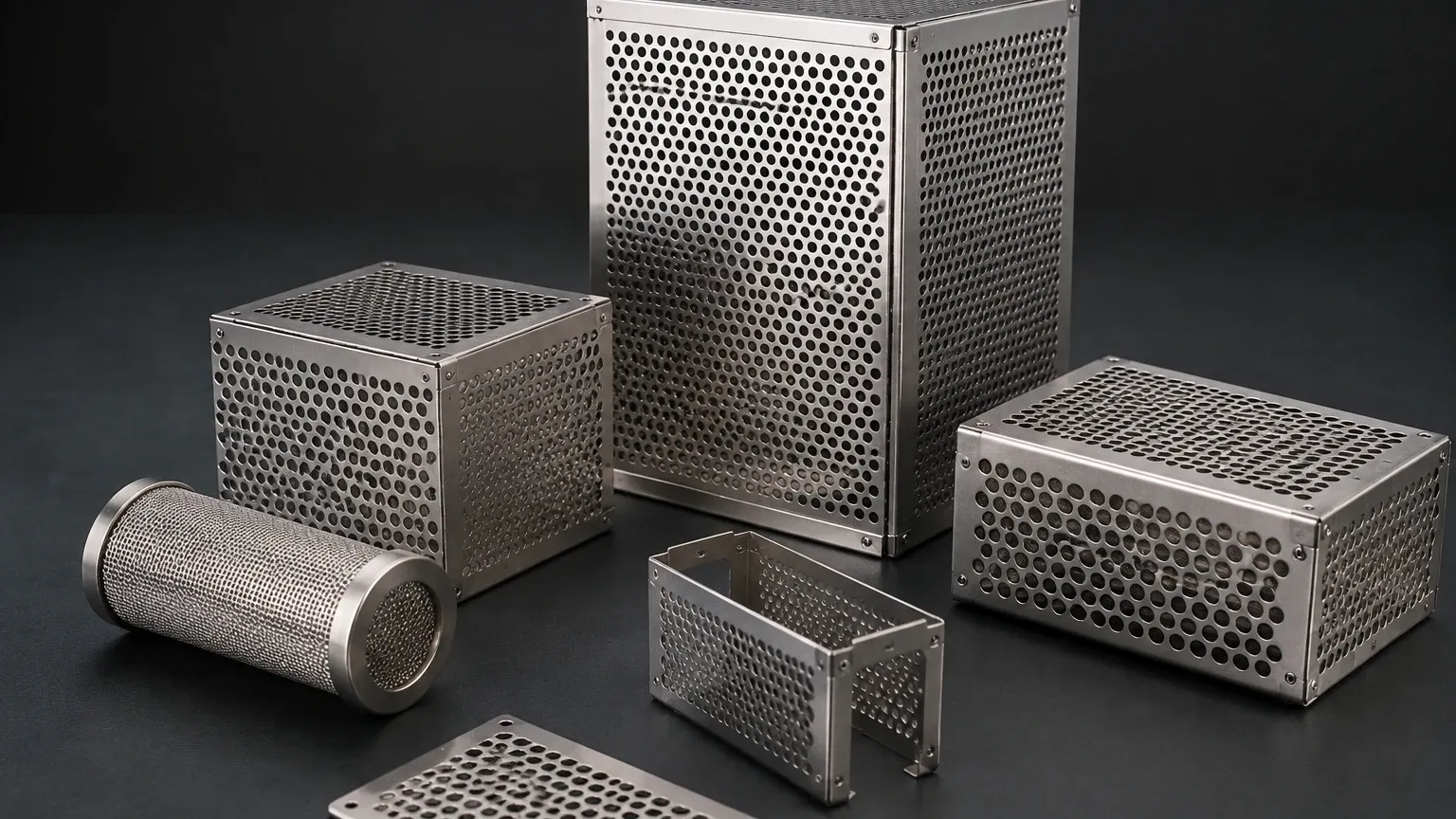
Key Applications for a Perforated Metal Enclosure
Because of its versatility, the perforated metal enclosure is found in nearly every sector of modern industry. Its role varies depending on the specific needs of the equipment it protects or the fluid it filters.
Industrial Filtration and Strainers
In many hydraulic and water treatment systems, a perforated enclosure acts as a "pre-filter" or a support basket. It protects finer, more delicate filter media (like wire mesh or pleated paper) from being crushed by high-pressure flow. In large-scale industrial strainers, the perforated enclosure itself may serve as the primary filter for removing large debris from cooling water or process chemicals.
Electronic and Electrical Housing
For power supplies, servers, and industrial control panels, heat dissipation is a primary concern. A perforated metal enclosure allows for continuous passive or active airflow while providing an EMI/RFI (Electromagnetic Interference/Radio Frequency Interference) shield. The metal structure protects internal components from physical damage and prevents unauthorized access to high-voltage areas while ensuring the electronics do not overheat.
Acoustic Dampening and Machinery Guarding
In manufacturing plants, noise pollution is a significant safety concern. Perforated metal panels are used in enclosures for loud machinery, such as compressors or generators. When combined with acoustic insulation materials, the perforated surface allows sound waves to pass through and be absorbed by the insulation rather than bouncing off a solid metal wall. Additionally, these enclosures serve as safety guards, preventing workers from coming into contact with moving parts while still allowing for visual inspection.
Customization and OEM Capabilities in Manufacturing
A standard off-the-shelf solution rarely meets the exacting requirements of complex industrial systems. This is where custom manufacturing and OEM (Original Equipment Manufacturer) capabilities become essential. A professional manufacturer like Kaifil works with engineers to provide tailored solutions that go beyond simple hole punching.
Secondary Fabrication Processes
To transform a perforated sheet into a functional enclosure, several secondary processes are typically required:
* Forming and Bending: Precision CNC bending ensures that the enclosure fits perfectly within the designated space of the machine or filtration housing.
* Welding: TIG, MIG, or spot welding is used to join the seams. For stainless steel enclosures, specialized welding techniques are required to maintain the corrosion resistance of the material at the weld points.
* Finishing: Processes such as deburring (to remove sharp edges), pickling, and passivation (to restore the chromium oxide layer on stainless steel) are critical for safety and longevity.
Precision and Tolerances
In high-performance applications, tolerances are tight. Engineers must specify the allowable variance in hole diameter, pitch, and overall dimensions. Advanced manufacturing facilities use high-speed presses and laser cutting technology to ensure that every enclosure meets the specified CAD drawings with sub-millimeter accuracy.
Technical Checklist for Engineers and Purchasing Teams
Before initiating a procurement request for a perforated metal enclosure, technical professionals should confirm several key variables to ensure the final product is fit for purpose and cost-effective.
1. Environment Compatibility: Will the enclosure be exposed to caustic chemicals, high temperatures, or high-pressure steam? This dictates the alloy (e.g., 304 vs 316L).
2. Flow Requirements: What is the required open area percentage? If the enclosure is part of a filtration system, what is the maximum allowable pressure drop?
3. Mechanical Load: Does the enclosure need to support its own weight, or will it be subjected to external pressure or impact? This determines the thickness (gauge) of the metal and the choice between perforated and expanded metal.
4. Edge and Margin Specifications: Do you require "safe edges" (unperforated borders) for handling or welding? Specify the width of these margins clearly in the design phase.
5. Regulatory Compliance: Does the enclosure need to meet specific industry standards, such as FDA requirements for food contact or ISO standards for industrial quality management?
6. Total Cost of Ownership: While a cheaper material or thinner gauge might reduce initial costs, it may lead to frequent replacements. Consider the lifespan of the component in its intended environment to calculate the true value.
By addressing these factors during the design and selection phase, engineers can ensure that the perforated metal enclosure provides reliable service, optimizes system performance, and minimizes maintenance downtime. As a specialized manufacturer, Kaifil provides the technical support and manufacturing precision necessary to turn these specifications into high-performance filtration and protective components.
