


Expanded Metal for Trailer Ramp
In the realm of industrial logistics and transport equipment, the selection of surfacing materials for ramps is a critical engineering decision. The material must provide a balance of structural integrity, user safety, and long-term durability under varying environmental conditions. For many engineers and fleet managers, expanded metal for trailer ramp applications has become the standard due to its unique mechanical properties and cost-effectiveness.
Unlike traditional solid plating or perforated sheets, expanded metal is manufactured by simultaneously slitting and stretching a single sheet of metal. This process creates a diamond-shaped pattern of openings, which are integral to the sheet's strength. When specifying Perforated & Expanded Metal for heavy-duty ramps, understanding the technical nuances of the manufacturing process and material behavior is essential for ensuring safety and performance.
Engineering Fundamentals of Expanded Metal for Trailer Ramps
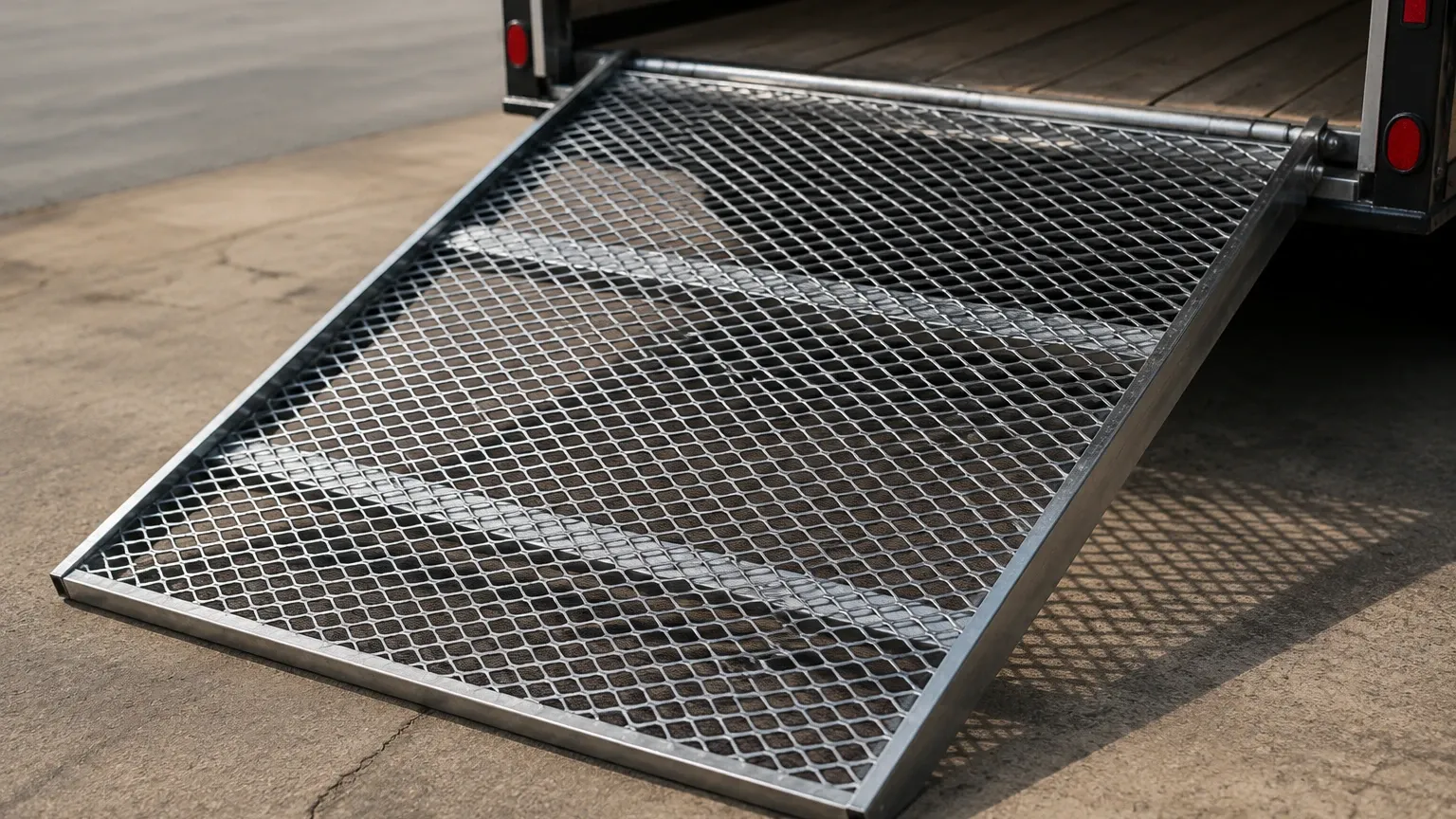
The utility of expanded metal for trailer ramp construction lies in its geometry. The expansion process produces "strands" and "bonds" that are set at an angle to the original plane of the sheet. This creates a three-dimensional surface that offers inherent advantages for traction and drainage.
Raised vs. Flattened Expanded Metal
For trailer ramps, the primary choice is between "raised" (also known as standard) and "flattened" expanded metal.
* Raised Expanded Metal: This is the product as it comes off the expanding machine. The strands and bonds are set at a uniform angle, providing a high-friction surface. In ramp applications, this raised profile is almost always preferred because it offers multi-directional grip for tires, footwear, and equipment treads.
* Flattened Expanded Metal: This is raised expanded metal that has been cold-rolled through a mill to flatten the strands and bonds back into a single plane. While this creates a smoother surface, it significantly reduces the traction capabilities required for inclined ramps. Flattened metal is generally reserved for decorative or filtration applications where a flush surface is required.
Key Dimensional Terminology
When communicating with manufacturers like Kaifil, engineers must use precise terminology to ensure the delivered product meets the load-bearing requirements:
* SWD (Short Way of Diamond): The distance from the center of one bond to the center of the next bond across the short axis of the diamond.
* LWD (Long Way of Diamond): The distance across the long axis of the diamond.
* Strand Thickness: The thickness of the base metal used.
* Strand Width: The amount of metal fed into the machine for each slit.
For trailer ramps, the orientation of the SWD and LWD is critical. To maximize strength, the LWD should typically run perpendicular to the direction of travel, or the SWD should be supported by frequent cross-members to prevent sagging.
Material Selection: Balancing Durability and Environment
Kaifil specializes in stainless steel solutions, and while carbon steel is common for general-purpose ramps, stainless steel offers distinct advantages in specific industrial contexts. The choice of material directly impacts the total cost of ownership and the replacement cycle of the ramp.
Stainless Steel (304 and 316 Grades)
In industries such as food processing, pharmaceutical transport, or marine logistics, stainless steel expanded metal for trailer ramp use is often mandatory.
* Corrosion Resistance: Stainless steel does not require galvanization or painting to resist rust. In environments where ramps are exposed to salt, chemicals, or frequent wash-downs, Grade 304 or Grade 316 stainless steel ensures the structural integrity of the ramp remains uncompromised over decades.
* Hygiene: For food-grade trailers, stainless steel is non-porous and easy to sanitize, preventing the buildup of organic contaminants within the mesh.
* Strength-to-Weight Ratio: Stainless steel provides high tensile strength, allowing for thinner gauges to be used without sacrificing the load-bearing capacity of the ramp.
Carbon Steel and Galvanized Options
For standard dry-van trailers or equipment haulers, carbon steel is a frequent choice due to its lower initial material cost. However, it requires a protective coating—typically hot-dip galvanization—to prevent oxidation. Engineers must account for the fact that the expansion process creates many sharp edges and crevices where coatings may fail over time, making stainless steel a more reliable long-term investment for demanding environments.
Structural Integrity: Load-Bearing and Support Spans
One of the most common mistakes in specifying expanded metal for trailer ramp applications is underestimating the deflection under concentrated loads. Unlike a solid plate, expanded metal distributes weight through its interconnected bonds.
Calculating Load Requirements
Engineers must determine the maximum point load, which is usually the weight of the heaviest piece of equipment (e.g., a forklift, pallet jack, or vehicle) divided by the number of wheels in contact with the ramp at any given time.
* Concentrated Load vs. Uniform Load: Trailer ramps are rarely subjected to uniform loads. Instead, they face high-pressure concentrated loads. The gauge of the expanded metal must be thick enough to prevent the strands from bending or "dishing" under the wheel.
* Support Spans: Expanded metal is not a self-supporting structural member over long distances. It must be welded to a frame, usually consisting of C-channel or angle iron. The spacing between these cross-members (the support span) is the most critical factor in preventing ramp failure. For heavy equipment, support spans are often placed every 8 to 12 inches.
The Importance of Bond Integrity
In high-performance filtration and industrial metal components, the integrity of the bond—where the strands meet—is paramount. If the expansion process is not precisely controlled, the bonds can become stress points that crack under repeated loading. Kaifil’s manufacturing expertise ensures that the Perforated & Expanded Metal maintains uniform bond strength, which is vital for the cyclic loading experienced by trailer ramps.
Safety and Traction: The Functional Advantage of Raised Mesh
The primary reason for choosing expanded metal over other materials for trailer ramps is safety. Slip-and-fall accidents and equipment sliding off ramps are significant liabilities in industrial settings.
Multi-Directional Grip
The angular orientation of the strands in raised expanded metal provides grip in multiple directions. This is particularly important when ramps are inclined at steep angles or when they become wet or oily. The "teeth" of the expanded metal bite into rubber tires and boot soles, providing a level of traction that cannot be replicated by anti-slip coatings on flat metal.
Debris and Fluid Management
Trailer ramps are often used outdoors or in loading docks where they are exposed to rain, snow, mud, and oil.
* Self-Cleaning Properties: The open area of the expanded metal (often ranging from 40% to 70%) allows debris to fall through the ramp rather than accumulating on the surface. This prevents the formation of slick layers that could cause loss of traction.
* Wind Resistance: For ramps that remain attached to the trailer during transit (such as fold-up ramps), the open mesh design reduces wind resistance, which can improve fuel efficiency and reduce the strain on the ramp’s mounting hardware.
Installation and Technical Integration
Proper installation is as important as material selection. When integrating expanded metal for trailer ramp surfaces, several engineering considerations must be addressed during the fabrication process.
Welding and Attachment
Expanded metal should be tack-welded to the supporting frame at every second or third bond along the perimeter and at every bond along the cross-members. Because the strands are thin compared to the structural frame, welders must exercise care to avoid "burning through" the mesh. In stainless steel applications, using the correct filler metal is essential to maintain the corrosion resistance of the weld joints.
Edge Protection
The edges of expanded metal are naturally sharp due to the slitting process. For trailer ramps, these edges should be recessed into the frame or covered with a "U-edging" or flat bar trim. This protects the tires of the equipment being loaded and prevents injury to personnel handling the ramp.
Orientation for Strength
As noted previously, the orientation of the diamonds matters. For maximum rigidity, the LWD (Long Way of Diamond) should run across the width of the ramp (perpendicular to the side rails), while the SWD (Short Way of Diamond) runs the length of the ramp. This orientation allows the strands to act as small trusses, providing the greatest resistance to bending.
Procurement Checklist: Confirming Specifications
Before finalizing a purchase order for expanded metal for trailer ramp projects, purchasing teams and engineers should confirm the following technical details with their supplier:
1. Material Grade: Is the specific alloy (e.g., SS304 vs. SS316) appropriate for the operating environment?
2. Style Designation: Is the requirement for "Raised" or "Flattened"? (Ensure "Raised" is specified for ramps).
3. Gauge and Strand Dimensions: Does the strand width and thickness meet the calculated point-load requirements?
4. Open Area Percentage: Is the open area sufficient for drainage without compromising the contact surface area for small-wheeled equipment?
5. Sheet Dimensions and Orientation: Are the sheets cut so that the LWD and SWD are oriented correctly for the frame design?
6. Tolerances: What are the allowable variances in sheet flatness and diamond uniformity?
Conclusion
Expanded metal for trailer ramp applications offers a sophisticated solution to the challenges of traction, weight, and durability. By selecting the appropriate Perforated & Expanded Metal specifications, engineers can design ramps that withstand the rigors of industrial use while ensuring the safety of personnel and the security of cargo.
Whether the application involves a lightweight utility trailer or a heavy-duty chemical transport vehicle, the technical performance of the mesh depends on precise manufacturing and informed material selection. Kaifil’s commitment to quality and engineering precision provides the foundation for reliable filtration and structural components that meet these demanding industrial standards. By focusing on the mechanical properties of the diamond mesh and the environmental requirements of the application, B2B buyers can optimize their equipment for long-term performance and safety.
