


Food Grade Expanded Metal
In the rigorous environment of food and beverage processing, the selection of materials for filtration, screening, and structural support is a critical engineering decision. Food grade expanded metal represents a specialized category of industrial materials designed to meet stringent hygiene standards while providing mechanical strength and efficient flow characteristics. Unlike standard industrial meshes, food-grade variants must adhere to specific metallurgical compositions and surface finish requirements to prevent contamination and ensure the safety of the final product.
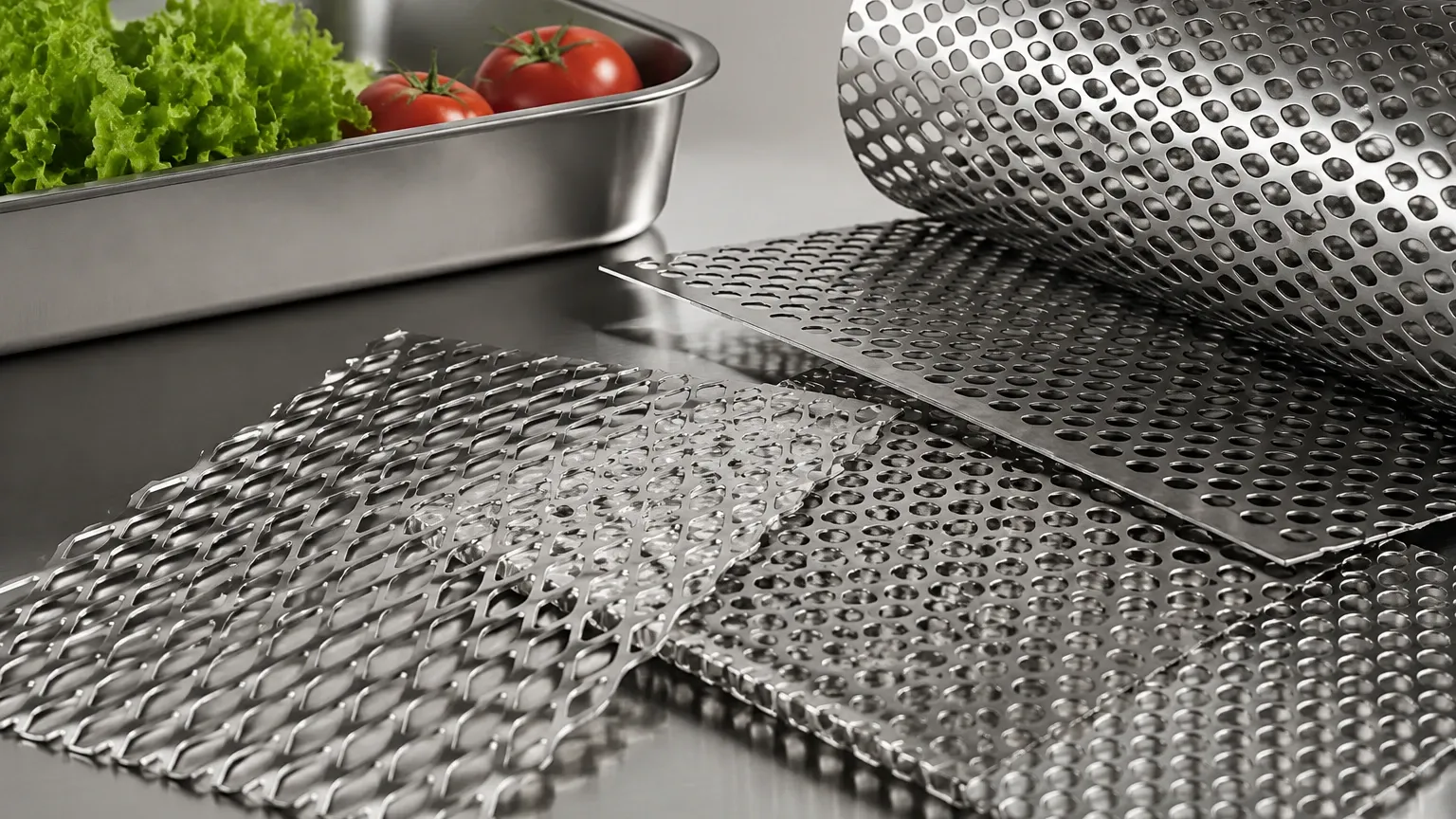
At its core, expanded metal is produced by simultaneously slitting and stretching a solid metal sheet, creating a diamond-shaped pattern of openings. This process involves no waste, as the material is expanded rather than punched, resulting in a high strength-to-weight ratio. For food-centric applications, this material must be engineered to withstand corrosive cleaning agents, high-temperature sterilization, and constant mechanical stress without shedding particles or harboring bacterial growth.
Material Science: Why Stainless Steel Dominates Food Grade Applications
The primary requirement for any material in contact with food is non-reactivity. For this reason, stainless steel is the industry standard for food grade expanded metal. While various alloys exist, the food processing industry relies almost exclusively on the 300-series austenitic stainless steels.
Grade 304 Stainless Steel
Grade 304 is the most common choice for general food processing equipment. It contains approximately 18% chromium and 8% nickel, providing excellent resistance to oxidation and corrosion from most organic acids and many industrial chemicals. In applications such as fruit and vegetable washing or grain screening, 304 stainless steel offers a cost-effective balance of durability and hygiene.
Grade 316/316L Stainless Steel
For more demanding environments, particularly those involving high salt concentrations, acidic marinades, or aggressive chemical cleaning cycles, Grade 316 is preferred. The addition of 2% to 3% molybdenum significantly enhances its resistance to pitting and crevice corrosion. 316L (the low-carbon version) is often specified for components that require welding, as it minimizes carbide precipitation that can lead to intergranular corrosion. Engineers must evaluate the specific chemical profile of the food products and cleaning agents used to determine if the upgrade to 316 is necessary for the long-term integrity of the Perforated & Expanded Metal components.
The Manufacturing Advantage of Expanded Metal Over Perforated Sheets
When choosing between different types of metal screens, engineers often compare expanded metal with perforated metal. While both fall under the umbrella of Perforated & Expanded Metal solutions, expanded metal offers several unique advantages in a food processing context.
1. Structural Integrity: Because expanded metal is made from a single piece of material, the "bonds" (the intersections of the diamonds) are part of the original metal. This makes the structure inherently stronger than woven wire mesh, which can fray or unravel, and often more rigid than perforated sheets of the same weight.
2. Material Efficiency: The expansion process generates zero scrap. In contrast, perforated metal involves punching out holes, which can result in up to 40% to 60% material waste. This efficiency often translates to a lower total cost for high-grade alloys like SS316.
3. Three-Dimensional Geometry: Standard expanded metal has a slightly raised profile where the strands are angled. This creates a 3D surface that can be beneficial for certain applications, such as allowing air to circulate under products on a drying tray or facilitating the drainage of fats and liquids during cooking or cooling processes.
Surface Finish and Hygiene: Achieving Food Grade Compliance
The most critical factor in transforming industrial expanded metal into food grade expanded metal is the surface treatment. In food processing, any microscopic pit, crack, or burr can become a breeding ground for bacteria (biofilm). Standard industrial expansion processes can leave sharp edges and microscopic surface irregularities that are unacceptable in a sanitary environment.
Deburring and Smoothing
Mechanical deburring is the first step to ensure there are no sharp edges that could tear gloves, injure workers, or, more importantly, break off into the food supply. For food-grade applications, the material must be processed to ensure all edges are smooth and radiused.
Electropolishing and Pickling
To achieve the required "sanitary finish," the metal often undergoes electropolishing. This electrochemical process removes a fine layer of surface material, including microscopic peaks and valleys. The result is a mirror-like, ultra-smooth finish that is much easier to clean and significantly more resistant to corrosion. Pickling, or chemical descaling, is also used to remove impurities and heat tint from welding, ensuring a pure chromium oxide layer for maximum passivity.
Roughness Average (Ra) Requirements
Engineers often specify a maximum Ra value for food contact surfaces. A lower Ra value indicates a smoother surface. For many high-hygiene applications, an Ra of 0.8 μm (32 micro-inches) or less is required. Confirming the surface finish capability of the manufacturer is a vital step in the procurement process.
Engineering Specifications: Open Area, Airflow, and Structural Integrity
Selecting the right food grade expanded metal requires a precise understanding of technical specifications. The performance of the filter or screen depends on the geometry of the diamond pattern.
* LWD and SWD: These stand for Long Way of Diamond and Short Way of Diamond. They measure the distance from the center of one bond to the center of the next. These dimensions determine the size of the particles that will be retained or passed through the screen.
* Strand Width and Thickness: These parameters dictate the strength and the open area percentage. A wider strand increases the weight and load-bearing capacity but reduces the open area.
* Percentage of Open Area: This is a critical calculation for engineers designing drying systems, fryers, or cooling tunnels. It determines the volume of air or liquid that can pass through the screen at a given pressure. Unlike perforated metal, where the open area is straightforward to calculate, expanded metal calculations must account for the angle of the strands if the material is not flattened.
Flattened vs. Raised Expanded Metal
Expanded metal can be supplied in its "raised" state or "flattened." Flattened expanded metal is passed through a cold-rolling mill, which levels the strands and bonds to the same plane as the original sheet. For food processing, flattened expanded metal is often preferred because it provides a smooth, consistent surface for conveyor belts or trays, making it easier to clean and preventing the product from sticking in the angled crevices of a raised mesh.
Industrial Applications in Food and Beverage Processing
The versatility of food grade expanded metal allows it to be used across various stages of production, from raw material handling to final packaging.
Drying and Dehydration
In industrial dehydrators, expanded metal trays allow for maximum airflow around the product. The 3D structure of raised expanded metal can prevent flat products (like sliced fruits or jerky) from sticking to the tray surface, significantly improving drying efficiency and product quality.
Filtration and Separation
Stainless steel expanded metal serves as a robust support structure for finer filter media or as a primary coarse filter in beverage production. In brewing or juice extraction, it is used to separate solids from liquids, where its rigidity ensures the filter element does not collapse under high pressure or flow rates.
Smoking and Cooking Racks
In the meat processing industry, expanded metal is used for smoking racks and oven trolleys. Its ability to withstand high temperatures and frequent high-pressure washdowns makes it superior to many plastic or lower-grade metal alternatives.
Protective Guarding
Beyond direct food contact, food-grade expanded metal is used for safety guards on machinery. Because it allows for visibility and ventilation while preventing physical access to moving parts, it is an essential component of a safe, hygienic production floor. Unlike solid guards, expanded metal guards do not trap heat or moisture, reducing the risk of mold growth in damp environments.
Maintenance, Sterilization, and Long-Term Performance
The total cost of ownership for filtration and screening components is heavily influenced by their maintenance requirements and lifespan. Food grade expanded metal is engineered for longevity in harsh environments.
Clean-in-Place (CIP) Compatibility
Modern food processing facilities rely on CIP systems to sanitize equipment without disassembly. Expanded metal components must be designed to ensure there are no "dead zones" where cleaning fluids cannot reach. The open nature of the diamond pattern, especially when properly deburred and electropolished, facilitates excellent drainage and exposure to sanitizing chemicals.
Sterilization Cycles
Whether using steam (autoclaving), hot water, or chemical sterilants like peracetic acid or chlorine dioxide, stainless steel expanded metal maintains its structural integrity. It does not become brittle at low temperatures (for freezing applications) or lose strength at high temperatures (for baking or frying).
Replacement Cycles
While highly durable, expanded metal components should be inspected regularly for mechanical wear, such as cracked bonds or thinning strands. In high-vibration environments, such as vibratory separators, fatigue can eventually lead to failure. Choosing the correct gauge and strand width during the design phase can significantly extend the replacement cycle, reducing downtime and maintenance labor costs.
Selection Criteria: What Engineers Should Confirm Before Procurement
When sourcing food grade expanded metal, purchasing teams and engineers should move beyond basic dimensions and focus on the technical details that ensure compliance and performance. Before taking the next step, confirm the following with your manufacturer:
1. Alloy Certification: Request Mill Test Reports (MTRs) to verify the chemical composition of the stainless steel (e.g., confirming it is true 316L rather than a lower-grade substitute).
2. Regulatory Compliance: Ensure the material and the manufacturing process meet relevant standards, such as FDA 21 CFR 177.2600 or EU 1935/2004, depending on the target region.
3. Surface Finish Specification: Define the required Ra value and the preferred finishing method (e.g., electropolishing vs. mechanical polishing).
4. Load Requirements: For trays or walkways, provide the expected weight load to ensure the strand thickness and LWD/SWD orientation are optimized for structural stability.
5. Customization Options: Discuss the need for custom framing, specialized shapes, or integrated mounting points. A manufacturer specializing in Perforated & Expanded Metal can often provide a more integrated solution than a general metal supplier.
By focusing on these technical parameters, industrial professionals can ensure that their choice of food grade expanded metal provides the necessary safety, efficiency, and durability required for modern food and beverage processing operations.
