


Expanded Metal Gauge Chart
In industrial manufacturing and filtration engineering, precision is the primary driver of performance. When selecting materials for structural support, protective screening, or filtration substrates, the expanded metal gauge chart serves as a critical technical reference. Understanding the relationship between metal thickness, diamond dimensions, and open area percentages is essential for engineers who must balance mechanical strength with fluid dynamics.
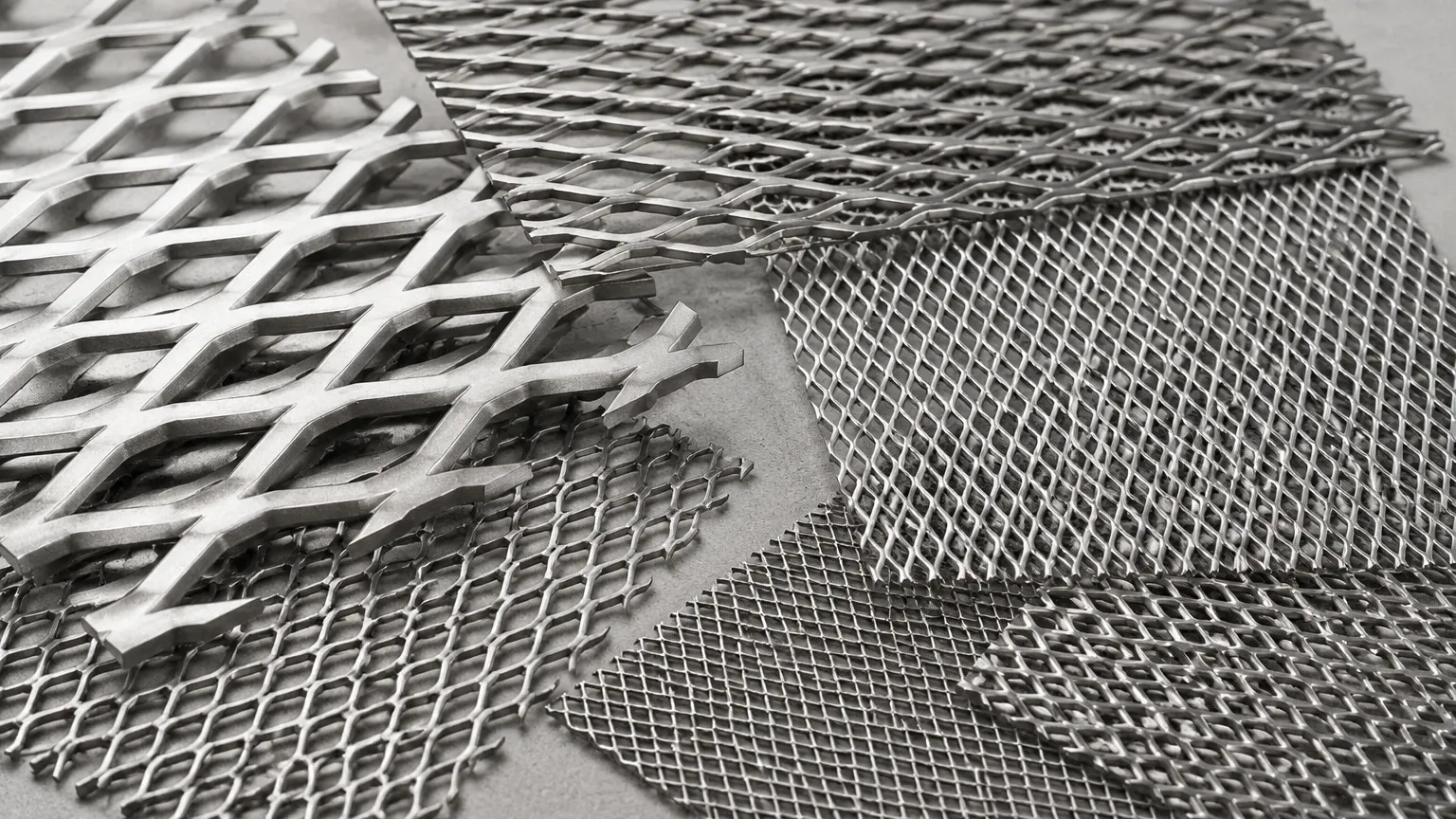
Expanded metal is produced by simultaneously slitting and stretching a solid sheet of metal. This process creates a continuous piece of material without welds or joints, resulting in a high strength-to-weight ratio. For B2B procurement and engineering teams, navigating the specifications within an expanded metal gauge chart is the first step in ensuring that the final component—whether a support cage for a filter cartridge or a heavy-duty industrial grate—meets the rigorous demands of the application.
Understanding the Fundamentals of Expanded Metal Specifications
To effectively use an expanded metal gauge chart, one must first master the specific terminology used by manufacturers like Kaifil. Unlike standard wire mesh, expanded metal is defined by the geometry of its "diamonds" and the thickness of the strands.
SWD and LWD
* SWD (Short Way of Diamond): This refers to the distance from the center of one bond to the center of the next bond, measured across the short axis of the diamond.
* LWD (Long Way of Diamond): This is the distance measured across the long axis of the diamond, from bond center to bond center.
These dimensions determine the size of the openings. In filtration applications, the SWD is often the more critical dimension as it dictates the maximum particle size that can pass through the mesh or the level of support provided to a finer filter media layered over the Perforated & Expanded Metal.
Strand Width and Thickness
* Strand Thickness: This is the thickness of the base metal used to produce the expanded sheet. This is the value typically found in the "gauge" column of a chart.
* Strand Width: This is the amount of metal fed into the precision dies between each stroke of the expansion press.
By manipulating the strand width and the degree of expansion, manufacturers can create a wide variety of open area percentages using the same base gauge of metal. This flexibility is a key advantage for custom OEM filtration solutions.
How to Use an Expanded Metal Gauge Chart
An expanded metal gauge chart typically lists products by their "Style Designation." A common designation might look like "1/2#18." In this nomenclature, the first number (1/2") refers to the nominal SWD dimension, while the second number (#18) refers to the gauge of the metal.
When reviewing a chart for technical selection, engineers should focus on the following columns:
1. Weight per Square Foot: Essential for calculating the total load on a filtration system or structural frame.
2. Percent Open Area: A critical metric for hydraulic and chemical processing. If the open area is too low, the pressure drop across the filter will be too high. If it is too high, the material may lack the structural integrity to withstand high-pressure flows.
3. Overall Thickness: In "Standard" (raised) expanded metal, the overall thickness is significantly greater than the strand thickness because the strands are turned at an angle to the original plane of the sheet.
Representative Gauge Values
| Gauge (Carbon or Stainless) | Nominal Thickness (Inches) | Metric Equivalent (mm) |
| :— | :— | :— |
| 9 Gauge | 0.149" | 3.78 mm |
| 13 Gauge | 0.092" | 2.34 mm |
| 16 Gauge | 0.059" | 1.50 mm |
| 18 Gauge | 0.048" | 1.21 mm |
| 20 Gauge | 0.036" | 0.91 mm |
| 22 Gauge | 0.030" | 0.76 mm |
It is important to note that stainless steel gauges may vary slightly from carbon steel gauges in their decimal equivalents. When specifying for precision filtration components, always confirm the exact decimal thickness with the manufacturer.
Standard vs. Flattened Expanded Metal: Technical Differences
One of the most important decisions an engineer must make when consulting an expanded metal gauge chart is whether to specify "Standard" or "Flattened" material. This choice affects both the physical dimensions and the performance characteristics of the component.
Standard Expanded Metal
Standard expanded metal, also known as "raised" expanded metal, comes off the machine with the strands and bonds set at a sharp angle to the plane of the sheet. This creates a three-dimensional surface that offers:
* High Rigidity: The angled strands act like structural beams, providing excellent resistance to bending.
* Enhanced Grip: The raised edges are ideal for applications requiring high friction or mechanical interlocking.
* Directional Flow: The angled openings can be used to deflect fluid or air flow in specific directions within a housing.
Flattened Expanded Metal
Flattened expanded metal is produced by passing the standard expanded sheet through a cold-rolling reducing mill. This process flattens the strands and bonds back into a single plane. The technical implications of flattening include:
* Reduced Thickness: The overall thickness of the sheet is reduced, often to within 5-10% of the original strand thickness.
* Smooth Surface: This is vital for filtration applications where the expanded metal serves as a support for delicate wire mesh or synthetic membranes. A raised surface could puncture or abrade the finer media.
* Increased LWD: The rolling process slightly elongates the diamond pattern in the long direction.
Material Selection and Its Impact on Gauge Performance
While the expanded metal gauge chart provides the dimensions, the material choice dictates the environmental limits of the part. In the B2B industrial sector, stainless steel is the gold standard for filtration and chemical processing.
Stainless Steel 304 vs. 316
* Type 304: The most common grade, offering excellent corrosion resistance and formability. It is suitable for most food and beverage or general industrial water treatment applications.
* Type 316: Contains molybdenum, which provides superior resistance to chlorides and pitting. This is the preferred choice for marine environments, pharmaceutical manufacturing, and aggressive chemical processing.
When using thinner gauges (such as 20ga or 22ga) for precision filter cartridges, the inherent strength of stainless steel allows for a lightweight design that does not sacrifice durability. In high-temperature environments, the thermal stability of the selected gauge must be evaluated to prevent warping or structural failure under thermal cycling.
Engineering Considerations for Industrial Filtration Support
In the context of industrial filtration, expanded metal is rarely used as the primary filter media for fine particles. Instead, it functions as a "drainage layer" or a "support pleat." When engineers review an expanded metal gauge chart for these purposes, they must consider the following:
Pressure Drop and Flow Resistance
The percentage of open area is the primary variable here. A 13-gauge expanded metal with a large diamond (e.g., 1-1/2") will have a much higher open area (often 70-80%) than a 20-gauge metal with a micro-diamond pattern. Engineers must calculate the "Face Velocity" of the fluid to ensure the expanded metal does not introduce excessive turbulence or backpressure.
Mechanical Loading
In hydraulic systems, filter elements are often subjected to high differential pressures. The expanded metal must act as a rigid skeleton. If the gauge is too light, the mesh may collapse inward (implosion) or outward (bursting). The gauge chart helps engineers select a thickness that provides a safety factor of at least 3:1 over the maximum expected operating pressure.
Compatibility with Fine Mesh
If the expanded metal is being used to support a 5-micron stainless steel wire mesh, the bond points and strand edges must be free of burrs. Flattened expanded metal is almost always specified in these scenarios to ensure a uniform contact surface, preventing "point loading" on the finer mesh which can lead to premature fatigue failure.
Specifying Custom Dimensions for OEM Applications
Standard charts provide a baseline, but many industrial applications require custom configurations. When working with a manufacturer like Kaifil, B2B buyers should be prepared to confirm several details beyond the gauge chart:
1. Tolerance Requirements: Standard industrial tolerances for expanded metal are typically +/- 1/4" on sheet size, but precision filtration components often require tolerances within +/- 0.010".
2. Edge Configurations: Should the sheet have "random sheared" edges (where diamonds are cut through) or "bond sheared" edges (where the cut follows the solid bond of the metal)? Bond shearing provides a safer, smoother edge for handling and assembly.
3. Surface Finish: For pharmaceutical or food-grade applications, the expanded metal may require electropolishing or ultrasonic cleaning to remove any residual oils from the manufacturing process.
4. Forming Requirements: Will the expanded metal be rolled into a cylinder or welded into a conical shape? The ductility of the gauge and material grade will determine the minimum bend radius without cracking the strands.
Conclusion
The expanded metal gauge chart is more than just a list of thicknesses; it is a roadmap for balancing structural requirements with functional performance. For engineers and purchasing teams, selecting the correct gauge involves a holistic evaluation of the diamond geometry, the material properties of stainless steel, and the specific flow dynamics of the application.
By understanding the nuances between standard and flattened styles and the impact of strand dimensions on open area, professionals can specify components that optimize the lifespan and efficiency of their industrial systems. Whether the goal is to provide a robust support structure for high-pressure hydraulics or a precision-engineered screen for chemical separation, the data found in a gauge chart remains the foundation of successful filtration design.
