


Expanded Metal Hole Size
In industrial filtration and structural engineering, the specification of expanded metal requires a precise understanding of geometry, material behavior, and manufacturing tolerances. Unlike perforated metal, which is created by punching holes and removing material, expanded metal is produced by simultaneously slitting and stretching a solid sheet. This process creates a unique diamond-shaped pattern without any material waste. However, defining the "expanded metal hole size" is more complex than simply stating a diameter. It involves several interdependent dimensions that dictate the material’s filtration efficiency, structural integrity, and flow characteristics.
For engineers and procurement professionals working with Perforated & Expanded Metal, selecting the correct hole size is critical to the performance of the final component, whether it is used as a primary filter medium, a support cage for a filter cartridge, or a protective screen in a chemical processing plant.
Understanding the Geometry of Expanded Metal Openings
To accurately specify expanded metal, one must distinguish between the dimensions of the diamond pattern and the actual clear opening through which fluids or particles pass. In the industry, hole size is typically defined by four primary measurements:
SWD and LWD (Short Way of Design and Long Way of Design)
These measurements refer to the distance from a point on one diamond to the corresponding point on the next diamond, measured across the short and long axes. Specifically, these are center-to-center dimensions. While they define the overall pattern density, they do not represent the actual "hole size" in terms of clearance.
SWO and LWO (Short Way of Opening and Long Way of Opening)
For filtration and separation applications, SWO and LWO are the most critical metrics.
- SWO (Short Way of Opening): The clear distance between the inside edges of the strands across the short axis.
- LWO (Long Way of Opening): The clear distance between the inside edges of the strands across the long axis.
When an engineer discusses expanded metal hole size, they are usually referring to the SWO, as this dimension typically determines the maximum particle size that can pass through the mesh. The relationship between the SWD/LWD and the SWO/LWO is governed by the strand width.
The Impact of Strand Width and Thickness
The strand is the individual metal strip that forms the border of the diamond opening. The dimensions of the strand—specifically the width and the thickness—directly influence the resulting hole size and the overall open area of the sheet.
1. Strand Width: This is the amount of metal fed into the expanding machine between each slit. Increasing the strand width while keeping the SWD constant will decrease the SWO, effectively making the hole size smaller and the material heavier.
2. Strand Thickness: This is the thickness of the original base metal sheet. While it does not change the two-dimensional hole size (SWO/LWO), it significantly affects the three-dimensional depth of the opening and the structural rigidity of the mesh.
In high-pressure hydraulic or chemical filtration, the strand width must be calculated to withstand the differential pressure without deforming, which could otherwise lead to an unintended increase in the expanded metal hole size during operation.
Standard vs. Flattened Expanded Metal: Dimensional Differences
One of the most important decisions in specifying expanded metal is choosing between the "standard" (raised) and "flattened" states. This choice has a direct impact on the effective hole size and flow dynamics.
Standard (Raised) Expanded Metal
In its standard form, the strands are turned at an angle to the plane of the sheet. This creates a three-dimensional profile. While the SWO and LWO might meet the technical requirements, the angled strands create a "louvre" effect. This can be beneficial for directing flow or providing extra grip, but it also means the effective filtration size may vary depending on the angle of approach of the fluid or gas.
Flattened Expanded Metal
Flattened expanded metal is produced by passing the standard expanded sheet through a cold-roll reducing mill. This process flattens the strands back into the same plane as the original sheet. Flattening increases the LWD slightly and can marginally alter the SWO. More importantly, it creates a smooth, two-dimensional surface. For many filtration applications, flattened metal is preferred because it allows for easier cleaning (backwashing) and provides a consistent thickness for integration into filter housings.
Calculating Open Area and Filtration Performance
The percentage of open area is a vital calculation for engineers concerned with flow rates and pressure drops. The open area is the ratio of the area of the openings to the total area of the sheet. Unlike perforated metal, where open area is easily calculated based on hole diameter and pitch, expanded metal calculations must account for the strand width and the angle of the diamond.
A smaller expanded metal hole size generally results in a lower percentage of open area, which increases the pressure drop across the filter. However, because expanded metal strands are interconnected (not joined by welds or weaves), the material maintains exceptional structural integrity even with a high percentage of open area. This makes it an ideal support medium for finer wire mesh layers in multi-stage filter cartridges.
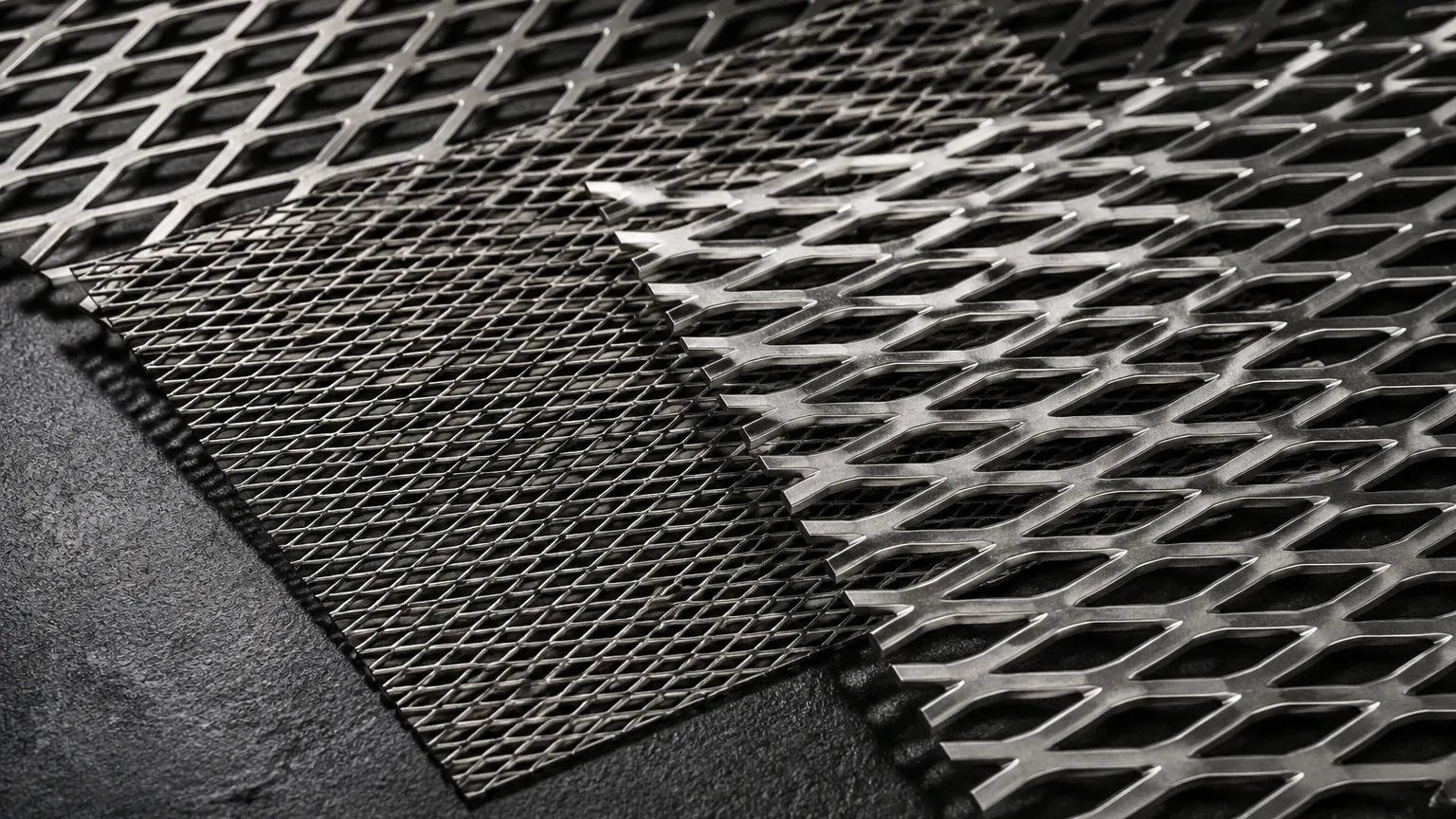
Material Selection and Its Effect on Hole Precision
Kaifil specializes in manufacturing filtration solutions from high-performance materials, primarily stainless steel (304, 316L), but also specialized alloys for extreme environments. The choice of material affects the precision and stability of the hole size:
* Stainless Steel 316L: Preferred for pharmaceutical and food-grade applications due to its corrosion resistance. It maintains precise hole dimensions even when exposed to caustic cleaning agents.
* High-Nickel Alloys: Used in high-temperature chemical processing where thermal expansion could potentially alter the hole size. These alloys ensure that the filtration accuracy remains consistent across a wide temperature range.
* Carbon Steel: Suitable for general industrial use, though it requires coating or galvanization to prevent corrosion from closing the openings over time.
When working with stainless steel, the mechanical properties of the alloy—such as ductility and tensile strength—influence how the metal reacts during the expansion process. High-quality manufacturing ensures that the expansion is uniform across the entire width of the coil, preventing "dead spots" or variations in hole size that could compromise filtration performance.
Engineering Considerations for OEM Customization
When partnering with a manufacturer like Kaifil for custom Perforated & Expanded Metal components, engineers should evaluate several factors beyond just the nominal hole size:
1. Filtration Accuracy vs. Structural Support
Is the expanded metal intended to be the primary filter, or is it a support for a finer mesh? If it is a support layer, the hole size must be large enough to minimize pressure drop but small enough to prevent the fine mesh from "pleating" or collapsing into the openings under pressure.
2. Direction of Flow
In standard (raised) expanded metal, the orientation of the diamonds (LWD vs. SWD) relative to the flow can change the turbulence and the bypass rate. Specifying the "bond" orientation is essential for consistent OEM production.
3. Edge Conditions and Tolerances
Expanded metal can be supplied with "random sheared" edges or "bond sheared" edges. For precision filter cartridges, bond shearing ensures that the edges are consistent, which is critical for welding the mesh into a cylindrical shape without creating gaps that exceed the specified hole size.
4. Total Cost of Ownership
While smaller hole sizes may offer finer filtration, they also require more frequent cleaning or replacement if the material is prone to blinding. Engineers must balance the initial filtration requirement with the expected maintenance cycle and the durability of the material.
Common Industry Applications
The versatility of expanded metal hole sizes allows for its use across a broad spectrum of industrial sectors:
* Chemical Processing: Used in baskets and strainers where resistance to aggressive chemicals and precise particle retention are required.
* Food & Beverage: Flattened stainless steel expanded metal is used in drying trays and filtration screens where hygiene and ease of cleaning are paramount.
* Hydraulic Systems: As a support core for high-pressure hydraulic filters, providing the necessary strength to withstand surges while maintaining flow.
* Water Treatment: Large-scale intake screens utilize expanded metal to prevent debris from entering pump systems while allowing high volumes of water to pass through.
Conclusion: Selecting the Right Specification
Determining the optimal expanded metal hole size is a balance between technical requirements and manufacturing possibilities. Engineers must look beyond the diamond dimensions and consider the SWO, strand geometry, and the final state of the material (standard vs. flattened). By focusing on these technical details, purchasing teams can ensure they receive a product that meets the rigorous demands of industrial filtration.
Kaifil provides comprehensive engineering support to help global customers navigate these choices. From initial material selection to the final design of custom filtration components, our expertise ensures that every specification—from hole size to alloy grade—is optimized for the specific application environment. Whether you require precision stainless steel cartridges or heavy-duty support screens, understanding the nuances of expanded metal geometry is the first step toward achieving efficient and durable filtration performance.
