


How to Measure Expanded Metal
In industrial filtration and structural engineering, precision is the foundation of performance. When specifying components for filtration systems, such as support cores or outer protective cages, understanding the exact dimensions of the materials used is critical. Expanded metal is a versatile material created by simultaneously slitting and stretching a metal sheet, resulting in a diamond-shaped pattern. However, because of its unique three-dimensional geometry, measuring it requires a specific technical vocabulary and methodology.
For engineers and procurement professionals working with Perforated & Expanded Metal, accurate measurement ensures that the component fits perfectly within a housing, provides the necessary structural support, and maintains the required flow characteristics. This guide provides a comprehensive technical breakdown of how to measure expanded metal to ensure consistency between design specifications and manufactured reality.
Understanding the Geometry of Expanded Metal
Before diving into specific measurements, it is essential to understand how expanded metal is produced. Unlike perforated metal, which involves punching holes and removing material, expanded metal is made by a shearing and stretching process. This means no material is lost, and the resulting mesh has a distinct "raised" profile unless it undergoes a secondary flattening process.
There are two primary forms of expanded metal:
1. Standard (Raised) Expanded Metal: The strands are canted at an angle to the plane of the sheet. This provides a high strength-to-weight ratio and excellent grip or filtration turbulence but adds thickness to the overall profile.
2. Flattened Expanded Metal: The raised mesh is passed through a cold-rolling reducing mill, which flattens the strands into the same plane as the sheet. This results in a smooth surface and a thinner overall profile, which is often preferred for precision filtration layers where a flush fit is required.
Knowing which type you are measuring is the first step, as it affects how you will measure the thickness and the strand width.
Key Dimensional Parameters: LWD and SWD
The most fundamental measurements in expanded metal are the "Way of Design" dimensions. These describe the distance between the centers of the diamonds. When learning how to measure expanded metal, these two terms are the most frequent points of confusion.
Long Way of Design (LWD)
LWD refers to the distance from a point on one diamond to the corresponding point on the next diamond, measured across the long axis of the diamond. Crucially, this measurement is taken from the center of the "bond" (where the strands intersect) to the center of the next bond.
Short Way of Design (SWD)
SWD refers to the distance from a point on one diamond to the corresponding point on the next diamond, measured across the short axis of the diamond. Like the LWD, this is measured center-to-center of the bonds.
Technical Tip: When providing specifications to a manufacturer like Kaifil, always list the SWD first (e.g., 1/2" SWD x 1.2" LWD). This is the industry standard for identifying the mesh size. The orientation of these diamonds relative to the sheet dimensions is also critical for structural integrity in hydraulic or chemical filtration applications.
Measuring the Openings: LWO and SWO
While LWD and SWD measure the centers of the pattern, engineers focusing on filtration performance are often more concerned with the actual "hole" size. This is where LWO and SWO come into play.
Long Way of Opening (LWO)
LWO is the measure of the clear opening of the diamond's long axis. This measurement does not include the width of the strands. It is the maximum distance between the inside edges of the bonds across the long direction.
Short Way of Opening (SWO)
SWO is the measure of the clear opening of the diamond's short axis. This is the most critical dimension for particle retention in coarse filtration or for determining the support capabilities for finer wire mesh layers. It measures the clear space between the inside edges of the strands across the short direction.
In filtration applications, the SWO determines the largest particle that can pass through the mesh if the mesh is used as a primary filter. If used as a support for a stainless steel filter cartridge, the SWO and LWO together determine the "open area," which directly impacts the pressure drop across the filter element.
Strand Characteristics: Width and Thickness
The physical properties of the metal itself—the strands that form the diamonds—determine the strength and durability of the mesh. Measuring these requires precision tools like a micrometer or digital calipers.
Strand Width
Strand width refers to the amount of metal fed through the dies for each expansion stroke. Even in flattened expanded metal, the strand width remains a key specification. It is measured perpendicular to the length of the strand.
Strand Thickness (Gauge)
Strand thickness is the thickness of the base metal used to produce the expanded metal.
* In Standard (Raised) expanded metal, the strand thickness is simply the thickness of the original sheet.
* In Flattened expanded metal, the cold-rolling process slightly reduces the thickness of the original sheet. Therefore, when measuring flattened mesh, you must distinguish between the "original thickness" and the "final thickness."
For industrial filtration components, Kaifil typically utilizes high-grade stainless steel (304 or 316L). Accurate strand measurements are vital for calculating the total weight of the component and ensuring it can withstand the mechanical stresses of high-pressure hydraulic or chemical processing environments.
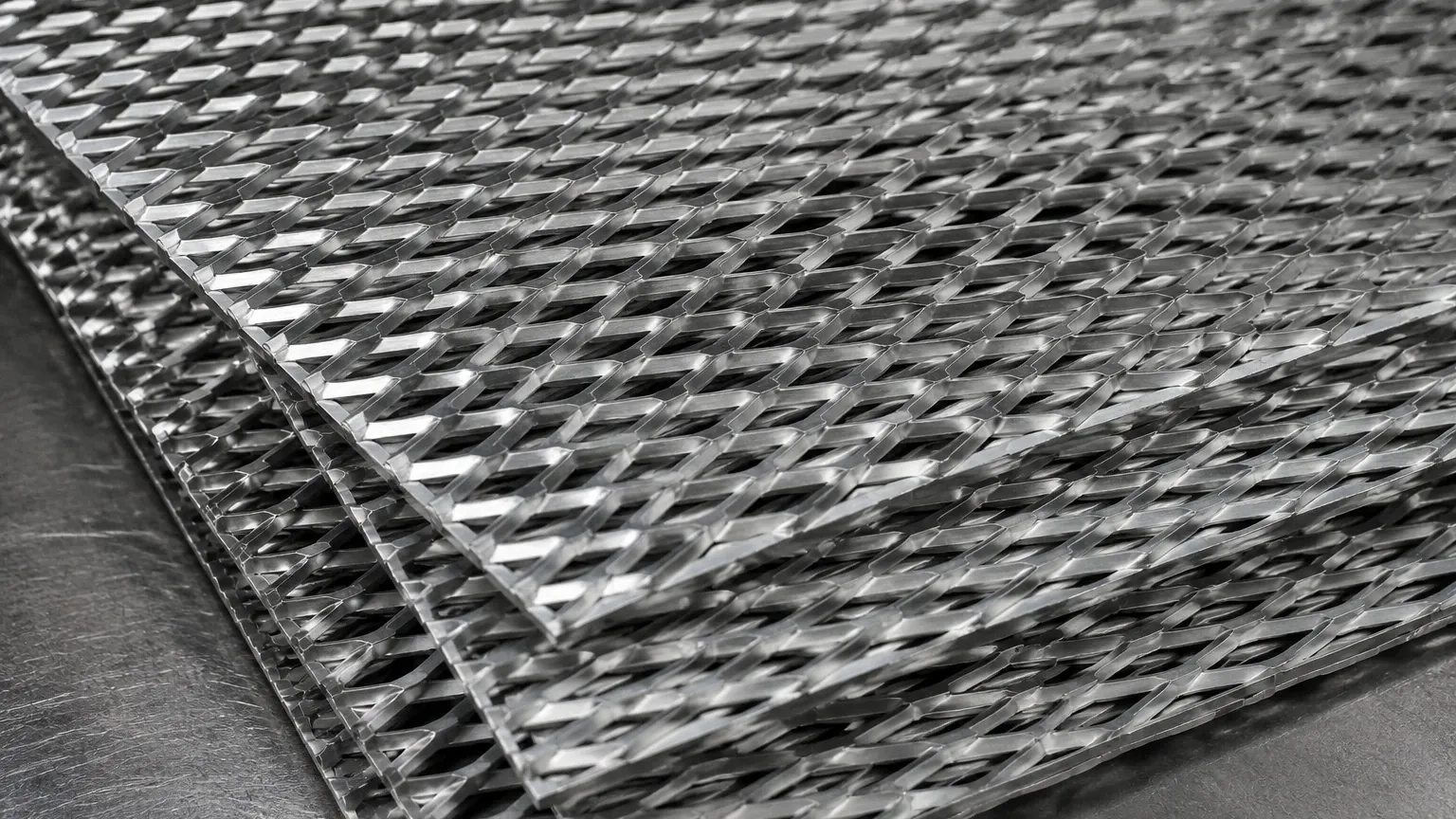
How to Measure Expanded Metal: A Step-by-Step Guide
To ensure accuracy and consistency, follow this technical procedure when measuring a sample of expanded metal:
1. Identify the Orientation: Lay the sheet down. Identify which direction the diamonds are pointing. The direction of the LWD usually runs parallel to the width of the original coil, but this can vary in custom-cut pieces.
2. Measure the SWD (Center-to-Center): Place your calipers at the center of one bond and measure to the center of the next bond along the short axis. Record this value.
3. Measure the LWD (Center-to-Center): Repeat the process along the long axis, measuring from the center of one bond to the center of the next.
4. Measure the Clear Openings (SWO and LWO): Use the internal jaws of your calipers to measure the maximum clear space inside a single diamond in both directions. This confirms the aperture size for filtration requirements.
5. Measure the Strand Width: Measure the width of a single strand. Take multiple measurements across different parts of the sheet to ensure uniformity.
6. Measure the Overall Thickness: For raised mesh, use a caliper to measure the total height of the mesh from the bottom-most point to the top-most point. For flattened mesh, measure the thickness of the flattened strand.
7. Define Sheet Dimensions: Finally, measure the overall length and width of the sheet. Specify which dimension the SWD runs parallel to. For example, "48 inches (parallel to SWD) x 96 inches (parallel to LWD)."
Technical Considerations for Industrial Filtration
When measuring or specifying Perforated & Expanded Metal for use in filtration, several engineering factors must be considered beyond basic dimensions.
Percentage of Open Area
The open area is the ratio of the area of the openings to the total area of the sheet. In filtration, a higher open area results in a lower pressure drop and higher flow rates. However, increasing the open area usually involves narrowing the strands, which can compromise the structural integrity of the filter cartridge. Engineers must balance these two factors. The formula for open area in expanded metal is more complex than perforated metal due to the angled strands, making precise SWO and strand width measurements essential.
Material Compatibility
In chemical processing or pharmaceutical applications, the material grade is as important as the dimensions. Stainless steel 316L is often preferred for its superior corrosion resistance. When measuring expanded metal, it is also important to verify that the expansion process hasn't introduced micro-fractures in the strands, which can occur if the material is too brittle or the expansion ratio is too aggressive.
Shearing and Edges
How the expanded metal is cut (sheared) to size affects the final measurement and the safety of the component.
* Random Shearing: The cut falls anywhere on the pattern, often leaving sharp "prongs" or open diamonds.
* Bond Shearing: The cut is made exactly through the center of the bonds, resulting in a closed-diamond edge that is safer to handle and easier to weld into a filter frame.
Common Risks and Specification Errors
Miscommunication during the measurement phase can lead to costly manufacturing errors. Here are the most common pitfalls to avoid:
* Confusing SWD and SWO: If you specify a 1/4" SWD but actually need a 1/4" clear opening (SWO), the resulting mesh will be much tighter than required, leading to restricted flow and potential system failure.
* Ignoring the "Bond" Dimension: The bond is where the strands intersect. If the bond is too small, the mesh may lack the structural rigidity to support a pleated filter element under high differential pressure.
* Flattening Tolerances: When specifying flattened expanded metal, be aware that the flattening process can slightly increase the LWD and SWD dimensions as the material is stretched further. Always confirm the final tolerances with the manufacturer.
* Direction of Mesh: In many structural applications, the orientation of the LWD vs. the SWD affects the load-bearing capacity. If the mesh is being rolled into a cylinder for a filter core, the orientation determines the ease of rolling and the final crush strength of the tube.
Confirming Specifications for Custom Solutions
For engineers looking to integrate expanded metal into complex filtration systems, providing a detailed specification sheet is the best way to ensure performance. When contacting a manufacturer like Kaifil, ensure you have confirmed the following:
1. Material Grade: (e.g., SS304, SS316L).
2. Mesh Type: (Standard/Raised or Flattened).
3. Design Dimensions: Exact SWD and LWD.
4. Opening Dimensions: Required SWO and LWO for filtration accuracy.
5. Strand Details: Strand width and thickness.
6. Overall Sheet Size and Orientation: Which way the diamonds should run relative to the sheet edges.
7. Edge Treatment: (Random sheared or Bond sheared).
By following these rigorous measurement standards, purchasing teams and engineers can ensure that their filtration components provide the durability and precision required for demanding industrial environments. Whether you are designing a custom hydraulic filter or a large-scale chemical strainer, the accuracy of your measurements is the first step toward an optimized filtration solution.
