


How Is Expanded Metal Made
In the realm of industrial filtration and structural engineering, expanded metal stands as a critical component due to its unique combination of strength, permeability, and cost-efficiency. Unlike many other mesh products, expanded metal is produced through a precise mechanical process that involves no scrap material, making it an environmentally and economically sustainable choice for high-performance applications. For engineers and procurement specialists, understanding the technical nuances of how this material is formed is essential for selecting the right specifications for filtration systems, protective guards, and structural supports.
At Kaifil, we specialize in high-precision stainless steel filtration solutions. Understanding the underlying manufacturing processes of Perforated & Expanded Metal allows our clients to better integrate these components into complex industrial environments, such as chemical processing, hydraulic systems, and pharmaceutical manufacturing.
The Fundamental Manufacturing Process
The question of how is expanded metal made can be answered by looking at the "slit and stretch" method. This process is distinct from weaving or punching. It involves a single piece of sheet metal or coil that is simultaneously slit and stretched by a set of reciprocating knives.
1. Feeding the Material
The process begins with a solid metal sheet or coil, typically stainless steel, carbon steel, or aluminum. The material is fed into an expanding machine, which is equipped with a specific set of dies or knives designed to create a particular diamond pattern. The thickness of the base metal determines the final strength and weight of the expanded product.
2. Slitting and Stretching
As the metal moves through the machine, the upper knife descends and creates a series of slits in the metal. Immediately following the slit, the machine stretches the metal. This stretching action expands the slits into diamond-shaped openings. The knives are offset so that the slits are staggered, creating the characteristic interconnected bond structure that gives expanded metal its structural integrity.
3. The Absence of Waste
One of the most significant engineering advantages of this process is that no metal is removed during production. In perforated metal manufacturing, the "slugs" or holes punched out of the sheet represent wasted material. In expanded metal production, the original sheet can be expanded up to ten times its original length without any loss of material. This efficiency directly impacts the total cost of ownership for large-scale industrial projects.
Standard vs. Flattened Expanded Metal
When evaluating how expanded metal is made, it is important to distinguish between the two primary finishes available: standard (raised) and flattened. Each serves different functional requirements in industrial filtration.
Standard (Raised) Expanded Metal
Standard expanded metal is the product as it comes directly off the expanding machine. The strands and bonds are set at a uniform angle to the plane of the sheet. This creates a three-dimensional surface that provides excellent grip and structural rigidity. In filtration, the raised profile can be used to create turbulence or to provide a high-friction surface for holding filter media in place. However, the raised edges may not be suitable for applications requiring a perfectly flush surface.
Flattened Expanded Metal
To produce flattened expanded metal, the standard expanded sheet is passed through a cold-roll reducing mill. This process flattens the strands and bonds into a single plane, resulting in a smooth, flat surface. Flattening reduces the overall thickness of the sheet and slightly elongates the diamond pattern. For engineers designing multi-layer filtration cartridges, flattened expanded metal is often preferred because it allows for tighter tolerances and easier stacking of different mesh layers without creating gaps or uneven pressure points.
Technical Parameters and Engineering Specifications
To accurately specify expanded metal for a project, engineers must use standardized terminology. These measurements are determined during the manufacturing process by the configuration of the knives and the degree of the stretch.
* SWD (Short Way of Design): The distance from the center of one bond to the center of the next bond measured across the short diamond diagonal.
* LWD (Long Way of Design): The distance from the center of one bond to the center of the next bond measured across the long diamond diagonal.
* SWO (Short Way of Opening): The actual width of the opening, measured from the inside of the bonds.
* LWO (Long Way of Opening): The actual length of the opening, measured from the inside of the bonds.
* Strand Width: The amount of metal fed into the machine between the knives for each stroke.
* Strand Thickness: The thickness of the original base metal.
Understanding these dimensions is critical for calculating the "open area" percentage. The open area determines the flow rate and pressure drop across a filter. For example, a larger SWD and LWD with a narrow strand width will result in a higher open area, which is ideal for high-flow water treatment applications but may offer less structural support than a more densely expanded sheet.
Material Selection for Industrial Filtration
The choice of material is as important as the manufacturing method. While expanded metal can be made from various alloys, stainless steel remains the gold standard for industrial filtration due to its mechanical properties and chemical resistance.
Stainless Steel (304 and 316L)
Stainless steel expanded metal is widely used in chemical processing and food production. Grade 304 offers excellent general corrosion resistance, while Grade 316L (low carbon) is preferred for environments involving chlorides or high temperatures. The manufacturing process for stainless steel requires more robust machinery and higher-grade tool steel knives due to the material's work-hardening characteristics.
Specialty Alloys
For extreme environments, such as those found in aerospace or petrochemical refining, expanded metal can be produced from Monel, Inconel, or Titanium. These materials ensure that the filter components can withstand corrosive acids and extreme thermal cycling without losing their structural shape.
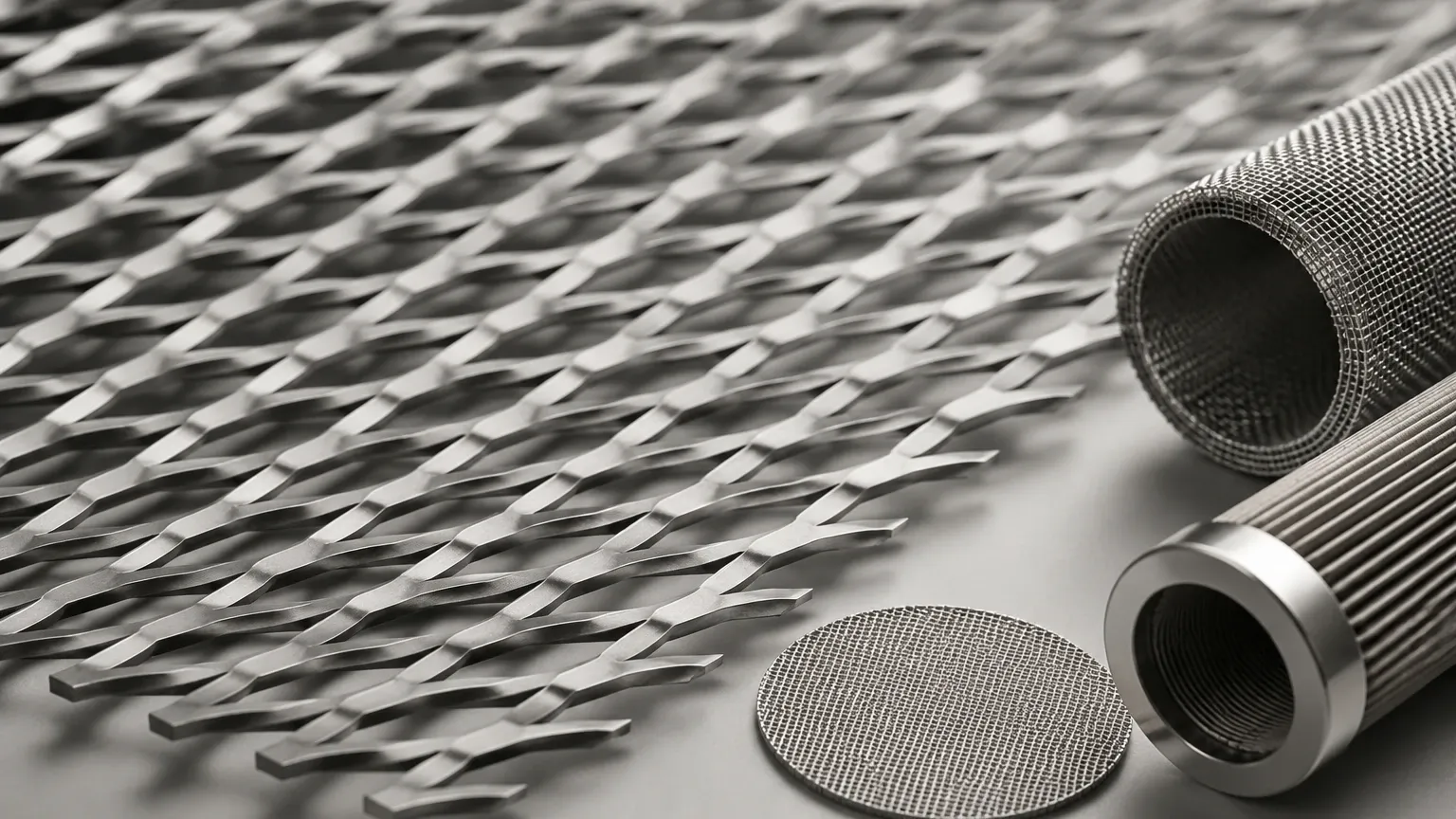
Comparing Expanded Metal to Perforated Metal
In many B2B procurement scenarios, the choice between Perforated & Expanded Metal is a common point of discussion. While both provide filtration and support, their manufacturing origins lead to different performance profiles.
* Structural Integrity: Expanded metal is a single, continuous piece of material. The bonds are not welded or joined; they are part of the original metal. This makes it exceptionally strong and resistant to unraveling if a single strand is cut. Perforated metal, while also a single sheet, loses some of its inherent strength because material is physically removed.
* Cost Efficiency: Because there is no scrap, expanded metal is often more cost-effective per square foot than perforated metal, especially when using expensive alloys like 316L stainless steel.
* Hole Geometry: Perforated metal offers more flexibility in hole shapes (round, square, slotted). Expanded metal is primarily limited to diamond or hexagonal shapes, although the aspect ratio of these diamonds can be adjusted during the stretching phase.
* Weight-to-Strength Ratio: Expanded metal provides a higher strength-to-weight ratio. This is particularly beneficial in the design of large-scale industrial filter housings where reducing the overall weight of the internal components can simplify maintenance and installation.
Applications in Filtration and Engineering
How expanded metal is made directly influences its role in various industrial sectors. Its versatility allows it to function as both a primary filter and a secondary support structure.
Filter Support and Pleat Spacing
In high-pressure hydraulic systems, expanded metal is often used as a support layer for finer wire mesh or synthetic filter media. It prevents the delicate mesh from collapsing under the force of the fluid flow. The diamond pattern of expanded metal provides multiple contact points, ensuring uniform support across the entire surface of the filter element.
Pre-Filtration and Debris Removal
In water treatment and HVAC systems, expanded metal acts as a pre-filter. It captures large particulates and debris before they reach more expensive, high-precision filter cartridges. The ability to customize the SWO and LWO during manufacturing allows engineers to target specific particle sizes for removal.
EMI/RFI Shielding
In the electronics and pharmaceutical industries, expanded metal is used for electromagnetic interference (EMI) shielding. The continuous nature of the expanded sheet (no joins or welds) provides excellent electrical conductivity, which is essential for effective shielding in sensitive laboratory environments.
Engineering Considerations Before Purchasing
Before finalizing a specification for expanded metal components, technical teams should confirm several key factors with their manufacturer:
1. Tolerances: Expanded metal manufacturing involves mechanical stretching, which can lead to slight variations in dimensions. It is important to define the acceptable tolerances for LWD and SWD, especially for components that must fit into precision-machined housings.
2. Edge Configuration: Expanded metal can be supplied with "random sheared" edges or "bond sheared" edges. Random shearing may leave sharp points (prongs), whereas bond shearing cuts through the center of the bonds for a cleaner edge. This choice impacts both safety and how the component is welded or framed.
3. Flow Direction: The orientation of the diamonds can affect fluid dynamics. Engineers should specify whether the LWD should be parallel or perpendicular to the flow or the length of the final part.
4. Surface Treatment: Depending on the application, expanded metal may require passivating (for stainless steel), galvanizing (for carbon steel), or powder coating. These treatments should be considered during the initial design phase to ensure they do not clog the openings or alter the filtration performance.
Conclusion
Understanding how is expanded metal made reveals why it is such a staple in industrial filtration. The process of slitting and stretching creates a durable, waste-free, and versatile material that meets the rigorous demands of modern engineering. Whether used as a support structure in a high-pressure hydraulic filter or as a protective screen in a chemical reactor, expanded metal offers a unique set of benefits that are difficult to replicate with other materials.
At Kaifil, we combine our manufacturing expertise with a deep understanding of filtration principles to provide customized solutions. By selecting the right material, expansion ratio, and finish, we help our clients optimize their filtration processes for maximum efficiency and durability. For those looking to integrate these components into their systems, we encourage a thorough review of technical specifications to ensure the best possible performance in the field.
