


Inventor Expanded Metal
In the realm of industrial design and filtration engineering, the transition from a digital concept to a physical component requires a deep understanding of material properties and manufacturing constraints. For engineers utilizing CAD software to develop complex systems, "inventor expanded metal" often refers to the modeling and specification of expanded metal components within a digital environment like Autodesk Inventor. However, the successful implementation of these components in industrial filtration depends on more than just a 3D model; it requires a precise alignment between design parameters and the physical realities of metal expansion.
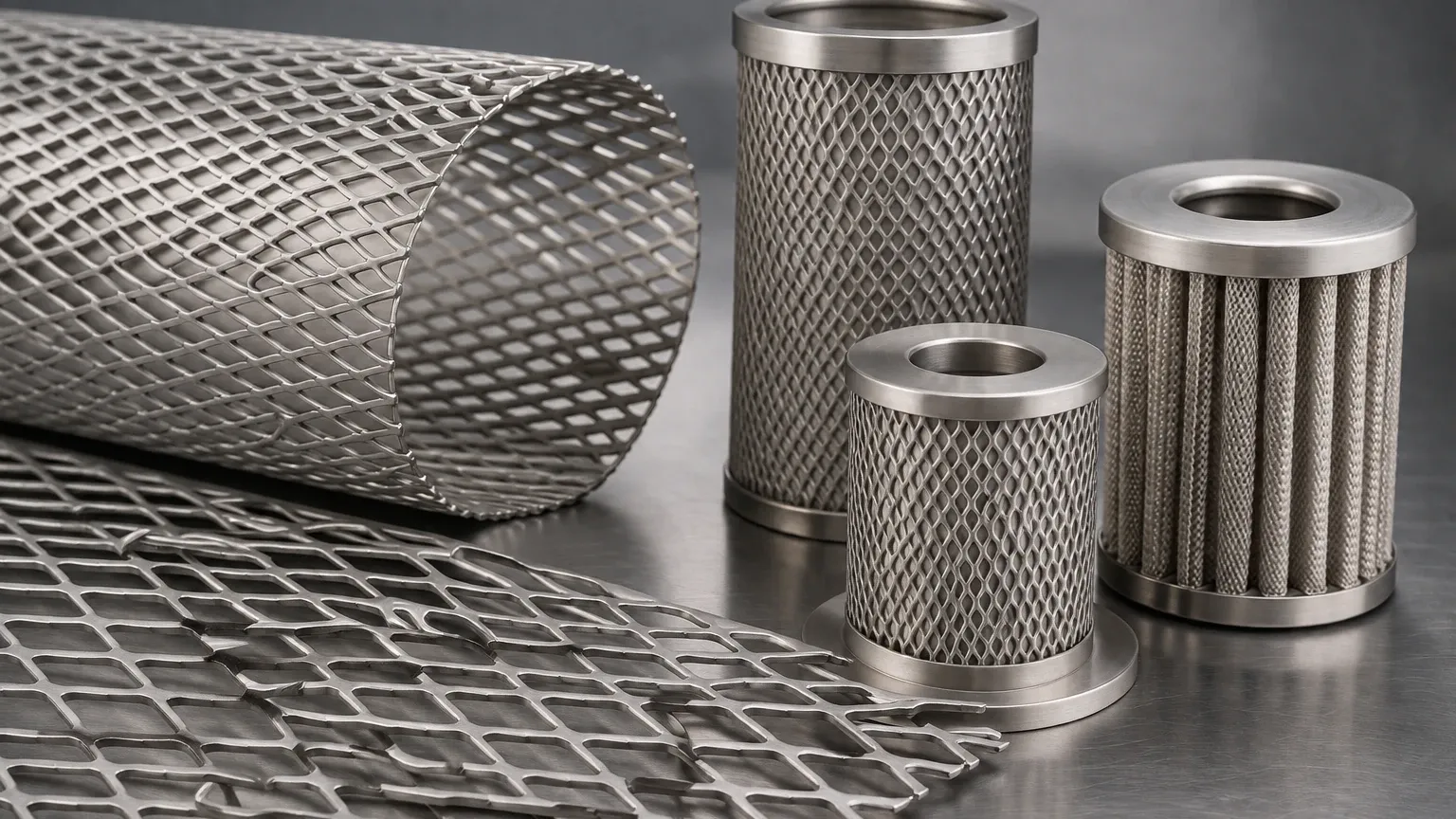
Expanded metal is a versatile material produced by simultaneously slitting and stretching a solid sheet of metal. Unlike perforated metal, which involves punching holes and generating scrap, the expansion process creates a diamond-shaped pattern without any material loss. This makes it an inherently cost-effective and structurally rigid option for support structures, protective guards, and coarse filtration stages. When specifying Perforated & Expanded Metal for industrial applications, engineers must account for specific geometric variables that dictate both the flow characteristics and the mechanical strength of the final product.
Technical Fundamentals of Expanded Metal Geometry
To accurately model or specify expanded metal, one must understand the four primary dimensions that define the mesh. These terms are standard across the industry and are critical for any engineer working on a design project:
1. SWD (Short Way of Design): This is the distance from the center of one bond to the center of the next bond measured across the short axis of the diamond.
2. LWD (Long Way of Design): This is the distance measured across the long axis of the diamond.
3. Strand Width: The amount of metal fed into the machine between the slits, which determines the thickness of the "ribs" of the mesh.
4. Strand Thickness: The original thickness of the base metal sheet.
In a CAD environment, such as when creating an "inventor expanded metal" part, these dimensions must be accurately represented to ensure the component fits within its housing and provides the necessary open area for fluid or gas flow. Miscalculating the strand width or the angle of expansion can lead to significant discrepancies in pressure drop or structural failure under high-pressure hydraulic loads.
Structural Advantages in Filtration Support
One of the primary roles of expanded metal in the filtration industry is providing a rigid skeleton for finer filter media. In high-pressure applications, such as hydraulic oil filtration or high-viscosity chemical processing, the delicate wire mesh used for fine particle capture cannot withstand the differential pressure on its own.
Expanded metal offers several structural advantages over other support methods:
* High Strength-to-Weight Ratio: Because the material is a single piece of metal with no welds or joints, the structural integrity is superior to woven wire of the same weight. The "truss-like" nature of the diamond pattern distributes stress evenly across the sheet.
* Uninterrupted Conductivity: Since there are no breaks in the material, expanded metal provides excellent electrical and thermal conductivity, which is essential in applications where static dissipation or heat exchange is a factor.
* Anti-Slip and Directional Flow: The angled strands of standard (unflattened) expanded metal can be used to direct flow or provide mechanical grip for secondary layers of filter media, preventing the media from shifting during backpulsing or cleaning cycles.
Material Selection for Industrial Environments
While the geometry defines the performance, the material selection defines the longevity of the filter component. In the B2B industrial sector, stainless steel remains the gold standard due to its corrosion resistance and thermal stability.
Stainless Steel Grades
For most filtration applications, Grade 304 and Grade 316L are the primary choices. Grade 304 offers excellent strength and basic corrosion resistance suitable for many industrial environments. However, in chemical processing, pharmaceutical manufacturing, or marine applications, Grade 316L is preferred due to the addition of molybdenum, which enhances resistance to pitting and crevice corrosion in chloride-rich environments.
Specialty Alloys
In extreme cases involving high temperatures or highly acidic fluids, engineers may specify expanded metal made from Hastelloy, Monel, or Inconel. When designing these parts in a CAD system, it is vital to remember that the ductility of the base material affects how it expands. Harder alloys may require different tooling or yield slightly different diamond shapes than standard carbon steel or aluminum.
Comparing Standard vs. Flattened Expanded Metal
When specifying Perforated & Expanded Metal, a critical decision is whether to use the "standard" or "flattened" variety.
* Standard Expanded Metal: This is the material as it comes off the expansion press. The strands are set at a sharp angle to the original plane of the sheet. This creates a 3D profile that is thicker than the original sheet. It provides maximum rigidity and a high degree of flow turbulence, which can be beneficial in certain mixing or heat transfer applications.
* Flattened Expanded Metal: After expansion, the sheet is passed through a cold-rolling reducing mill. This flattens the strands and bonds back into a single plane, resulting in a smooth, flat surface. Flattened expanded metal is often used when the filter component must be sandwiched tightly between other layers or when a smooth surface is required to prevent abrasion of a delicate outer filter membrane.
For an engineer modeling an "inventor expanded metal" component, the choice between standard and flattened will significantly impact the "overall thickness" parameter of the part, which in turn affects the clearance within the filter housing.
Engineering Considerations: Open Area and Pressure Drop
In filtration, the percentage of open area is a decisive factor in determining the flow rate and the initial pressure drop across the system. Calculating the open area for expanded metal is more complex than for perforated metal because of the angularity of the strands.
If the open area is too low, the pump or compressor must work harder to move the fluid, leading to increased energy costs and potential system fatigue. Conversely, if the open area is too high, the structural support may be compromised. Professional manufacturers like Kaifil provide technical data sheets that correlate SWD, LWD, and strand width with the resulting open area, allowing engineers to make informed decisions during the design phase.
Customization and OEM Integration
Most industrial filtration systems require bespoke components that do not conform to off-the-shelf hardware store specifications. This is where the synergy between digital design and specialized manufacturing becomes apparent. When an engineering team develops an "inventor expanded metal" model, they are often looking for an OEM partner capable of translating that digital file into a high-precision metal component.
Customization options include:
* Custom Diamond Sizes: Tailoring the SWD and LWD to match the specific support requirements of a proprietary filter media.
* Variable Strand Widths: Adjusting the width to balance the need for open area versus mechanical strength.
* Edge Treatments: Providing expanded metal with solid borders (random sheared or bond sheared) to facilitate easier welding into a filter cartridge frame.
* Secondary Processing: Including annealing, pickling, or passivating to ensure the stainless steel meets the strict hygiene standards of the food and beverage or pharmaceutical industries.
Verification and Quality Control
Before moving from the design stage to procurement, several factors must be confirmed to ensure the expanded metal component performs as expected in a demanding industrial environment. Engineers should verify the following:
1. Tolerance Requirements: Standard industrial tolerances for expanded metal can be broader than those for machined parts. If your housing requires tight tolerances, this must be communicated during the quoting process.
2. Flatness Specifications: Especially for large-diameter filter discs, the degree of flatness is critical for maintaining a proper seal.
3. Burr Removal: The expansion process can leave sharp edges. For filtration applications involving manual handling or delicate membranes, deburring or electropolishing may be necessary.
4. Direction of Expansion: The orientation of the diamonds (parallel to the length or width of the sheet) can affect how the material rolls into a cylinder for filter cartridges.
Conclusion
Whether you are a design engineer working on an "inventor expanded metal" project or a purchasing professional sourcing components for a large-scale filtration system, understanding the technical nuances of expanded metal is essential. By focusing on precise geometric specifications, appropriate material selection, and the functional differences between standard and flattened profiles, you can ensure that your filtration solution is both durable and efficient.
For those seeking technical guidance or custom-engineered components, exploring the options for Perforated & Expanded Metal provides a foundation for high-performance industrial filtration. By partnering with a manufacturer that understands the complexities of metal expansion, you can bridge the gap between a digital CAD model and a reliable, long-lasting industrial product.
