


Perforated Metal J Channel
In the landscape of industrial filtration and structural support, the perforated metal j channel serves as a critical interface component. It is designed to provide edge protection, structural rigidity, and a mounting framework for various filtration media. For engineers and procurement specialists, understanding the technical nuances of these components is essential for ensuring the longevity and efficiency of filtration systems in demanding environments such as chemical processing, food and beverage production, and hydraulic applications.
As a specialized manufacturer, Kaifil provides precision-engineered Perforated & Expanded Metal solutions that integrate seamlessly with custom J-channel profiles. This guide examines the engineering considerations, material selections, and application-specific requirements that define high-performance perforated metal j channels.
The Role of J Channels in Industrial Filtration Systems
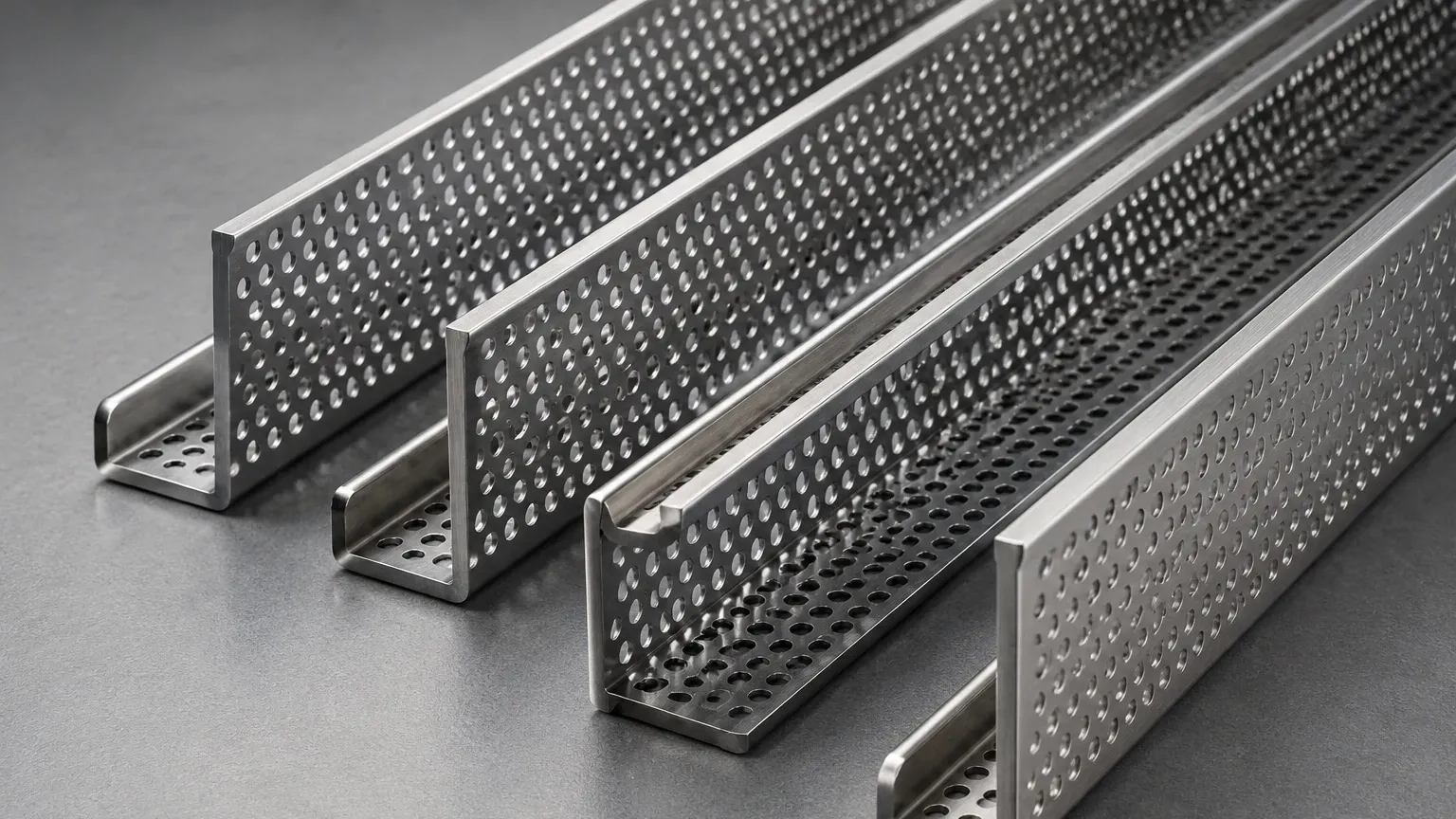
A J channel is a roll-formed or press-braked metal profile characterized by a "J" shaped cross-section. It features one long leg and one short leg connected by a base, creating a pocket or track. In industrial filtration, the perforated metal j channel is rarely a standalone product; it functions as a perimeter frame or a support track for perforated sheets, wire mesh, or expanded metal panels.
Edge Containment and Safety
Perforated metal sheets often have sharp edges after being sheared to size. A J channel encapsulates these edges, providing a smooth finish that protects both the filtration media and the personnel handling the equipment. This is particularly important in the food and pharmaceutical industries, where exposed metal burrs can lead to contamination or safety hazards.
Structural Rigidity
Large-scale filtration panels can suffer from sagging or vibration under high-pressure flow. By nesting the edge of a perforated panel within a J channel, the assembly gains significant moment of inertia, resisting deformation. This ensures that the filtration surface remains flat and positioned correctly relative to the flow path.
Mounting and Modular Design
The J-channel profile allows for easy installation and removal of filter panels. In modular systems, the J channel acts as a slide-in track, facilitating rapid maintenance and replacement cycles, which is a key factor in reducing total cost of ownership in industrial settings.
Material Engineering: Selecting Stainless Steel for Durability
The choice of material for a perforated metal j channel is dictated by the chemical and thermal environment of the application. Given Kaifil’s focus on high-performance industrial solutions, stainless steel is the primary material of choice due to its corrosion resistance and mechanical properties.
Grade 304 Stainless Steel
304 stainless steel is the standard for general industrial applications. It offers excellent formability and weldability, making it ideal for creating complex J-channel profiles. It is suitable for water treatment and general industrial filtration where extreme chemical resistance is not required.
Grade 316 and 316L Stainless Steel
For chemical processing and marine environments, 316 stainless steel is preferred due to the addition of molybdenum, which enhances resistance to pitting and crevice corrosion in chloride-rich environments. The "L" (low carbon) variant is specifically used when the J channel must be welded to a larger assembly, as it prevents carbide precipitation that can lead to intergranular corrosion.
Specialty Alloys
In high-temperature or highly acidic environments, engineers may specify duplex stainless steels or nickel-based alloys. These materials maintain their structural integrity and perforation accuracy under conditions that would cause standard steels to fail.
Technical Specifications and Geometry of the J Profile
When specifying a perforated metal j channel, dimensional accuracy is paramount. The "fit" between the J channel and the Perforated & Expanded Metal panel it holds determines the stability of the entire assembly.
Key Dimensions
1. Long Leg Height: Provides the primary mounting surface for fastening the channel to a wall or machine frame.
2. Short Leg Height: Secures the filtration media in place without obstructing too much of the active filtration area.
3. Base (Gap) Width: This must be slightly wider than the thickness of the perforated sheet or mesh it will hold. A gap that is too tight can cause stress on the material, while a gap that is too loose leads to vibration and noise.
4. Material Gauge: The thickness of the J channel itself must be sufficient to support the weight and pressure load of the filter panel.
Perforation Patterns in the Channel
While the primary filtration happens in the main panel, the J channel itself can also be perforated. This is often done to prevent liquid entrapment within the channel base, which could otherwise lead to bacterial growth in food-grade applications or localized corrosion. Common patterns include round holes, square holes, or slots, with the open area percentage calculated to balance drainage with structural strength.
Performance Evaluation: Open Area and Flow Dynamics
In any filtration application, the goal is to maximize flow while maintaining structural integrity. The introduction of a perforated metal j channel affects the overall flow dynamics of the system.
Calculating Effective Open Area
Engineers must account for the area of the perforated panel that is obscured by the legs of the J channel. If the J channel covers 10% of the panel's perimeter, the effective open area is reduced accordingly. This must be factored into the pressure drop calculations for the system. If the J channel itself is perforated, it can contribute to the flow, particularly in bypass or drainage scenarios.
Minimizing Turbulence
The transition between the J channel and the filtration media should be as flush as possible. Sharp transitions or large gaps can create localized turbulence, which may lead to uneven sediment buildup or premature wear on the filtration mesh. Precision manufacturing ensures that the J channel profile matches the media thickness perfectly.
Customization and OEM Manufacturing Capabilities
No two industrial filtration requirements are identical. Customization is the hallmark of effective filtration engineering. When sourcing a perforated metal j channel, OEM capabilities allow for the integration of specific features that off-the-shelf components cannot provide.
Custom Hole Patterns and Pitch
Depending on the particle size being targeted, the perforations in the J channel or the supported panel can be customized. This includes varying the hole diameter and the center-to-center distance (pitch) to achieve a specific micron rating or flow rate.
Advanced Fabrication Techniques
Kaifil utilizes advanced manufacturing processes to ensure that the J channels are produced with tight tolerances. This includes:
* Precision Punching: Ensuring clean holes without burrs or deformation.
* CNC Bending: Achieving exact angles for the J profile to ensure a perfect fit with the filter housing.
* Surface Finishing: Options such as passivating, electropolishing, or sandblasting to meet the hygiene standards of the pharmaceutical and food industries.
Installation Best Practices and Structural Integration
The method of integrating the perforated metal j channel into the larger system is as important as the component's design. Improper installation can lead to bypass—where unfiltered fluid escapes around the edges of the filter.
Welding vs. Mechanical Fastening
In permanent installations, J channels are often welded to the filter housing. This provides a leak-proof seal and maximum strength. However, in systems where the filter media must be frequently cleaned or replaced, mechanical fasteners (such as bolts or clips) are used. In these cases, gaskets or sealants may be required within the J channel pocket to prevent bypass.
Thermal Expansion Considerations
In high-temperature applications, such as steam filtration or hot chemical processing, the J channel and the perforated panel may expand at different rates if they are made from different materials or have different thicknesses. Engineers should design the J channel with sufficient clearance to allow for thermal movement without buckling.
Procurement Checklist: Engineering Data Required for Specification
Before initiating a purchase or a custom manufacturing run for a perforated metal j channel, the following technical details should be confirmed to ensure the product meets the application's demands:
* Material Grade: (e.g., SS304, SS316L, or specialty alloys).
* Channel Dimensions: Long leg, short leg, and base width (pocket size).
* Material Thickness: Gauge of the metal used for the channel.
* Perforation Specs: Hole shape, size, pitch, and orientation (staggered or straight) if the channel is to be perforated.
* Panel Thickness: The exact thickness of the Perforated & Expanded Metal that the channel will hold.
* Finishing Requirements: Is electropolishing or passivation required for corrosion resistance or hygiene?
* Quantity and Lengths: Standard stock lengths or custom-cut sizes.
* Environmental Factors: Operating temperature, pressure, and chemical exposure.
By addressing these factors, engineering teams can ensure they select a perforated metal j channel that provides the necessary structural support and filtration performance for their specific industrial environment. Kaifil’s expertise in custom stainless steel filtration solutions ensures that every component, from the primary filter cartridge to the supporting J-channel frame, is engineered for reliability and precision.
