


Expanded Metal Nearby
In the landscape of industrial manufacturing and filtration engineering, the procurement of high-quality components often begins with a search for reliability and proximity. When engineers and purchasing managers search for expanded metal nearby, they are typically looking for more than just a local warehouse; they are seeking a supply chain partner capable of delivering precise technical specifications, material certifications, and structural integrity. Expanded metal serves as a foundational component in many filtration systems, providing the necessary mechanical support for delicate filter media while maintaining optimal flow characteristics.
Understanding the nuances of expanded metal production and its application in demanding environments is essential for making informed procurement decisions. Whether used as a support cage for a stainless steel filter cartridge or as a protective screen in a chemical processing plant, the quality of the expanded metal directly impacts the longevity and efficiency of the entire system.
Understanding Expanded Metal in Industrial Filtration
Expanded metal is manufactured through a unique process of simultaneously slitting and stretching a solid sheet of metal. Unlike perforated metal, which involves punching holes and generating scrap material, the expansion process creates a diamond-shaped pattern without any waste. This makes it an inherently cost-effective and environmentally conscious choice for industrial applications.
The resulting mesh is a single piece of material, meaning there are no welds or joints that could fail under high pressure or thermal cycling. In filtration, this structural continuity is vital. For instance, when used as a support layer in hydraulic filters, the expanded metal must withstand significant differential pressure without deforming. If the support structure fails, the filter media can rupture, leading to downstream contamination and potential equipment failure.
From an engineering perspective, expanded metal is categorized into two primary forms: raised and flattened. Raised expanded metal retains the natural ridges created during the stretching process, offering a high strength-to-weight ratio and excellent grip. Flattened expanded metal undergoes an additional cold-rolling process to create a smooth, level surface. For filtration applications where the mesh is in direct contact with fine wire mesh or synthetic membranes, flattened expanded metal is often preferred to prevent abrasion or puncturing of the secondary media.
Sourcing Expanded Metal Nearby: Balancing Logistics and Technical Precision
When a project requires expanded metal nearby, the primary drivers are often lead times and shipping costs. However, for specialized industries such as pharmaceutical manufacturing or food and beverage processing, geographic proximity should not override technical competence. A local general-purpose metal supplier may carry standard carbon steel or aluminum mesh, but they may lack the specialized stainless steel alloys or the precision tolerances required for high-performance filtration.
For engineers, the "nearby" factor is increasingly being redefined by digital transparency and rapid logistics. A manufacturer with deep expertise in Perforated & Expanded Metal can often provide more value through customized designs and material traceability than a local distributor with limited stock. When evaluating a supplier, it is critical to confirm their ability to work with specific grades of stainless steel, such as 304, 316, or 316L, which are standard in corrosive or sanitary environments.
Furthermore, sourcing from a dedicated filtration component manufacturer ensures that the expanded metal is produced with the end-use in mind. This includes considerations for burr-free edges, degreasing (essential for oxygen service or food-grade applications), and precise dimensional accuracy for integration into automated assembly lines.
Key Engineering Specifications for Perforated & Expanded Metal
To ensure the performance of expanded metal in a B2B context, engineers must define several critical parameters. These specifications dictate how the material will behave under load and how it will interact with the fluid or gas being filtered.
1. SWD (Short Way of Design): The distance from the center of one bond to the center of the next bond across the short axis of the diamond.
2. LWD (Long Way of Design): The distance across the long axis of the diamond.
3. Strand Width and Thickness: These dimensions determine the overall strength and the percentage of open area. A thicker strand increases durability but may reduce the flow rate.
4. Percentage of Open Area: This is perhaps the most critical metric for filtration. It determines the pressure drop across the component. Engineers must balance the need for structural support with the requirement for low resistance to flow.
When comparing perforated vs. expanded metal, it is important to note that perforated metal offers more precise control over hole size and shape, which is useful for direct filtration (sieving). Expanded metal, however, is often superior as a support structure because its three-dimensional geometry can help distribute flow more evenly across the surface of a filter pleat.
Material Selection and Durability in Demanding Environments
Material selection is the cornerstone of durability in industrial filtration. While carbon steel expanded metal may be suitable for simple air intake screens, it is rarely sufficient for the aggressive environments found in chemical processing or water treatment.
Stainless Steel (304 and 316L)
Stainless steel is the industry standard for expanded metal used in filtration. Grade 304 offers excellent corrosion resistance for general industrial use, while Grade 316L (low carbon) is preferred for environments involving chlorides or high temperatures. The addition of molybdenum in 316L provides superior resistance to pitting and crevice corrosion, which is essential for marine applications or chemical reactors.
Specialty Alloys
In extreme cases, such as highly acidic processing or high-heat aerospace applications, specialty alloys like Monel, Inconel, or Hastelloy may be required. These materials maintain their mechanical properties under conditions that would cause standard stainless steel to oxidize or become brittle. When searching for expanded metal nearby, verify that the supplier has experience handling these difficult-to-process alloys, as the expansion characteristics of Inconel differ significantly from those of mild steel.
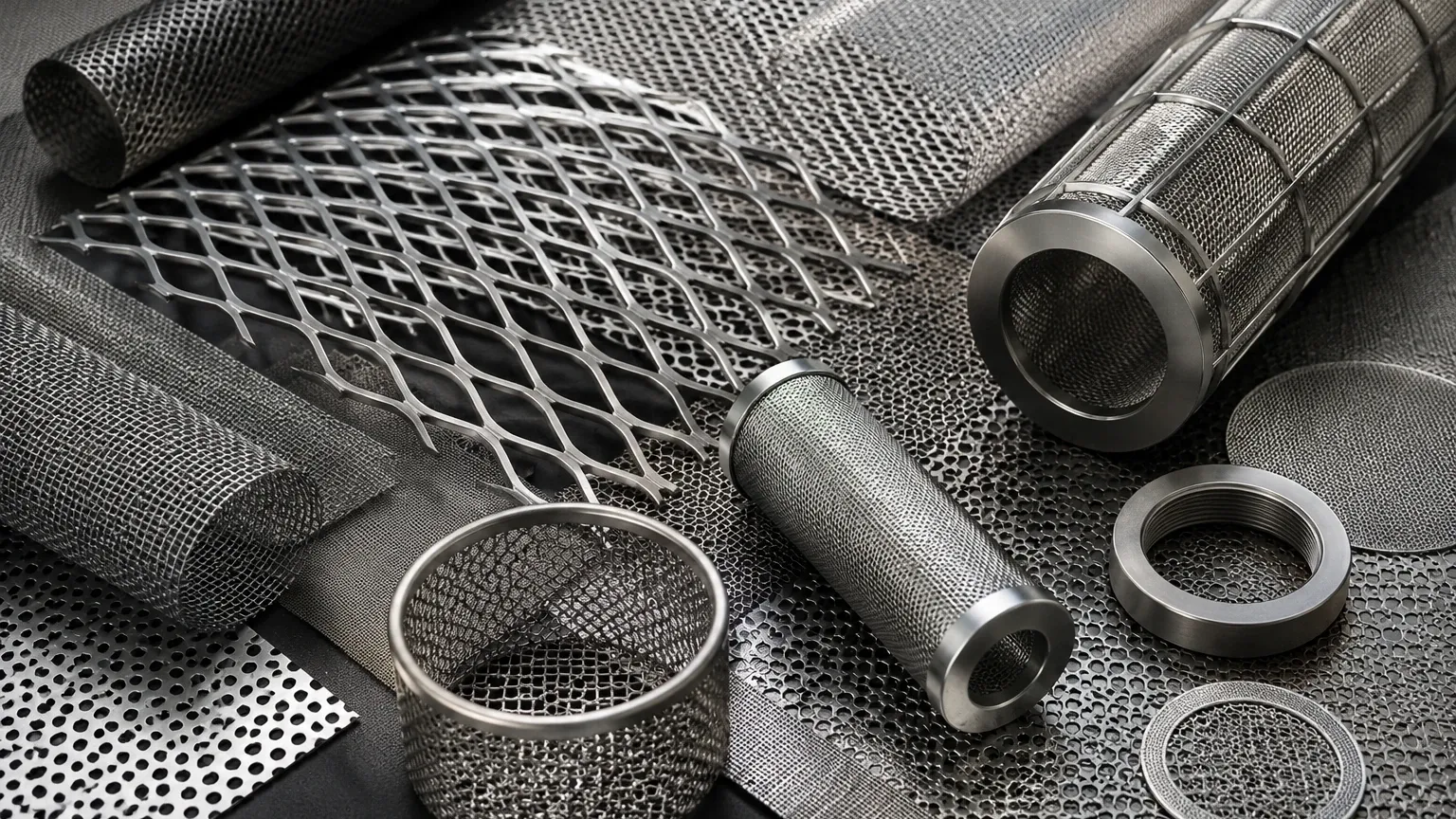
Comparing Perforated vs. Expanded Metal for Filtration Support
Engineers often face the choice between using perforated metal or expanded metal for filter cages and core tubes. Both have distinct advantages depending on the application requirements.
Perforated Metal Advantages:
* Precision: Hole diameters can be controlled to within microns, making it suitable for primary filtration.
* Smoothness: The punching process leaves one side perfectly flat, which is ideal for protecting delicate outer wraps of a filter cartridge.
* Custom Patterns: Holes can be arranged in staggered or straight rows to optimize flow in specific directions.
Expanded Metal Advantages:
* Strength-to-Weight: The truss-like structure of expanded metal provides exceptional rigidity with less weight than a solid perforated sheet of the same thickness.
* Flow Dynamics: The angled strands of raised expanded metal can create beneficial turbulence or help break up laminar flow, which can improve filtration efficiency in certain liquid-solid separation processes.
* Cost Efficiency: Because there is no material waste during production, expanded metal is generally more economical than perforated metal, especially when using expensive alloys.
In many high-pressure hydraulic systems, a combination is used: an expanded metal inner core for maximum crush resistance and a perforated outer wrap for aesthetic finish and media protection.
Quality Assurance and Compliance for Industrial Sourcing
For purchasing teams, the risk of selecting an inadequate supplier for expanded metal can lead to significant downstream costs. A failure in a $50 filtration component can result in the shutdown of a multi-million dollar production line. Therefore, quality assurance must be a non-negotiable part of the sourcing process.
Before finalizing a contract for expanded metal nearby, technical teams should confirm the following:
* Material Certification: Does the supplier provide Mill Test Reports (MTRs) to verify the chemical composition and mechanical properties of the steel?
* Dimensional Consistency: What are the tolerances for SWD, LWD, and flatness? In automated filter assembly, even a slight deviation in sheet flatness can cause machine jams.
* Cleaning Standards: For the pharmaceutical and food industries, is the metal free from residual oils and lubricants used during the expansion process?
* Customization Capabilities: Can the supplier provide value-added services such as shearing to size, forming into cylinders, or welding?
Total Cost of Ownership in Filtration Components
While the initial price per square foot is a factor, the total cost of ownership (TCO) is a more accurate measure of value. Inexpensive expanded metal that suffers from rapid corrosion or structural fatigue will require frequent replacement, increasing maintenance labor and downtime.
By selecting high-grade stainless steel expanded metal from a manufacturer with a deep understanding of filtration, companies can extend the service life of their equipment. Furthermore, a supplier that offers customized solutions can help optimize the design of the filter, potentially reducing the number of components needed or improving the overall energy efficiency of the pump system by minimizing pressure drop.
In conclusion, the search for expanded metal nearby should be viewed through the lens of technical partnership. While physical distance matters for logistics, the engineering expertise, material quality, and manufacturing precision of the supplier are the true determinants of success in industrial filtration applications. By focusing on these factual boundaries and engineering requirements, B2B buyers can ensure they receive components that meet the rigorous demands of their specific industrial environment.
