


Number 9 Expanded Metal
In the landscape of industrial materials, specifically within the realm of Perforated & Expanded Metal, the designation "Number 9" represents one of the most versatile and widely utilized specifications for heavy-duty applications. For engineers and procurement professionals, understanding the technical nuances of number 9 expanded metal is essential for ensuring structural integrity, filtration efficiency, and long-term durability in demanding environments.
At its core, number 9 expanded metal refers to the gauge of the base metal used before the expansion process. In the United States standard for expanded metal, #9 gauge corresponds to a nominal thickness of approximately 0.134 inches (3.4 mm). When this material is slit and stretched into a diamond-shaped pattern, it creates a rigid, high-strength mesh that offers a unique combination of open area and structural support. This guide examines the technical specifications, material considerations, and industrial applications of this specific material grade, particularly its role in advanced filtration systems.
Technical Specifications and Dimensional Standards
Specifying number 9 expanded metal requires more than just identifying the gauge. Engineers must define several dimensional variables that dictate how the material will perform under mechanical stress or fluid flow. The "Number 9" designation is typically applied to both carbon steel and stainless steel variants, though the physical properties and corrosion resistance profiles differ significantly between the two.
SWD and LWD Measurements
The geometry of expanded metal is defined by the Short Way of Design (SWD) and the Long Way of Design (LWD). These measurements refer to the distance from the center of one diamond join (bond) to the center of the next. For number 9 expanded metal, common configurations include:
* 1/2" #9: Typically features an SWD of 0.500" and an LWD of 1.200".
* 3/4" #9: Typically features an SWD of 0.923" and an LWD of 2.100".
* 1-1/2" #9: Features a larger diamond pattern for applications requiring higher open area and lower weight.
Strand Width and Thickness
While the base metal is 0.134 inches thick, the "strand width" is the amount of metal fed into the expanding machine between each slit. The relationship between the strand width and the gauge thickness determines the overall strength and weight of the finished sheet. In filtration support applications, a wider strand provides more surface area for bonding filter media but may reduce the total open area, impacting flow rates.
Raised vs. Flattened Expanded Metal
One of the most critical decisions during the selection process is whether to utilize raised (standard) or flattened expanded metal. Each has distinct mechanical properties that affect its suitability for industrial filtration and structural components.
Raised Expanded Metal (Standard)
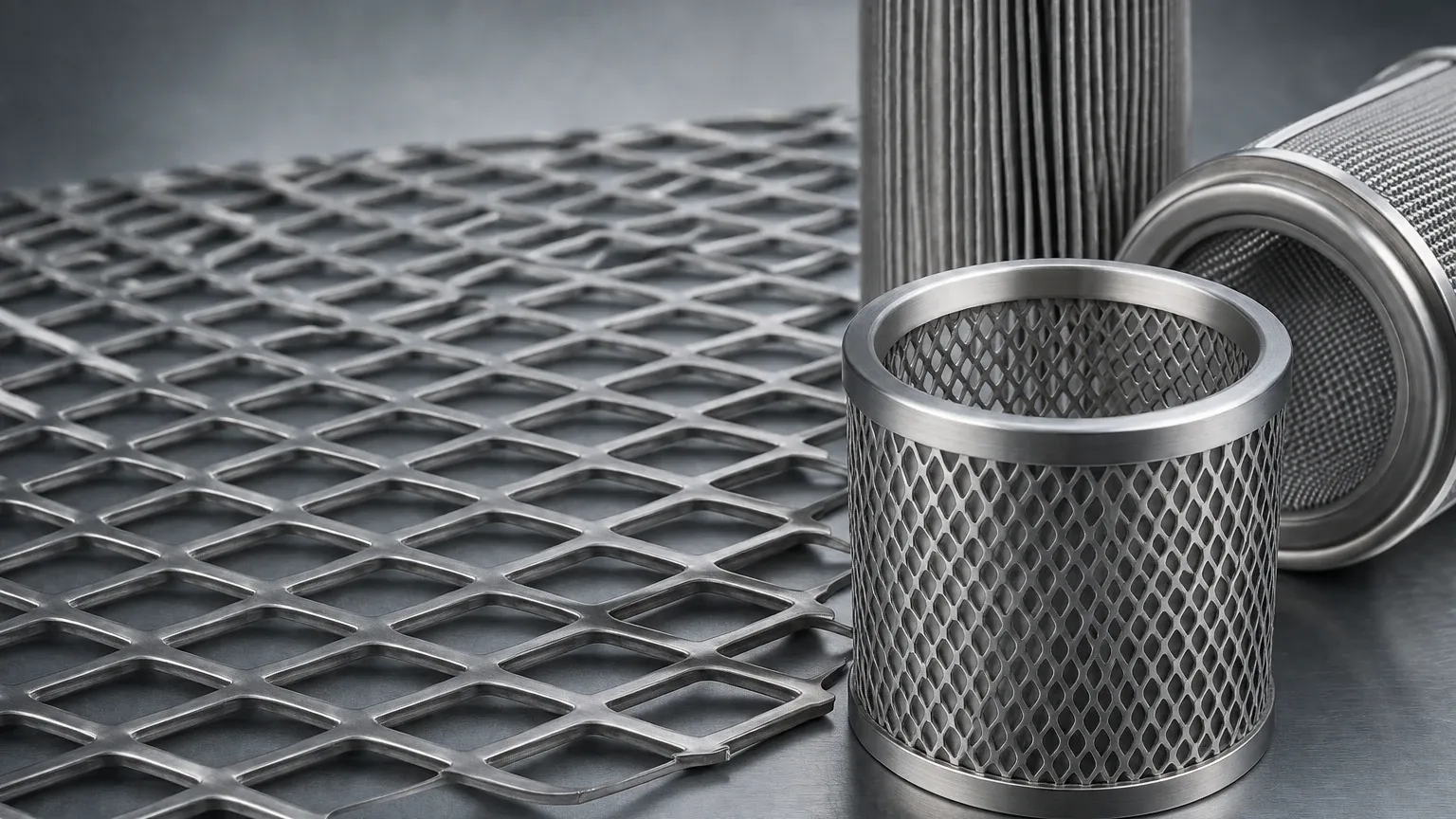
In its standard form, number 9 expanded metal is produced by simultaneously slitting and stretching the metal. The strands and bonds are set at a uniform angle to the plane of the sheet. This creates a three-dimensional texture that provides:
1. High Strength-to-Weight Ratio: The angled strands act as structural trusses, providing excellent rigidity.
2. Directional Flow Control: The angled openings can be used to deflect or direct fluid and air flow.
3. Enhanced Grip: In non-filtration contexts, the raised surface provides a slip-resistant area.
Flattened Expanded Metal
Flattened expanded metal is produced by passing the standard raised sheet through a cold-roll reducing mill. This process flattens the strands and bonds into a single plane, resulting in a smooth, level surface. For the filtration industry, flattened number 9 expanded metal is often preferred because it provides a consistent, flush surface for supporting fine wire mesh or synthetic filter media. This prevents the support structure from puncturing or abrading the delicate primary filtration layers during high-pressure cycles.
Material Selection: The Role of Stainless Steel
While carbon steel is common for general industrial use, Kaifil specializes in stainless steel Perforated & Expanded Metal solutions to meet the rigorous demands of the chemical, pharmaceutical, and food processing industries. Choosing the correct alloy for number 9 expanded metal is vital for preventing premature failure due to corrosion or high temperatures.
Grade 304 Stainless Steel
Grade 304 is the standard "18/8" stainless steel. It is frequently used for #9 expanded metal in environments where moisture is present but where highly corrosive chemicals are not the primary concern. It offers excellent weldability and formability for creating filter baskets and support cylinders.
Grade 316/316L Stainless Steel
For applications involving marine environments, chlorides, or acidic chemical processing, Grade 316 stainless steel is the preferred choice. The addition of molybdenum enhances pitting resistance. In filtration systems handling aggressive solvents or wastewater, 316L (low carbon) is often specified to prevent sensitization during welding, ensuring the integrity of the mesh bonds.
Applications in Industrial Filtration and Support
Number 9 expanded metal is a cornerstone material in the construction of heavy-duty industrial filters. Its thickness (0.134") provides the necessary physical barrier and structural skeleton required for high-differential pressure applications.
Filter Core Support
In large-scale liquid and gas filtration, the primary filter media (such as sintered mesh or pleated fabric) often lacks the structural strength to withstand the pressure of the process flow. Number 9 expanded metal is rolled into cylinders to serve as an internal or external support core. Because it is expanded from a single piece of metal, there are no joins or welds within the mesh itself (other than the final seam), which eliminates potential points of failure found in woven or welded wire products.
Industrial Strainers and Grilles
For coarse filtration or the removal of large particulates, #9 expanded metal functions as a primary strainer. Its robust nature allows it to withstand the impact of heavy debris in water intake systems or industrial flumes. The diamond pattern is particularly effective at trapping irregular solids while maintaining a high percentage of open area to minimize pressure drop.
Protective Guards for Filtration Equipment
Beyond the internal components, expanded metal is used to fabricate protective housings and debris guards for sensitive filtration machinery. The #9 gauge provides sufficient impact resistance to protect internal components from mechanical damage in harsh factory environments.
Engineering Considerations for Selection
When evaluating number 9 expanded metal for a specific project, engineers must account for several performance factors to ensure the material meets the application's lifecycle requirements.
Open Area and Flow Dynamics
The percentage of open area is a critical calculation for any filtration component. For number 9 expanded metal, the open area can range from 30% to over 70%, depending on the SWD and LWD chosen. A higher open area reduces resistance to flow (Delta P) but may compromise the structural support provided to the primary filter media. Engineers must balance these two competing requirements based on the viscosity of the fluid and the expected flow velocity.
Load-Bearing Capacity
Because #9 gauge is relatively thick, it is often used in applications where the mesh must support significant weight or pressure. In horizontal filtration beds, the orientation of the diamonds (SWD vs. LWD) relative to the support beams significantly affects the deflection rate. Generally, the SWD should run parallel to the span for maximum strength.
Corrosion and Fouling
In many industrial processes, the accumulation of solids (fouling) can occur on the support structure. The smooth surface of flattened stainless steel #9 expanded metal is easier to clean via backwashing or chemical CIP (Clean-in-Place) cycles compared to raised mesh, which may trap particles in the angled crevices of the strands.
Customization and OEM Capabilities
Standard off-the-shelf expanded metal sheets often require further processing to be integrated into industrial filtration systems. Working with a specialized manufacturer like Kaifil allows for precise customization that aligns with specific engineering drawings.
Precision Cutting and Forming
Number 9 expanded metal can be difficult to work with due to its thickness. Advanced manufacturing facilities utilize heavy-duty shearing and CNC punching to provide exact dimensions. Furthermore, specialized rolling equipment is required to form #9 gauge material into small-diameter cylinders for filter cores without distorting the diamond pattern.
Welding and Assembly
Integrating expanded metal into a filter assembly often involves TIG or MIG welding to end caps, flanges, or other housing components. Proper welding technique is essential to ensure that the bonds of the expanded metal are not weakened by excessive heat, which could lead to stress corrosion cracking in stainless steel alloys.
Total Cost of Ownership and Replacement Cycles
While number 9 expanded metal may have a higher initial material cost than thinner gauges or plastic alternatives, its total cost of ownership is often lower in industrial settings. The durability of 0.134" thick stainless steel significantly extends the replacement cycle, reducing downtime and maintenance labor.
When inspecting filtration systems, engineers should look for signs of "blinding" (permanent clogging), strand thinning due to erosion, or deformation of the diamond pattern. If the support structure shows signs of bowing, it indicates that the differential pressure has exceeded the material's yield strength, necessitating a move to a more robust specification or a change in the support configuration.
Conclusion
Number 9 expanded metal is a vital component for industrial applications requiring a balance of high strength, significant open area, and durability. Whether used as a support core for sophisticated filtration media or as a heavy-duty strainer in its own right, this material provides the structural foundation necessary for reliable industrial processing. By selecting the appropriate material grade—typically 304 or 316 stainless steel for filtration—and choosing between raised and flattened profiles, engineers can optimize their systems for performance and longevity.
For technical teams seeking to integrate high-performance filtration components, reviewing the available Perforated & Expanded Metal options is the first step toward achieving an engineered solution that meets specific operational demands. Understanding the physical properties of number 9 expanded metal ensures that the final product will withstand the rigors of the industrial environment while maintaining the necessary filtration accuracy.
