


No 16 Expanded Metal
In the landscape of industrial filtration and structural support, material selection is dictated by the balance between mechanical strength, open area, and chemical resistance. Among the various specifications available to engineers, no 16 expanded metal stands out as a versatile standard. This material, characterized by its specific gauge thickness and the unique geometry of the expansion process, serves as a critical component in the manufacturing of filter cartridges, protective screens, and industrial partitions.
For technical professionals and procurement teams, understanding the nuances of no 16 expanded metal is essential for ensuring the longevity and efficiency of filtration systems. As a specialized manufacturer of Perforated & Expanded Metal, Kaifil emphasizes the importance of precision in these components to meet the rigorous demands of chemical processing, water treatment, and hydraulic applications.
Technical Specifications of No 16 Expanded Metal
The designation "No. 16" primarily refers to the gauge of the base metal sheet before it undergoes the expansion process. In the context of stainless steel or carbon steel, 16 gauge typically corresponds to a nominal thickness of approximately 0.0598 inches (1.52 mm). However, the final properties of the expanded product depend heavily on the expansion ratio and the specific pattern chosen.
Dimensional Terminology
To evaluate no 16 expanded metal for an engineering application, several key dimensions must be confirmed:
1. SWD (Short Way of Design): The distance from the center of one bond to the center of the next bond measured across the short diamond diagonal.
2. LWD (Long Way of Design): The distance from the center of one bond to the center of the next bond measured across the long diamond diagonal.
3. SWO (Short Way of Opening): The actual width of the opening measured across the short diagonal.
4. LWO (Long Way of Opening): The actual length of the opening measured across the long diagonal.
5. Strand Width: The amount of metal fed into the expanding machine between the dies to create one strand.
6. Strand Thickness: The thickness of the original base metal (in this case, 16 gauge).
Standard vs. Flattened
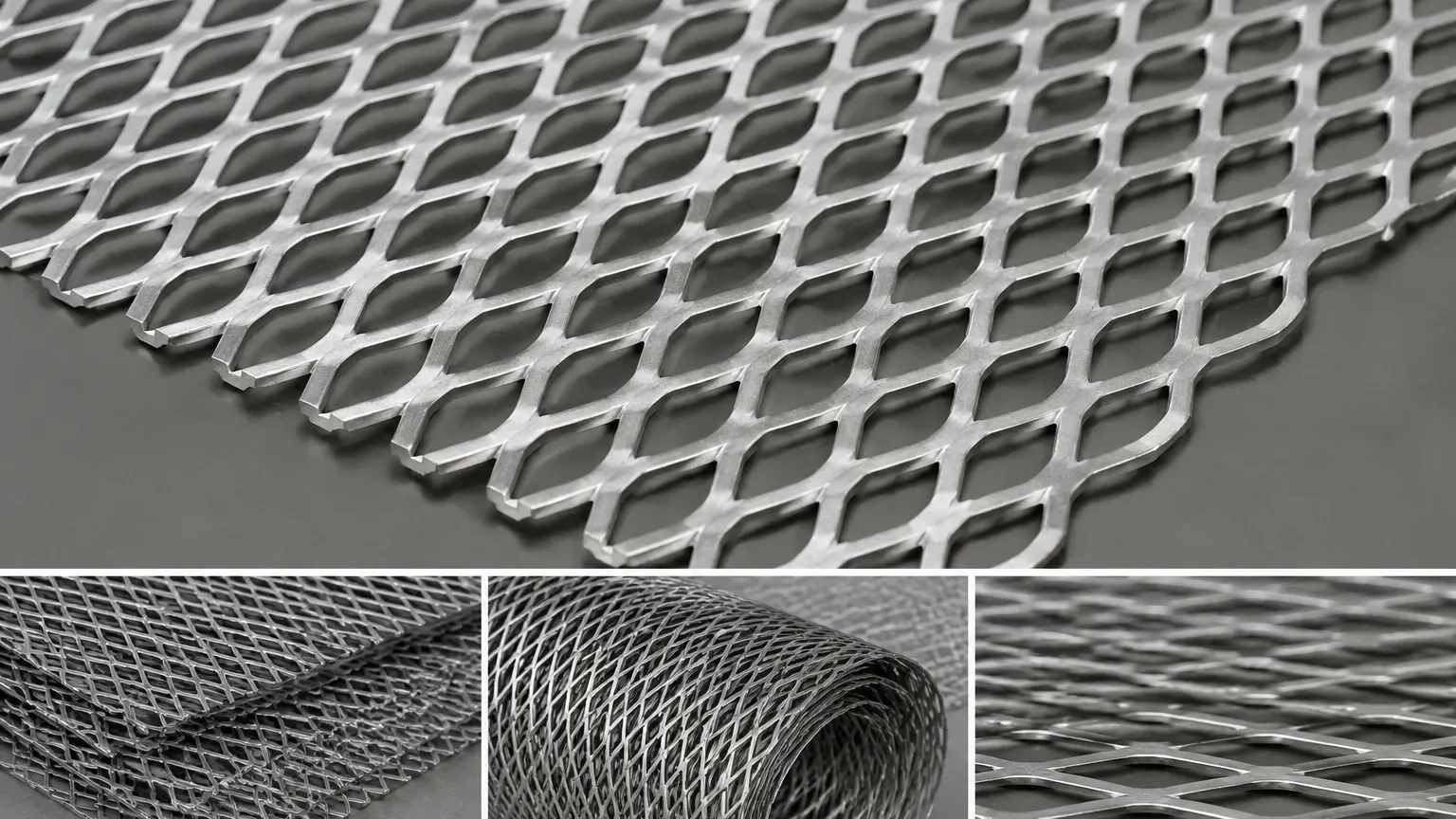
No 16 expanded metal is available in two primary forms: standard (raised) and flattened.
* Standard Expanded Metal: This is the product as it comes off the expanding machine. The strands and bonds are set at a uniform angle to the plane of the sheet, providing a three-dimensional texture. This structure offers maximum rigidity and a high strength-to-weight ratio, making it ideal for support cages in heavy-duty filter cartridges.
* Flattened Expanded Metal: This is standard expanded metal that has been cold-rolled through a reducing mill. The process flattens the strands and bonds into a single plane, reducing the overall thickness and creating a smooth surface. Flattened no 16 expanded metal is often preferred when the material must be integrated into tight tolerances or when a smooth surface is required to prevent damage to secondary filter media, such as fine wire mesh or non-woven fabrics.
Material Selection and Corrosion Resistance
While no 16 expanded metal can be produced from various materials, industrial filtration applications almost exclusively demand stainless steel due to its superior corrosion resistance and thermal stability. At Kaifil, we focus on high-performance alloys to ensure compatibility with aggressive process fluids.
Stainless Steel 304/304L
Grade 304 is the most common choice for general industrial use. It provides excellent forming and welding characteristics. For applications involving welding, the low-carbon version (304L) is often specified to minimize carbide precipitation and maintain corrosion resistance in the heat-affected zone.
Stainless Steel 316/316L
For environments involving chlorides, acids, or high temperatures—such as marine applications or chemical reactors—Grade 316 is the standard. The addition of molybdenum enhances pitting resistance. Like 304L, the 316L variant is used to ensure structural integrity after welding in corrosive environments.
Surface Treatments
To further enhance the performance of no 16 expanded metal, several surface treatments may be applied:
* Pickling and Passivation: Removes surface contaminants and restores the protective oxide layer.
* Electropolishing: Provides a microscopically smooth surface, which is critical in food and beverage or pharmaceutical applications to prevent bacterial growth and facilitate cleaning.
* Galvanizing: For carbon steel variants, hot-dip galvanizing provides a cost-effective barrier against atmospheric corrosion.
Role in Industrial Filtration Systems
In the filtration industry, no 16 expanded metal is rarely a standalone filter medium for fine particles. Instead, it serves as a foundational component that enables the performance of more delicate filtration layers.
Support Cages and Cores
In high-pressure hydraulic or process fluid systems, fine wire mesh or pleated paper media lack the structural integrity to withstand the differential pressure. No 16 expanded metal is rolled into cylinders to form the inner core or outer cage of a filter cartridge. Its rigidity prevents the media from collapsing or bursting under flow surges.
Pre-Filtration and Debris Screening
In water intake systems or coarse chemical processing, no 16 expanded metal acts as a primary screen to remove large debris, such as scales, wood chips, or plastic fragments. The diamond-shaped openings are particularly effective at catching irregular shapes that might pass through simple round-hole perforated metal.
Flow Distribution
The three-dimensional nature of standard (raised) expanded metal can be utilized to create turbulence or improve flow distribution across a filter bed. By breaking up laminar flow, it ensures that the entire surface area of the secondary filter media is utilized effectively, thereby extending the service life of the filter element.
Engineering Considerations for Selection
When specifying no 16 expanded metal, engineers must look beyond the gauge and consider the impact of the expansion pattern on the overall system performance.
Open Area Calculation
The percentage of open area determines the pressure drop across the screen. A higher expansion ratio results in larger openings and a higher open area, which reduces flow resistance but also reduces mechanical strength. For no 16 expanded metal, the open area typically ranges from 40% to 70%, depending on the SWD and LWD. Engineers must calculate the required flow rate and maximum allowable pressure drop to select the appropriate pattern.
Weight and Structural Integrity
One of the primary advantages of expanded metal over perforated metal is that it is produced from a single sheet without waste (no slugs are punched out). This makes it lighter than a perforated sheet of the same thickness and material. However, the orientation of the diamonds affects the load-bearing capacity. The LWD should generally run perpendicular to the support spans to maximize the structural strength of the panel.
Compatibility with Secondary Media
If the expanded metal is used as a support for fine wire mesh, the strand width and the smoothness of the bonds are critical. Sharp edges on standard expanded metal can cause point-loading and eventual fatigue failure of the mesh. In these instances, flattened no 16 expanded metal is often the safer engineering choice.
Customization and Manufacturing Precision
Industrial applications often require more than standard off-the-shelf sheets. Customization is a hallmark of professional filtration solutions. At Kaifil, we provide tailored Perforated & Expanded Metal components designed to meet specific housing dimensions and performance targets.
Precision Cutting and Forming
No 16 expanded metal can be sheared to precise tolerances, but the "open" nature of the diamonds requires careful planning to avoid jagged edges or "dangling" strands. Advanced CNC shearing and laser cutting allow for complex shapes and integrated mounting holes, reducing the need for secondary fabrication at the assembly site.
Welding and Assembly
Welding 16-gauge expanded metal requires expertise to avoid burn-through, especially when joining it to heavier flanges or thinner wire mesh. Resistance welding (spot welding) and TIG welding are the preferred methods for creating clean, high-strength joints in stainless steel filtration components.
Maintenance and Replacement Cycles
The durability of no 16 expanded metal makes it a long-term component, but it is not immune to wear. In abrasive environments, such as sand filtration or mining slurry processing, the strands can thin over time. Regular inspection should focus on:
* Erosion of Strands: Checking for significant reduction in strand thickness that could compromise structural integrity.
* Bond Integrity: Inspecting the points where the diamonds meet for signs of stress cracking or fatigue.
* Fouling: Ensuring that the openings are not permanently blinded by debris, which would increase pressure drop and stress the entire system.
Because expanded metal is often a permanent or semi-permanent part of a filter housing or a reusable cartridge core, proper material selection (e.g., opting for 316L over 304) significantly reduces the total cost of ownership by extending replacement intervals.
Conclusion
No 16 expanded metal is a fundamental material in the industrial filtration sector, offering a unique combination of strength, permeability, and cost-efficiency. Whether used as a protective outer wrap, a rigid inner core, or a primary debris screen, its performance is contingent upon precise specification and quality manufacturing.
By understanding the technical distinctions between standard and flattened forms, the importance of material grades, and the engineering impact of open area, purchasing teams and engineers can optimize their filtration systems for better reliability and lower maintenance. For those requiring specialized dimensions or high-grade stainless steel configurations, partnering with an experienced manufacturer ensures that the Perforated & Expanded Metal components will perform as expected in the most demanding industrial environments.
