


Expanded Metal vs Perforated Metal
In the field of industrial filtration and structural component design, selecting the appropriate metal substrate is a critical engineering decision that impacts flow dynamics, structural integrity, and long-term operational costs. Two of the most prevalent materials used for filter support cores, protective cages, and specialized filtration media are expanded metal and perforated metal. While they may appear similar in function, their manufacturing processes, mechanical properties, and performance characteristics differ significantly.
For engineers and procurement professionals, understanding the technical nuances of expanded metal vs perforated metal is essential for optimizing system performance. This guide examines these differences through the lens of industrial filtration and precision manufacturing, providing the factual data needed to make an informed selection for demanding applications.
Manufacturing Processes and Material Integrity
The fundamental difference between these two materials lies in how the apertures are created. This process dictates the physical properties of the finished product and the efficiency of material usage.
Perforated Metal Production
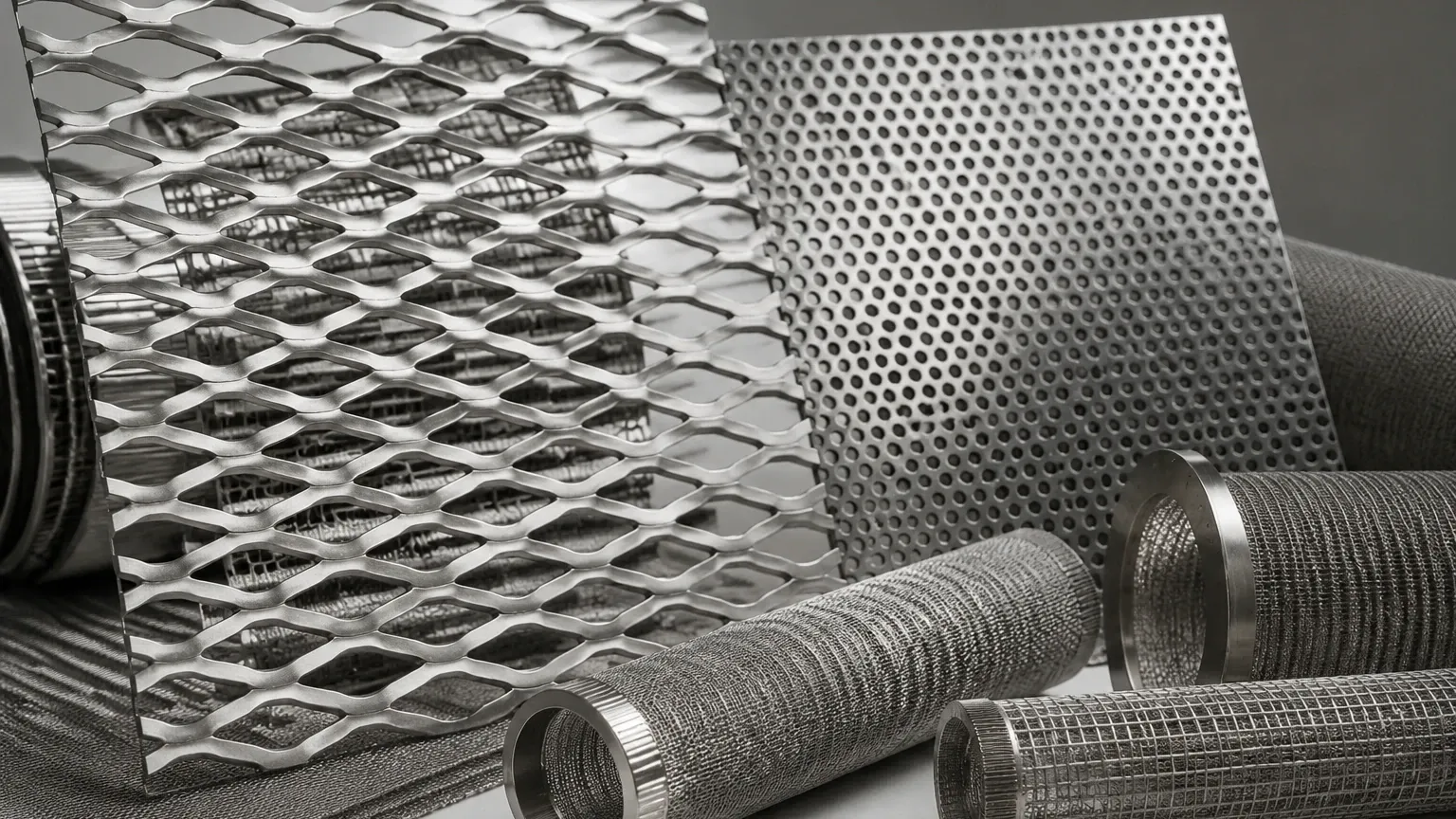
Perforated metal is manufactured through a punching process. A metal sheet is fed through a machine equipped with precision dies that punch out specific shapes—typically round, square, or slotted holes. The material removed during this process, known as the "slug," is discarded as scrap. While this allows for extremely high precision in hole size and spacing, it results in higher material waste, which is reflected in the total cost of the component.
Expanded Metal Production
Expanded metal is produced through a simultaneous slitting and stretching process. A machine slits the metal sheet and then pulls it apart, expanding the slits into diamond-shaped openings. Because no material is removed during this process, there is zero waste. This makes Perforated & Expanded Metal production highly sustainable and cost-effective. The resulting mesh is a single, continuous piece of metal without any joins or welds, which contributes to its inherent structural strength.
Strength-to-Weight Ratio and Structural Stability
When evaluating expanded metal vs perforated metal for structural support in filter cartridges or industrial screens, the strength-to-weight ratio is a primary consideration.
Expanded metal generally offers a superior strength-to-weight ratio. Because the strands and bonds are angled to the plane of the sheet, the material possesses a three-dimensional rigidity that flat perforated sheets lack. In filtration applications, this means expanded metal can often support higher pressure differentials without deforming, even when using a thinner gauge of base material.
Perforated metal, conversely, remains a flat two-dimensional surface. While it is incredibly strong, its strength is limited by the amount of material remaining between the holes (the "bridges"). If the open area requirement is high, the bridges become narrow, potentially compromising the structural integrity of the cylinder or panel under high-flow conditions. However, perforated metal is easier to form into perfectly concentric cylinders for high-precision filter cores where tight tolerances are required for end-cap fitment.
Filtration Precision and Open Area Calculations
The choice between these materials often hinges on the specific filtration requirements: is the material acting as the primary filter media or as a secondary support structure?
Precision of Apertures
Perforated metal is the clear choice when precise filtration accuracy is required. Punching technology allows for holes as small as 0.5mm with high consistency. Engineers can specify the exact hole diameter and pitch to achieve a calculated flow rate and particle retention size. This level of predictability is vital in chemical processing and pharmaceutical applications where validated performance is mandatory.
Open Area and Flow Rates
Expanded metal is often preferred when the goal is to maximize open area and minimize pressure drop. The expansion process can create products with up to 80% or 90% open area, which is difficult to achieve with perforated metal without making the sheet too fragile for industrial use. In pre-filtration or as a protective outer wrap, expanded metal allows for high-volume fluid passage with minimal resistance.
Economic Considerations and Total Cost of Ownership
From a procurement perspective, the cost difference between expanded metal vs perforated metal can be substantial, particularly when working with expensive alloys like SS316L or Hastelloy.
1. Material Utilization: As noted, expanded metal has zero waste. If you require a high-performance alloy, you are paying only for the material that ends up in the final product. With perforated metal, you are paying for the full weight of the sheet, including the 20% to 60% of material that is punched out and sold back as scrap at a fraction of the original cost.
2. Tooling Costs: Perforated metal often requires specific die sets. While manufacturers like Kaifil maintain a vast library of standard dies, custom hole patterns may incur additional tooling charges. Expanded metal tooling is generally more versatile for varying expansion ratios, though it is primarily limited to diamond-shaped patterns.
3. Secondary Processing: Expanded metal has a naturally raised surface. For applications requiring a smooth finish, it must be "flattened" through a cold-rolling process. This adds a manufacturing step and cost but results in a smooth, 2D product similar to perforated metal.
Application Suitability in Industrial Filtration
Both materials serve distinct roles across various industrial sectors. Selecting the right one depends on the specific environmental stressors and filtration goals.
When to Specify Perforated Metal
* High-Pressure Filter Cores: When a filter cartridge must withstand high collapse pressure, the uniform thickness and predictable strength of perforated stainless steel are advantageous.
* Fine Particle Retention: In applications where the metal itself acts as the filter (e.g., basket strainers), the precision of round-hole perforations ensures consistent particle size exclusion.
* Food and Beverage: The flat, smooth surface of perforated metal is easier to clean and sterilize, meeting stringent hygienic standards in dairy or brewing applications.
When to Specify Expanded Metal
* Support for Pleated Media: Expanded metal is an excellent support for pleated wire mesh or synthetic fiber media. Its angled strands provide "grip" and spacing that helps maintain pleat geometry under flow.
* Air and Gas Filtration: For HVAC or industrial air intake, the high open area of expanded metal provides low resistance and high dust-holding capacity when used as a pre-filter.
* Cost-Sensitive Large-Scale Projects: For large architectural screens or industrial guards where precision to the micron is not required, expanded metal offers significant savings.
Engineering Checklists for Selection
Before finalizing a specification for Perforated & Expanded Metal, engineers should confirm the following technical parameters with their manufacturer:
* Material Grade: Is SS304 sufficient, or does the chemical environment require the superior corrosion resistance of SS316L?
* Effective Open Area: Have you calculated the required flow rate vs. the percentage of open area to ensure the pressure drop (ΔP) remains within system limits?
* Direction of Flow: For expanded metal, the orientation of the diamonds (Long Way of Design vs. Short Way of Design) can affect flow turbulence and structural rigidity.
* Edge Requirements: Does the component require a solid border (common in perforated) for welding, or can it be cut to size from a continuous roll (common in expanded)?
* Surface Finish: Does the application require a burr-free finish? Perforated metal may require electropolishing, while expanded metal may need flattening and degreasing.
Conclusion
In the comparison of expanded metal vs perforated metal, there is no universal "superior" material; rather, there is a technically correct choice based on the application's specific demands. Perforated metal offers unparalleled precision and ease of cleaning, making it the standard for high-accuracy industrial filtration. Expanded metal provides an exceptional strength-to-weight ratio and cost efficiency, making it ideal for support structures and high-flow applications.
By evaluating the trade-offs between material waste, structural geometry, and filtration accuracy, engineering teams can optimize their filtration systems for both performance and budget. Partnering with a specialized manufacturer like Kaifil ensures that these components are produced to exact tolerances, providing reliable service in the most demanding industrial environments.
