


#6 Expanded Metal Thickness
In industrial filtration and structural engineering, the specification of metal components requires a precise understanding of material dimensions and their impact on performance. When discussing #6 expanded metal thickness, engineers and procurement specialists are typically navigating a landscape where "#6" refers to the gauge of the base material or a specific manufacturer designation. Understanding the nuances of this thickness—both the strand thickness and the overall thickness of the expanded sheet—is critical for ensuring the structural integrity of filter housings, support cores, and industrial guards.
As a manufacturer specializing in custom stainless steel filtration solutions, Kaifil provides high-performance Perforated & Expanded Metal components designed to withstand the rigors of chemical processing, hydraulic systems, and water treatment. This guide examines the technical specifications of #6 expanded metal, the variables affecting its thickness, and the engineering considerations necessary for successful implementation.
Defining #6 Expanded Metal in Industrial Contexts
The term "#6" in expanded metal usually refers to the gauge of the sheet or plate from which the material is produced. In the United States Standard Gauge system, 6 gauge represents a substantial thickness, often used in heavy-duty applications where mechanical strength is a primary requirement.
Nominal vs. Actual Thickness
For stainless steel, 6 gauge typically translates to a nominal thickness of approximately 0.1875 inches (4.76 mm). However, it is vital to distinguish between the thickness of the original sheet and the dimensions of the finished expanded product. In the expansion process, the metal is simultaneously slit and stretched, creating a diamond-shaped pattern. This process results in two distinct thickness measurements:
1. Strand Thickness: This is the thickness of the original metal sheet (the 6-gauge measurement). It remains relatively constant during the expansion process, though slight variations can occur depending on the ductility of the alloy.
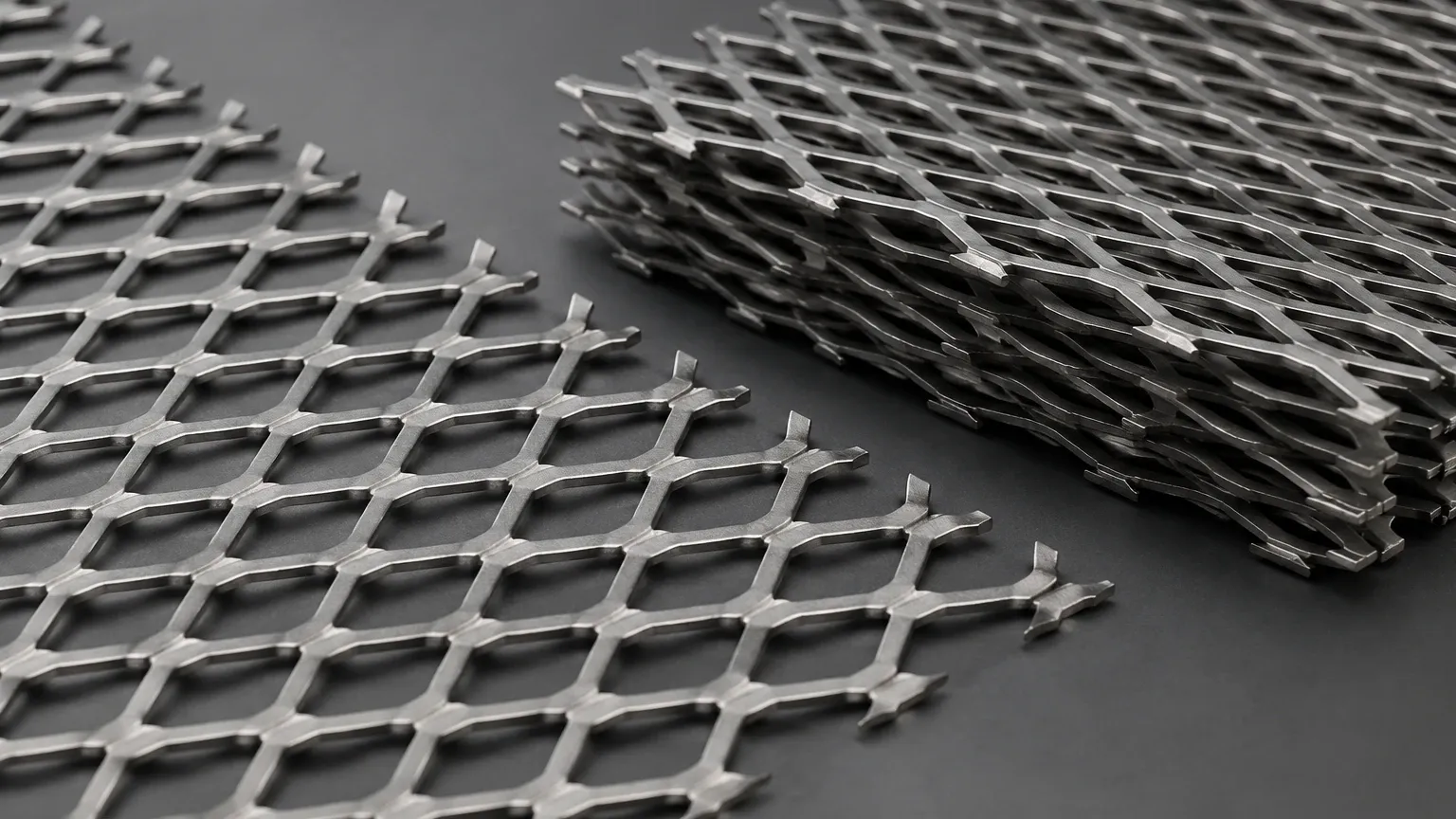
2. Overall Thickness: Also known as the "depth" of the expanded metal, this measurement reflects the total thickness of the sheet from the highest point to the lowest point of the angled strands. For raised (standard) expanded metal, the overall thickness can be two to three times the strand thickness.
The Impact of Flattening on #6 Expanded Metal Thickness
When ordering expanded metal for filtration or industrial use, engineers must choose between "Standard" (Raised) and "Flattened" varieties. This choice significantly alters the final thickness profile of the material.
Standard (Raised) Expanded Metal
In its standard form, the strands are turned at an angle to the plane of the sheet. For #6 expanded metal, this creates a three-dimensional structure that provides excellent grip and high rigidity. The overall thickness is much greater than the 6-gauge base material. This profile is often preferred for filter support structures where the angularity of the strands helps to break up flow patterns or provide a mechanical bond for secondary filter media.
Flattened Expanded Metal
Flattened expanded metal is produced by passing the standard expanded sheet through a cold-roll reducing mill. This process flattens the strands and bonds them back into a single plane.
* Thickness Reduction: Flattening typically reduces the strand thickness by about 5% to 10% and brings the overall thickness very close to the actual strand thickness.
* Surface Consistency: The result is a smooth, flat surface. In filtration applications, flattened #6 expanded metal is used when the component must fit within tight tolerances in a filter housing or when a smooth surface is required to prevent abrasion of delicate filter membranes.
Technical Specifications for #6 Gauge Materials
When specifying #6 expanded metal thickness for industrial projects, it is essential to look at the full dimensional profile. The thickness is only one part of the equation that determines the material's performance.
| Specification | Typical Value (6 Gauge Stainless) | Impact on Performance |
| :— | :— | :— |
| Strand Thickness | ~0.187 – 0.195 inches | Determines tensile strength and durability. |
| Strand Width | Custom (e.g., 0.200 – 0.250 inches) | Affects the open area and weight of the sheet. |
| Overall Thickness (Raised) | ~0.450 – 0.550 inches | Influences the space required for installation. |
| Weight per Square Foot | Varies by pattern (e.g., 3.0 – 4.5 lbs) | Affects the total weight of the filtration assembly. |
For engineers working in the chemical or pharmaceutical sectors, the material choice—most commonly 304 or 316L stainless steel—will also influence the exact #6 expanded metal thickness due to the specific gravity and manufacturing tolerances of different alloys.
Engineering Considerations for Filter Support and Grilles
Selecting #6 expanded metal thickness involves more than just matching a gauge; it requires an analysis of the operational environment. In the context of industrial filtration, the expanded metal often serves as a "backbone" for more delicate wire mesh or pleated media.
1. Pressure Drop and Open Area
The thickness and width of the strands in #6 expanded metal directly influence the percentage of open area. A thicker strand (6 gauge) provides immense strength but may reduce the open area compared to lighter gauges. Engineers must balance the need for structural support against the requirement for low-pressure drop across the filter element.
2. Mechanical Loading and Burst Strength
In hydraulic and high-pressure liquid filtration, the filter core must resist collapsing or bursting under differential pressure. The #6 expanded metal thickness offers high moment of inertia, making it suitable for high-viscosity fluids or systems with significant pressure spikes. The thickness of the material ensures that the diamond apertures do not deform under load, which would otherwise compromise the integrity of the primary filtration layer.
3. Corrosion Allowance
In aggressive chemical environments, material loss due to corrosion is a constant threat. Specifying a #6 gauge (thicker) material provides a greater "corrosion allowance" compared to thinner gauges. This extends the service life of the component, particularly in applications involving acidic or alkaline processing where stainless steel 316L is the standard.
Customization and Manufacturing Precision
At Kaifil, we recognize that standard catalog specifications do not always meet the unique requirements of specialized industrial equipment. When #6 expanded metal thickness is specified, we look at the application's specific geometry.
Precision Slitting and Stretching
The expansion process must be tightly controlled to ensure that the strand thickness remains uniform across the entire sheet. Inconsistencies in thickness can lead to weak points in a filter cartridge, potentially resulting in bypass or structural failure. Our manufacturing process ensures that the expansion ratios are optimized for the #6 gauge base material, maintaining the metallurgical properties of the stainless steel.
Secondary Operations
Often, expanded metal requires secondary processing to be integrated into a final product. This includes:
* Shearing to Size: Maintaining dimensional tolerances for diameter and length.
* Forming and Rolling: Shaping the #6 expanded metal into cylindrical cores for filter cartridges.
* Welding: Utilizing TIG or resistance welding to join the expanded metal, ensuring the joints are as strong as the base material.
Common Risks and Selection Pitfalls
When purchasing #6 expanded metal, procurement teams often encounter challenges that can lead to project delays or performance issues. Awareness of these risks is essential for making informed decisions.
* Gauge Confusion: Ensure that the supplier is using the correct gauge standard (e.g., U.S. Standard vs. Birmingham Gauge). A small difference in the base #6 expanded metal thickness can lead to significant variations in weight and strength.
* Tolerance Overlook: Standard industrial tolerances for expanded metal can be broader than those for cold-rolled sheet. If your application requires high precision (e.g., +/- 0.010 inches), this must be communicated during the design phase.
* Material Substitution: In some cases, "commercial grade" stainless steel may be offered. For critical filtration applications, always insist on certified 304 or 316L to ensure the thickness provides the expected chemical resistance and mechanical properties.
Total Cost Considerations
While #6 expanded metal is heavier and more expensive than thinner gauges, the total cost of ownership (TCO) is often lower in demanding industrial environments. The increased thickness leads to:
* Longer Replacement Cycles: Reduced frequency of filter element failure.
* Lower Maintenance Costs: The rigidity of the #6 gauge material makes it easier to clean and handle without causing damage.
* Enhanced Safety: In guarding and structural applications, the thickness provides a higher safety factor against impact.
Conclusion: Selecting the Right Specification
Understanding #6 expanded metal thickness is a prerequisite for designing durable and efficient industrial components. Whether it is used as a support core in a high-pressure hydraulic filter or as a protective screen in a chemical reactor, the thickness of the material defines its ability to perform under stress.
Engineers should confirm the following before finalizing their specification:
* Is the #6 designation referring to the base gauge or a specific pattern depth?
* Does the application require the three-dimensional strength of raised expanded metal or the flat profile of flattened metal?
* What are the specific tolerances required for integration into the final assembly?
Kaifil provides the technical expertise and manufacturing capabilities to deliver customized Perforated & Expanded Metal solutions that meet these rigorous standards. By focusing on material quality and precision manufacturing, we help our global partners achieve optimized filtration performance and structural reliability. For more information on material selection or to discuss a specific custom design, review our product options and application support to ensure your project benefits from the correct metal specifications.
