


Expanded Metal 13 Gauge
In the landscape of industrial filtration and structural support, material selection is a critical engineering decision that dictates the longevity, efficiency, and safety of a system. Among the various specifications available to engineers, expanded metal 13 gauge stands out as a versatile and robust option. This specific thickness provides a balance between structural rigidity and weight, making it an ideal candidate for demanding environments ranging from chemical processing to heavy-duty hydraulic filtration.
As a specialized manufacturer of Perforated & Expanded Metal and precision filtration components, Kaifil understands that the performance of a filter element often depends on the integrity of its support structure. Expanded metal, produced by simultaneously slitting and stretching a solid sheet of metal, creates a continuous mesh without joins or welds. When specified at a 13-gauge thickness, this material offers the mechanical strength required to withstand high-pressure differentials while maintaining the necessary open area for fluid or gas passage.
Understanding the Technical Specifications of 13 Gauge Expanded Metal
The term "gauge" refers to the thickness of the metal sheet before it undergoes the expansion process. In the context of carbon steel, 13 gauge typically translates to a thickness of approximately 0.0897 inches (2.28 mm), while in stainless steel, it may vary slightly depending on the specific standard used. For engineers, understanding the precise decimal thickness is paramount for calculating the mechanical load-bearing capacity and the overall profile of the filtration component.
When evaluating expanded metal 13 gauge, several geometric factors must be considered:
* SWD (Short Way of Design): The distance from the center of one bond to the center of the next bond measured across the short diamond diagonal.
* LWD (Long Way of Design): The distance measured across the long diamond diagonal.
* Strand Width: The amount of metal fed into the expanding machine between the slits.
* Strand Thickness: The original thickness of the base metal (in this case, 13 gauge).
By manipulating these variables, manufacturers can create a wide range of opening sizes and open area percentages. For industrial filtration, the open area is a decisive factor, as it directly influences the flow rate and the pressure drop across the filter media. A 13-gauge support core provides the necessary stiffness to prevent the collapse of finer filter meshes under high-viscosity or high-velocity flows.
The Role of 13 Gauge Expanded Metal in Industrial Filtration Systems
In many industrial applications, expanded metal is not the primary filtration medium but serves as a vital structural component. Its role is multifaceted, providing both protection and support for more delicate materials like wire mesh or synthetic membranes.
Support Cores for Filter Cartridges
In high-pressure hydraulic and chemical filtration, filter cartridges are often subjected to significant inward or outward pressure. A 13-gauge expanded metal cylinder acts as a rigid internal core or an external cage. Because the expansion process creates a single piece of metal with no welds to fail, the structural integrity is superior to woven components. This ensures that the pleated filter media remains in place and does not deform, which would otherwise lead to bypass or reduced filtration surface area.
Coarse Pre-Filtration
In water treatment and large-scale industrial intake systems, expanded metal 13 gauge can serve as a primary screen to remove large debris. Its durability allows it to withstand the impact of solids without denting or tearing. The diamond-shaped openings are particularly effective at capturing irregular particles while allowing high volumes of fluid to pass through with minimal resistance.
Diffusers and Flow Distributors
In chemical reactors and gas processing units, expanded metal is used to distribute flow evenly across a catalyst bed or a secondary filter stage. The angled strands of expanded metal (in its "raised" form) can help break up laminar flow and promote turbulence, which is often beneficial for heat exchange or mixing processes.
Material Selection: Stainless Steel vs. Carbon Steel for 13 Gauge Mesh
While 13 gauge defines the thickness, the material composition defines the chemical and thermal limits of the component. At Kaifil, we focus on high-performance alloys to meet the rigorous standards of the pharmaceutical, food and beverage, and chemical industries.
Stainless Steel 304 and 316L
For most B2B industrial applications, stainless steel is the preferred choice. Stainless steel 304 offers excellent corrosion resistance for general industrial use. However, for environments involving chlorides, acids, or high moisture (such as marine or pharmaceutical applications), stainless steel 316L is recommended. The "L" denotes low carbon content, which improves weldability and reduces the risk of intergranular corrosion at the points where the expanded metal is joined to end caps or flanges.
Specialized Alloys
In extreme environments, such as those found in petrochemical processing, even 316L may be insufficient. In these cases, 13-gauge expanded metal can be produced from Monel, Inconel, or Hastelloy. These materials maintain their structural integrity at extremely high temperatures and resist aggressive chemical attack, ensuring that the filtration system remains operational for extended cycles.
Engineering Performance: Open Area, Flow Rates, and Structural Integrity
One of the primary advantages of using expanded metal 13 gauge is the ability to customize the "Open Area Percentage." This is the ratio of the area of the openings to the total area of the sheet. For an engineer, calculating this is essential for determining the total flow capacity of a filter.
If the open area is too low, the pressure drop (delta P) will be too high, leading to increased energy consumption by pumps and potential system failure. Conversely, if the open area is too high, the structural integrity of the 13-gauge sheet may be compromised. Finding the "sweet spot" requires a deep understanding of the mechanical properties of the expanded diamonds.
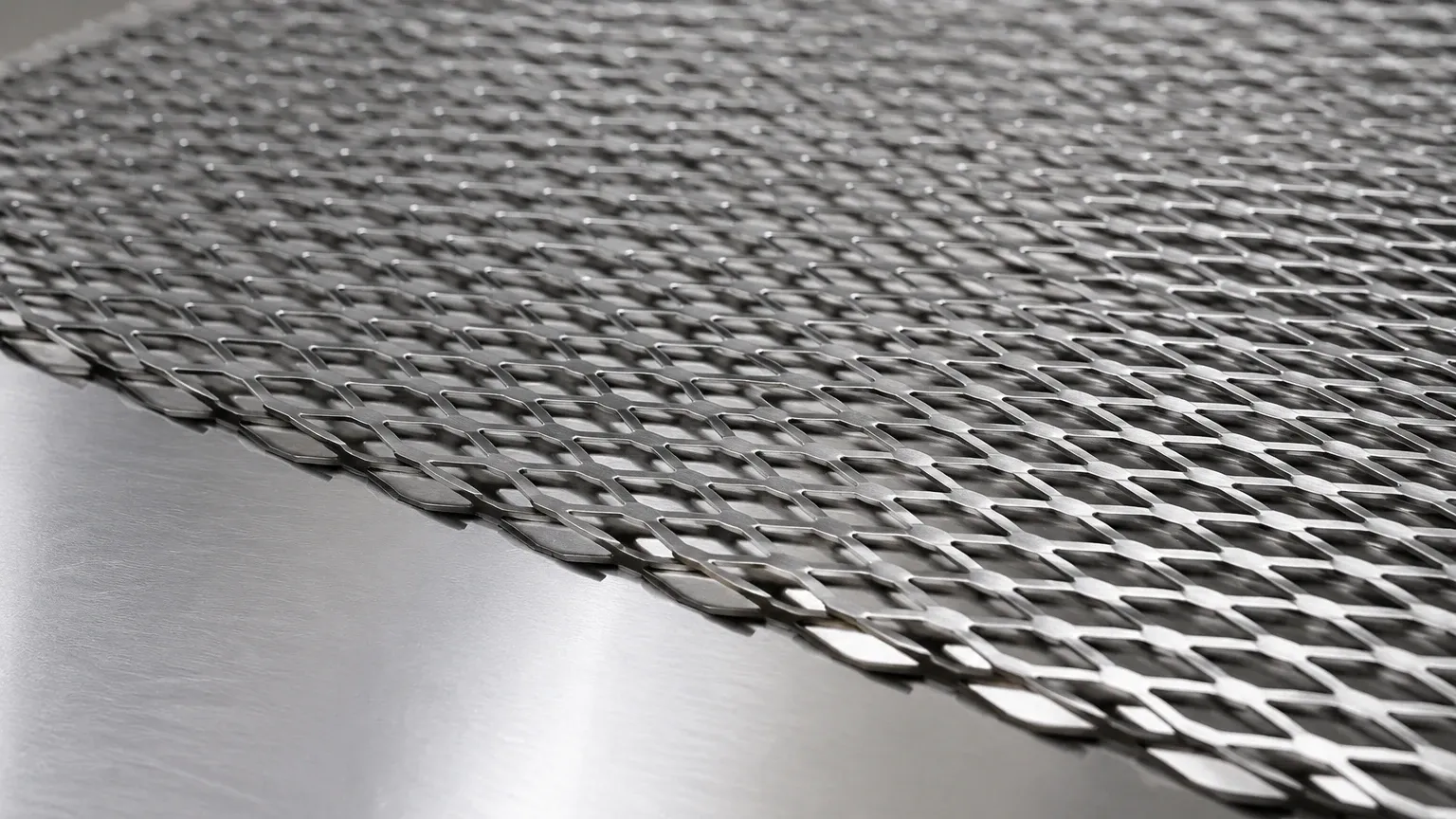
Because expanded metal is stretched, the strands are set at an angle to the plane of the sheet. This creates a three-dimensional structure that is significantly stiffer than a flat perforated sheet of the same gauge. For 13-gauge material, this stiffness allows for the use of larger sheets or longer filter cartridges without the need for additional reinforcing ribs, thereby simplifying the design and reducing the total cost of the assembly.
Manufacturing Processes: Flattened vs. Raised Expanded Metal
When ordering expanded metal 13 gauge, engineers must specify whether they require the material in its "standard" (raised) or "flattened" state.
Raised Expanded Metal
This is the product as it comes off the expanding machine. The strands and bonds are set at a uniform angle. This provides maximum rigidity and a slip-resistant surface. In filtration, raised expanded metal is often used as an outer guard for cartridges because the angled strands can deflect large particles and protect the inner filter media from mechanical damage during handling or installation.
Flattened Expanded Metal
Flattened expanded metal is produced by passing the standard expanded metal through a cold-roll reducing mill. This process flattens the strands and bonds into a single plane, reducing the overall thickness and creating a smooth surface. Flattened 13-gauge expanded metal is ideal when the mesh must be in direct contact with a fine wire cloth or a delicate membrane. The smooth surface prevents the support structure from abrading or puncturing the primary filtration layer during pressure fluctuations.
Critical Selection Criteria for Engineers and Purchasing Teams
Before finalizing a purchase of expanded metal 13 gauge for industrial filtration, several technical factors must be confirmed with the manufacturer to ensure the product meets the application's demands.
1. Chemical Compatibility: Ensure the metal alloy is compatible with the process fluid. For example, in food processing, 316-grade stainless steel is often a regulatory requirement to prevent contamination.
2. Dimensional Tolerances: Expanded metal can have slight variations in diamond size and sheet flatness. For precision filtration components, specify the allowable tolerances for LWD and SWD to ensure proper fitment within the filter housing.
3. Edge Conditions: Will the expanded metal be supplied with "random sheared" edges or "bond sheared" (closed) edges? Bond sheared edges are generally safer for handling and provide a more stable surface for welding to other components.
4. Surface Finish: In pharmaceutical or food applications, the expanded metal may require electropolishing or passivating to remove surface impurities and improve corrosion resistance. Confirm if the 13-gauge material requires a specific Ra (Roughness Average) value.
5. Load Requirements: If the expanded metal is acting as a floor grate or a heavy-duty support, the orientation of the diamonds (LWD vs. SWD) relative to the span is crucial. Expanded metal is much stronger when the LWD runs perpendicular to the support members.
Total Cost of Ownership and Maintenance
While the initial cost of expanded metal 13 gauge is a factor, B2B purchasing teams should focus on the total cost of ownership. Expanded metal is inherently more cost-effective than perforated metal because the process involves no scrap; the material is stretched rather than punched. This makes high-grade alloys like stainless steel 316 more affordable in an expanded format.
Furthermore, the durability of 13-gauge material reduces the frequency of replacement. In many industrial filtration systems, the support structure is designed to last the entire life of the equipment, with only the inner filter media being replaced periodically. By choosing a robust 13-gauge expanded metal core, engineers can prevent catastrophic failures that lead to expensive downtime and potential damage to downstream equipment.
Conclusion
Expanded metal 13 gauge is a cornerstone material for industrial filtration and structural engineering. Its unique combination of strength, open area, and cost-efficiency makes it an indispensable component in the manufacture of high-performance filter cartridges and protective screens. By understanding the nuances of gauge thickness, material properties, and the expansion process, engineers can optimize their systems for maximum durability and flow efficiency.
At Kaifil, we provide customized solutions tailored to the specific needs of our global clients. Whether you require flattened stainless steel 316 for a pharmaceutical filter or raised carbon steel for an industrial intake screen, our engineering team is ready to assist with material selection and design optimization. For more information on our capabilities and to explore our full range of products, please visit our Perforated & Expanded Metal section to review product options and application support.
