


1 4 Expanded Metal
In the landscape of industrial filtration and structural reinforcement, material selection is dictated by the balance between mechanical integrity and functional permeability. Among the various configurations available, 1 4 expanded metal—specifically referring to expanded metal with a nominal 1/4-inch diamond opening—stands out as a critical component for precision applications. Unlike woven wire mesh or perforated sheets, expanded metal offers a unique structural profile that is manufactured through a process of simultaneous slitting and stretching. This results in a continuous, jointless piece of metal that retains the inherent strength of the original sheet while providing a high strength-to-weight ratio.
For engineers and procurement specialists, understanding the technical nuances of Perforated & Expanded Metal is essential for optimizing the performance of filtration systems, protective guards, and industrial partitions. This guide examines the engineering specifications, material considerations, and application-specific advantages of 1 4 expanded metal in demanding industrial environments.
Understanding the Geometry of 1 4 Expanded Metal
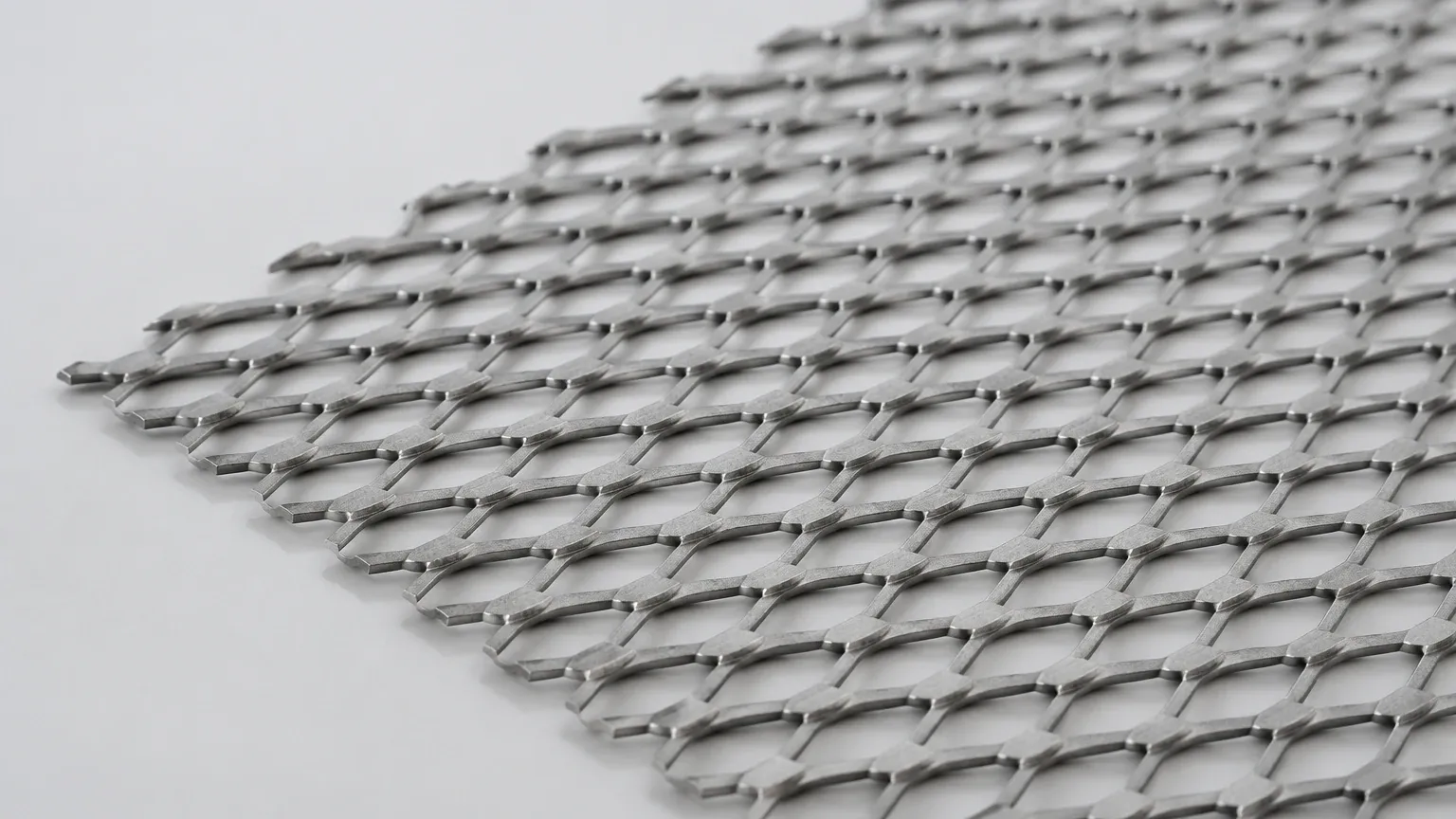
The performance of 1 4 expanded metal is defined by its geometric dimensions, which differ significantly from standard perforated holes. When evaluating this material, engineers must distinguish between the "Short Way of Design" (SWD) and the "Long Way of Design" (LWD). In the case of 1 4 expanded metal, the 1/4-inch designation typically refers to the SWD, which is the distance from the center of one bond to the center of the next bond across the short axis of the diamond.
Key geometric parameters include:
* SWD (Short Way of Design): The nominal 1/4-inch dimension that dictates the width of the diamond opening.
* LWD (Long Way of Design): The length of the diamond, usually ranging from 0.5 inches to 1.0 inch depending on the specific tool set used during expansion.
* Strand Width: The amount of metal fed into the expanding machine between slits. This determines the "thickness" of the diamond walls when viewed from the side.
* Strand Thickness: The original thickness of the base metal sheet.
* Opening Size (SWO and LWO): The actual clear space through which fluids or particles pass. For 1 4 expanded metal, the SWO (Short Way of Opening) is slightly less than 1/4 inch due to the strand width.
Because the expansion process does not involve removing material—unlike perforation—the resulting mesh is structurally sounder than a punched sheet of the same weight. The "bonds" (the points where the strands intersect) remain intact, providing a rigid framework that resists unraveling even if individual strands are cut.
Material Properties and Chemical Compatibility
For industrial filtration and chemical processing, the choice of alloy is as critical as the mesh geometry. Kaifil specializes in stainless steel solutions, which are the industry standard for 1 4 expanded metal in corrosive or high-temperature environments.
Stainless Steel 304
This is the most common grade for general industrial use. It offers excellent formability and weldability. In 1 4 expanded metal configurations, Type 304 provides sufficient corrosion resistance for most water treatment, food processing, and architectural applications. It is cost-effective but may be susceptible to pitting in high-chloride environments.
Stainless Steel 316/316L
For chemical processing, pharmaceutical manufacturing, and marine applications, Type 316 is preferred. The addition of molybdenum enhances resistance to chloride-induced pitting and crevice corrosion. When 1 4 expanded metal is used as a support layer in filter cartridges that undergo aggressive chemical cleaning cycles, 316L (the low-carbon version) is often specified to prevent sensitization during welding.
Other Alloys
While stainless steel is the primary focus for high-performance filtration, 1 4 expanded metal can also be produced in carbon steel, aluminum, and specialty alloys like Monel or Inconel for extreme temperature or highly acidic environments. Engineers must confirm that the selected material’s thermal expansion coefficient and yield strength align with the operating pressures of the filtration system.
Raised vs. Flattened: Selecting the Right Profile
One of the most important decisions when specifying 1 4 expanded metal is whether to use the "Raised" (Standard) or "Flattened" profile. This choice significantly impacts flow dynamics and mechanical fit.
Raised (Standard) Expanded Metal
In its raw state after expansion, the strands are set at an angle to the original plane of the sheet. This creates a three-dimensional surface that provides:
* Enhanced Rigidity: The angled strands act like structural beams, increasing the sheet's resistance to bending.
* Improved Grip and Deflection: The raised edges are ideal for applications requiring air turbulence or mechanical interlocking.
* Directional Flow: The angled profile can be used to deflect fluid or air in a specific direction, which is useful in certain separator designs.
Flattened Expanded Metal
Flattened 1 4 expanded metal is produced by passing the raised sheet through a cold-rolling reducing mill. This process levels the strands and bonds into a single plane. The advantages include:
* Surface Smoothness: Critical when the expanded metal is used as a support for fine wire mesh or filter paper. A flat surface prevents the delicate filter media from being punctured or abraded by raised edges.
* Dimensional Consistency: Flattening ensures a uniform thickness across the entire sheet, which is vital for components that must fit into tight tolerances within a filter housing.
* Ease of Cleaning: Without the crevices created by angled strands, flattened metal is easier to sanitize in food and pharmaceutical applications.
The Role of Expanded Metal in Industrial Filtration Systems
In the context of Kaifil’s expertise, 1 4 expanded metal is rarely a standalone filter. Instead, it serves as a foundational component in multi-stage filtration assemblies. Its primary roles include:
1. Support Cages for Filter Cartridges
High-pressure filtration systems often utilize pleated wire mesh or synthetic media. These media lack the structural integrity to withstand high differential pressures (ΔP). A cylinder of 1 4 expanded metal acts as an internal or external support cage, preventing the filter media from collapsing or bursting under load. The 1/4-inch diamond size is often the "sweet spot"—small enough to provide continuous support to the media, but large enough to maintain a high open area.
2. Coarse Pre-Filtration
In water treatment or hydraulic systems, 1 4 expanded metal can serve as a primary strainer to remove large debris, scale, or stones before the fluid reaches more sensitive fine filters. This protects the expensive downstream components from mechanical damage and extends the service life of the entire system.
3. Flow Diffusers
When placed at the inlet of a pressure vessel, 1 4 expanded metal helps to break up high-velocity fluid streams, ensuring a more uniform flow distribution across the face of the primary filter element. This prevents "channeling," where the fluid bypasses large portions of the filter media, leading to premature localized clogging.
Engineering Considerations: Open Area and Flow Dynamics
When integrating 1 4 expanded metal into a B2B industrial design, engineers must calculate the percentage of open area to ensure it does not become a bottleneck in the system. Unlike perforated metal, where the open area is a simple ratio of hole area to total area, expanded metal calculations must account for the strand width and the angle of the strands (in raised versions).
Open Area Calculation Factors:
* Percent Open Area: For a standard 1 4 expanded metal (e.g., #18 gauge), the open area typically ranges from 40% to 60%. Increasing the strand width reduces the open area but increases the structural load capacity.
* Pressure Drop (ΔP): Because expanded metal creates more turbulence than perforated metal, the pressure drop may be slightly higher at high flow velocities. In gas filtration, this turbulence can be beneficial for capturing particulate through impingement, but in liquid systems, it must be balanced against energy costs.
* Effective Aperture: Engineers must consider the "projected" opening. If fluid is hitting the metal at an angle, the effective opening size may be smaller than the nominal 1/4-inch SWD.
Procurement Guidelines for Custom Filtration Components
To ensure a successful procurement process for 1 4 expanded metal components, purchasing teams should provide manufacturers with a comprehensive set of specifications. At Kaifil, we recommend confirming the following details to avoid common pitfalls in industrial applications:
1. Style Designation: Specify both the gauge (thickness) and the nominal opening (e.g., 1/4" #18). Note that "#18" in expanded metal terminology refers to the approximate thickness of the metal before expansion.
2. Edge Conditions: Do you require "Bond Sheared" or "Random Sheared" edges? Bond shearing results in a closed diamond edge, which is safer to handle and easier to weld into frames. Random shearing leaves open prongs, which may be acceptable if the piece is being fully encapsulated.
3. Tolerances: Standard industrial tolerances for expanded metal are often broader than for machined parts. If the component must fit into a precision-machined filter housing, specify tighter tolerances for sheet width and length.
4. Surface Finish: For stainless steel, specify if the part requires passivating (to enhance corrosion resistance), electropolishing (for a mirror-like, ultra-clean finish), or simply a mill finish.
5. Direction of Diamond: In many filtration designs, the orientation of the LWD (Long Way of Design) relative to the flow or the structural supports is critical. Always specify if the LWD should run parallel or perpendicular to the long dimension of the part.
By focusing on these technical parameters, engineers can leverage the unique benefits of 1 4 expanded metal to create durable, efficient, and cost-effective filtration solutions. Whether used as a protective screen or a structural substrate, this material remains a cornerstone of modern industrial engineering. For more detailed specifications on available patterns and material grades, you can Review product options and application support to align your selection with specific operational requirements.
