


1 8 Expanded Metal
In industrial engineering and filtration design, selecting the appropriate structural support material is critical for ensuring the longevity and efficiency of a system. Among the various options available, 1/8" expanded metal—specifically referring to the Short Way of the Diamond (SWD) measurement—stands out as a versatile and robust solution. This material is widely utilized across the chemical processing, pharmaceutical, and food and beverage sectors, where precision and durability are non-negotiable.
Unlike traditional Perforated & Expanded Metal processes that involve punching holes and creating scrap, expanded metal is manufactured through a simultaneous slitting and stretching process. This method ensures no material waste while creating a rigid, one-piece structure that offers a high strength-to-weight ratio. For engineers, understanding the technical nuances of 1/8" expanded metal is essential for optimizing filter cartridges, protective guards, and structural components.
Understanding the Technical Geometry of 1/8" Expanded Metal
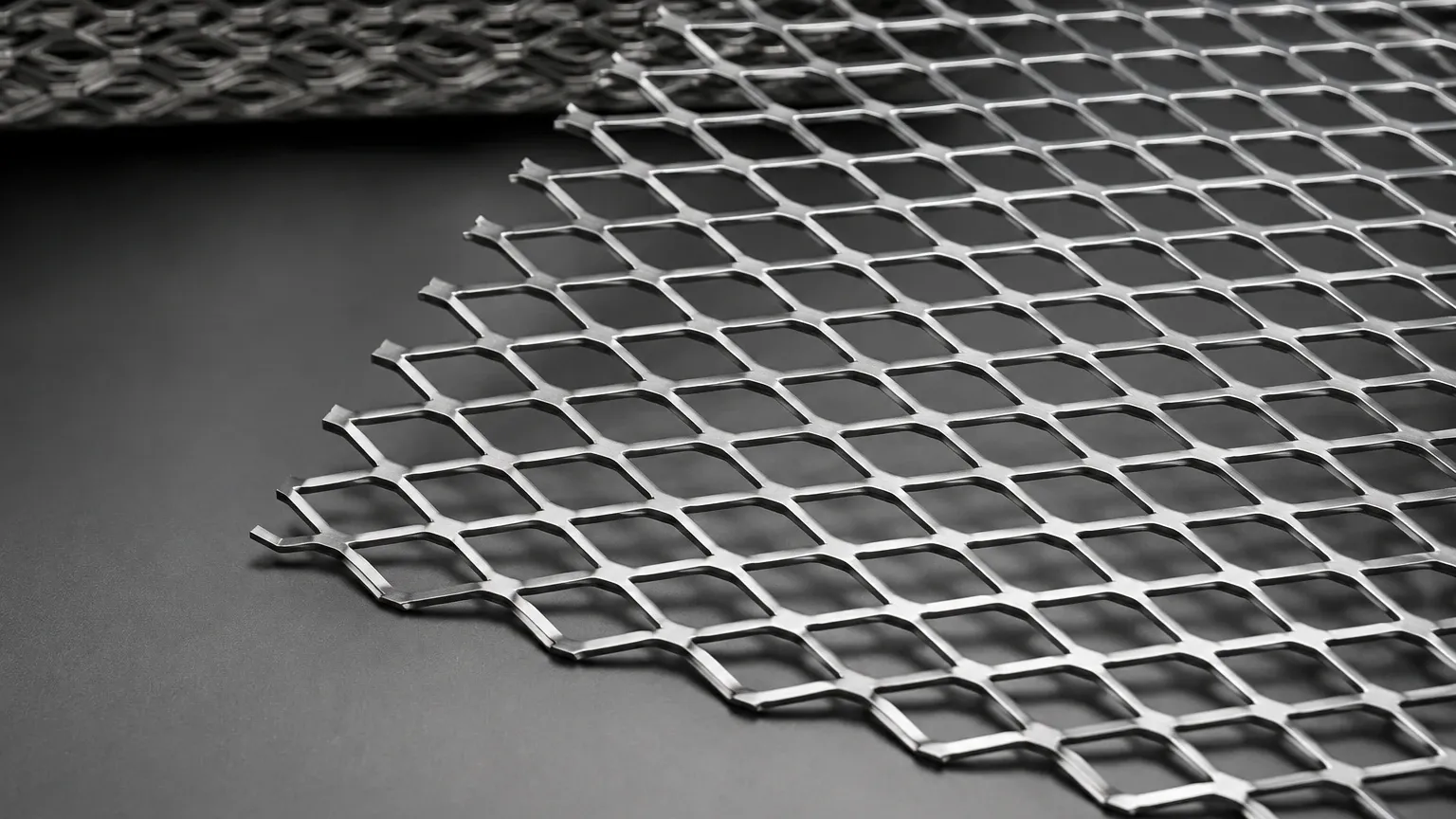
The term "1/8 expanded metal" typically identifies the nominal size of the diamond-shaped openings. In technical specifications, this is defined by the Short Way of the Diamond (SWD). To accurately specify this material for an industrial project, engineers must consider several geometric variables:
1. SWD (Short Way of the Diamond): The distance from the center of a bond to the center of the next bond across the short axis. In this case, it is nominally 0.125 inches.
2. LWD (Long Way of the Diamond): The distance across the long axis of the diamond. This measurement varies depending on the degree of stretching during the manufacturing process.
3. Strand Width: The amount of metal fed into the expanding machine between each stroke.
4. Strand Thickness: The original thickness of the base metal sheet.
These dimensions collectively determine the "Percent Open Area," a critical metric for fluid dynamics and airflow calculations. In filtration applications, the open area must be maximized to minimize pressure drop while maintaining enough surface area to support the primary filter media.
Standard vs. Flattened Expanded Metal
When sourcing 1/8" expanded metal, engineers must choose between two primary finishes: Standard (Raised) and Flattened. Each offers distinct mechanical advantages depending on the application.
Standard (Raised) Expanded Metal
In its standard form, the strands and bonds are set at a uniform angle to the plane of the sheet. This creates a three-dimensional surface that provides exceptional rigidity and a high degree of slip resistance. In industrial filtration, raised expanded metal is often used as a protective outer cage for filter elements, where its structural stiffness protects the internal mesh from mechanical impact and handling damage.
Flattened Expanded Metal
Flattened expanded metal is produced by passing the standard expanded sheet through a cold-roll reducing mill. This process flattens the strands and bonds into a single plane, resulting in a smooth, level surface. Flattened 1/8" expanded metal is the preferred choice for internal support cores in pleated filter cartridges. The smooth surface prevents the fine wire mesh or synthetic media from being abraded or punctured by the sharp edges of raised strands during pressure fluctuations.
Material Selection: The Importance of Stainless Steel
For B2B applications in demanding environments, the choice of alloy is as important as the mesh size. While expanded metal can be produced from carbon steel or aluminum, stainless steel is the industry standard for high-performance filtration and chemical processing.
* Grade 304 Stainless Steel: Offers excellent corrosion resistance and is suitable for most general industrial applications, including water treatment and food processing equipment.
* Grade 316/316L Stainless Steel: Contains molybdenum, which provides superior resistance to chlorides and pitting. This is the authoritative choice for pharmaceutical production, marine environments, and aggressive chemical filtration.
Using stainless steel for 1/8" expanded metal components ensures that the system can withstand rigorous Clean-in-Place (CIP) cycles and exposure to caustic cleaning agents without compromising structural integrity.
Applications in Industrial Filtration Systems
In the context of Kaifil’s expertise in custom filtration solutions, 1/8" expanded metal serves several critical functions. It is rarely used as a standalone filter for fine particles; instead, it acts as the "skeleton" of a multi-stage filtration assembly.
Support Cores for Filter Cartridges
High-pressure hydraulic and chemical systems generate significant differential pressure across filter media. Without a rigid internal core, the filter media would collapse inward. A cylinder formed from 1/8" expanded metal provides the necessary hoop strength to resist these forces while maintaining a high flow rate through its diamond-shaped apertures.
Protective Outer Wraps
For large-scale industrial filters, an outer layer of expanded metal protects the delicate inner layers of fine wire mesh from debris and rough handling. The 1/8" diamond size is small enough to prevent large objects from reaching the mesh but large enough to avoid significant flow restriction.
Flow Diffusers and Strainers
In some water treatment and coarse straining applications, 1/8" expanded metal is used as a primary strainer to remove large particulates before the fluid reaches more sensitive downstream components. Its one-piece construction ensures that no parts of the mesh can break off and contaminate the process stream, a common risk with woven wire mesh if it is not properly secured.
Engineering Considerations: Open Area and Pressure Drop
One of the most common questions engineers face is how 1/8" expanded metal affects the total cost and performance of a system. The primary factor here is the pressure drop ($ΔP$).
Because expanded metal has a specific percentage of open area (typically ranging from 40% to 70% for this size), it creates a predictable resistance to flow. When designing a filter, engineers must calculate the cumulative pressure drop of the expanded metal support, the fine mesh media, and the filter housing.
If the open area is too low, the system will require more energy to pump fluid, increasing the total cost of ownership. Conversely, if the open area is too high, the structural integrity of the support core may be compromised, leading to premature failure. Kaifil’s engineering team works closely with clients to balance these requirements, often customizing the strand width to achieve the optimal ratio of strength to permeability.
Customization and OEM Manufacturing Capabilities
Standard off-the-shelf expanded metal sheets rarely meet the precise tolerances required for high-end industrial equipment. Customization is often necessary to ensure a perfect fit within a filter housing or machine assembly. Key customization options include:
* Precision Shearing: Cutting sheets to exact dimensions with minimal tolerances to ensure seamless integration into cylindrical forms.
* Cylindrical Forming and Welding: Rolling the expanded metal into tubes and using advanced welding techniques (such as TIG or plasma welding) to create a burr-free, high-strength seam.
* Surface Finishing: Processes such as electropolishing or passivation to enhance corrosion resistance and remove any microscopic burrs that could harbor bacteria in food or pharmaceutical applications.
* Material Thickness: Adjusting the gauge of the base metal to handle specific pressure ratings or weight requirements.
Procurement Checklist: What to Confirm Before Ordering
To ensure the successful integration of 1/8" expanded metal into your project, purchasing teams and engineers should confirm the following technical details with their manufacturer:
1. Exact Alloy: Is 304 or 316L required for the specific chemical environment?
2. Flattened vs. Raised: Does the application require a smooth surface to protect secondary media, or is maximum rigidity the priority?
3. Dimensional Tolerances: What are the allowable variances for SWD, LWD, and overall sheet size?
4. Direction of the Diamond: In cylindrical applications, should the LWD run parallel or perpendicular to the length of the tube? This affects both the strength and the ease of rolling.
5. Edge Requirements: Do you require "random sheared" edges or "bond sheared" edges (which provide a finished, safer edge)?
Conclusion
1/8" expanded metal is a fundamental component in the design of high-performance industrial filtration and structural systems. Its unique manufacturing process provides a combination of strength, open area, and material efficiency that is difficult to match with other metal products. By selecting the correct material grade, finish, and geometric specifications, engineers can significantly enhance the durability and efficiency of their filtration solutions.
As a specialist in custom stainless steel filtration, Kaifil provides the technical expertise and manufacturing precision necessary to produce 1/8" expanded metal components that meet the most demanding industrial standards. Whether you are designing a new hydraulic filter or optimizing a chemical processing strainer, understanding these factual boundaries ensures a reliable and cost-effective outcome.
