


2×2 Expanded Metal
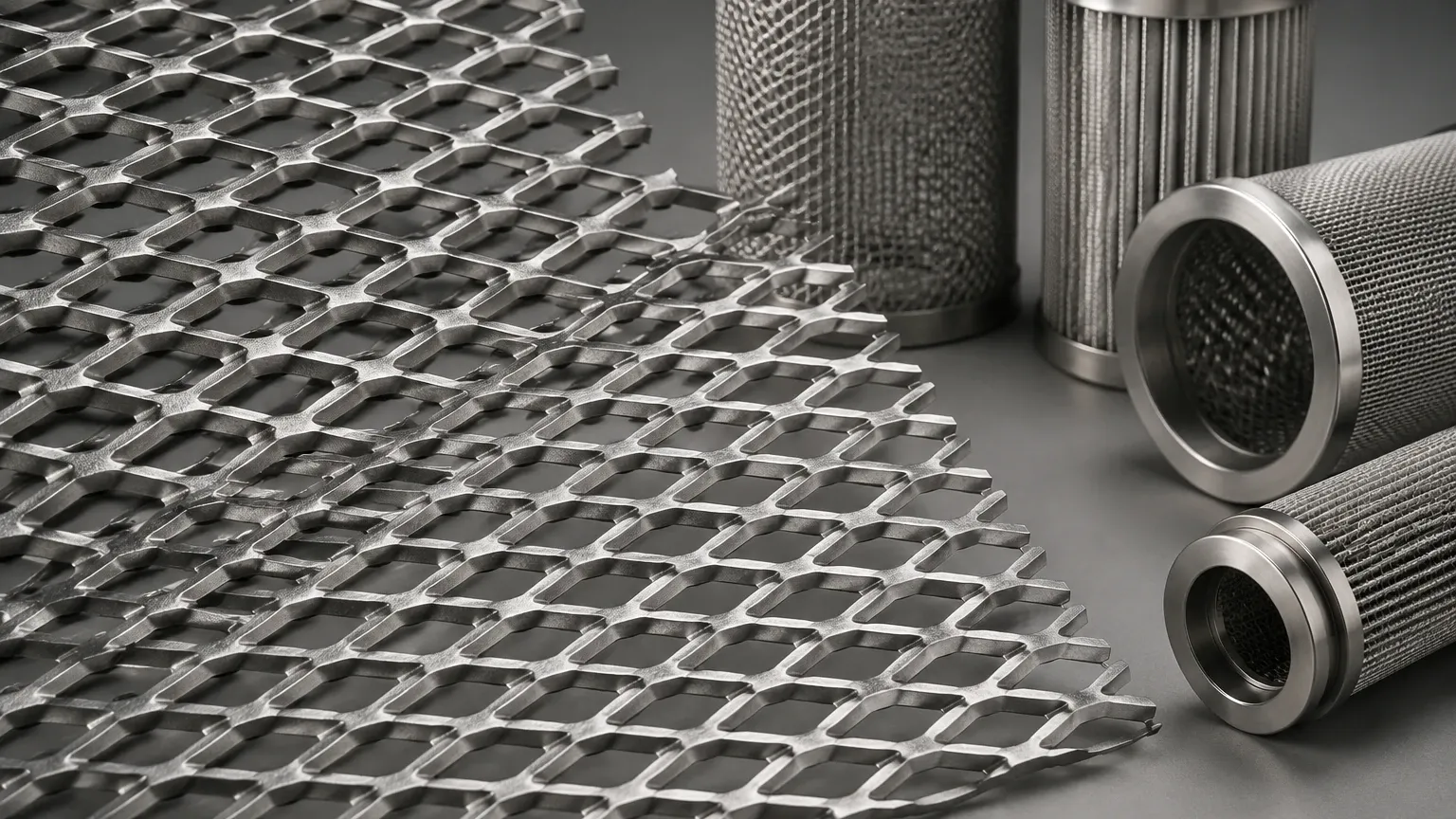
In industrial filtration and structural engineering, the selection of supporting media is as critical as the selection of the primary filtration layer. 2×2 expanded metal represents a specific configuration of expanded metal mesh characterized by its diamond-shaped openings, typically measuring 2 inches by 2 inches. Unlike woven wire or perforated sheets, expanded metal is produced through a simultaneous slitting and stretching process, resulting in a continuous piece of material without joints or welds. This unique manufacturing method provides a high strength-to-weight ratio, making it an essential component in heavy-duty industrial applications.
For engineers and procurement specialists, understanding the technical nuances of 2×2 expanded metal is vital for ensuring system integrity, especially when used as a support structure for finer stainless steel filter cartridges or as a protective barrier in harsh chemical environments.
Understanding the Technical Specifications of 2×2 Expanded Metal
When specifying 2×2 expanded metal, it is necessary to move beyond the nominal dimensions and look at the precise engineering metrics that define its performance. The term "2×2" generally refers to the nominal size of the diamond opening, but in a technical datasheet, this is broken down into the Long Way of the Diamond (LWD) and the Short Way of the Diamond (SWD).
LWD and SWD Measurements
The LWD is the distance from the center of a joint to the center of the next joint across the long axis of the diamond. The SWD is the corresponding distance across the short axis. For a 2×2 configuration, these dimensions provide the baseline for calculating the open area of the mesh. However, the actual clear opening (the space through which fluids or gases pass) will be slightly smaller than these center-to-center measurements due to the width of the metal strands.
Strand Width and Thickness
The strand width refers to the amount of metal between the openings, while the strand thickness is the thickness of the original base material. These two factors determine the rigidity and the weight of the final product. In high-pressure hydraulic or chemical processing applications, thicker strands are often required to prevent deformation under mechanical stress.
Raised vs. Flattened Expanded Metal
2×2 expanded metal is available in two primary forms:
1. Raised (Standard): The strands are set at an angle to the plane of the sheet. This creates a three-dimensional surface that offers excellent grip and high structural rigidity but may create more turbulence in fluid flow applications.
2. Flattened: The raised mesh is passed through a cold-rolling reducing mill, which flattens the strands into the same plane as the sheet. Flattened 2×2 expanded metal is often preferred when the mesh serves as a support for a delicate wire mesh filter, as it provides a smooth contact surface that prevents abrasion of the finer media.
Material Selection for Industrial Environments
The performance of 2×2 expanded metal is heavily dependent on the alloy from which it is manufactured. In the context of industrial filtration and chemical processing, stainless steel is the industry standard due to its mechanical properties and resistance to degradation.
Stainless Steel 304 and 316
Grade 304 is the most common choice for general industrial use, offering good corrosion resistance and durability. However, for applications involving marine environments, high chloride concentrations, or aggressive chemicals, Grade 316 (or 316L for welding applications) is required. The addition of molybdenum in 316 stainless steel significantly enhances its resistance to pitting and crevice corrosion.
Specialty Alloys
In extreme environments, such as those found in petrochemical refining or pharmaceutical manufacturing, specialty alloys like Monel, Inconel, or Hastelloy may be used for 2×2 expanded metal. These materials are selected for their ability to maintain structural integrity at high temperatures and their immunity to specific corrosive agents that would degrade standard stainless steel.
The Role of 2×2 Expanded Metal in Filtration Systems
While 2×2 expanded metal is not typically used as the primary filtration media for fine particles, it plays a foundational role in the design of high-performance filter assemblies. Its primary function is to act as a support or drainage layer.
Structural Support for Filter Cartridges
In stainless steel filter cartridges, a fine wire mesh is often too flexible to withstand the differential pressure generated during high-flow operations. By wrapping the fine mesh around a core of 2×2 expanded metal, engineers can ensure the filter maintains its shape and does not collapse. The large 2×2 openings ensure that the support structure does not significantly contribute to the pressure drop across the system.
Pre-Filtration and Debris Shielding
In water treatment and intake systems, 2×2 expanded metal serves as a primary guard. It is effective at capturing large debris—such as stones, wood, or plastic—before they can reach and damage more sensitive downstream components like pumps or fine-mesh strainers. Its robust construction allows it to handle the impact of large objects without tearing.
Comparing Perforated & Expanded Metal for Structural Support
When designing a filtration or separation system, engineers often choose between Perforated & Expanded Metal for the support framework. Both materials offer distinct advantages depending on the application requirements.
Material Efficiency and Cost
Expanded metal is generally more cost-effective than perforated metal. Because the expansion process involves slitting and stretching rather than punching holes, there is zero material waste. In a perforated sheet, the material removed to create the holes (the "slugs") is scrap, which increases the cost per square foot, especially when using expensive alloys like 316L stainless steel.
Weight and Strength
For a given weight, 2×2 expanded metal is typically stronger than a perforated sheet of the same material. The interconnected strands of expanded metal distribute loads across the entire sheet. However, perforated metal offers more precise control over the hole size and spacing, which can be critical in applications requiring very specific flow characteristics or aesthetic uniformity.
Flow Characteristics
Expanded metal creates a more tortuous path for fluid flow compared to the straight-through holes of perforated metal. While this can be a disadvantage if low turbulence is required, it can be an advantage in applications where mixing or flow diffusion is desired. In most 2×2 configurations, the open area is sufficiently high that the impact on flow resistance is negligible.
Engineering Considerations: Open Area and Flow Dynamics
The "Open Area" percentage is one of the most critical figures for an engineer to calculate when integrating 2×2 expanded metal into a system. It represents the ratio of the area of the openings to the total area of the sheet.
Calculating Open Area
For expanded metal, the open area is determined by the relationship between the SWD, LWD, and the strand width. A 2×2 expanded metal sheet with narrow strands will have a much higher open area (often exceeding 80%) than one with wide strands. A higher open area results in a lower pressure drop, which is essential for maintaining the efficiency of hydraulic and pneumatic systems.
Pressure Drop (ΔP)
In filtration, the pressure drop is the difference in total pressure between two points of a fluid-carrying network. Using a 2×2 expanded metal support allows for high-velocity flow with minimal resistance. This is particularly important in high-viscosity fluid filtration, where every additional barrier can significantly increase the energy required to pump the fluid through the system.
Customization and OEM Capabilities in Metal Fabrication
Industrial applications rarely allow for "off-the-shelf" solutions. Customization of 2×2 expanded metal is often necessary to meet specific housing dimensions, flow requirements, or chemical compatibility standards.
Dimensional Customization
Manufacturers like Kaifil provide the ability to customize the LWD and SWD beyond the standard 2×2 dimensions to optimize the mesh for specific filter housings. This includes custom sheet sizes, circular cutouts for pipe integration, or cylindrical forming for use as internal filter cores.
Edge Finishing and Fabrication
For safety and ease of installation, the edges of 2×2 expanded metal can be finished in several ways. "Bonded" edges (where the diamonds are cut at the joints) provide a smooth, safe edge, whereas "random" edges may be sharper but are often more economical for internal components that will be welded into a frame. Additionally, the mesh can be annealed to improve ductility for complex forming processes.
Maintenance and Replacement Cycles
The durability of stainless steel 2×2 expanded metal makes it a long-term solution, but it is not maintenance-free. In filtration environments, the mesh should be inspected for:
1. Scaling and Fouling: In water treatment, mineral deposits can accumulate on the strands, effectively reducing the open area and increasing pressure drop.
2. Mechanical Fatigue: In systems with high-frequency pressure pulsations (such as reciprocating pumps), the mesh should be checked for stress cracks at the joints.
3. Corrosion: Even stainless steel can succumb to localized corrosion if the fluid chemistry changes or if stagnant zones allow for the buildup of corrosive agents.
Because expanded metal is a single-piece construction, it cannot be "repaired" if a strand breaks. Instead, the entire section or cartridge component should be replaced to ensure the structural integrity of the system is not compromised.
Conclusion
2×2 expanded metal is a versatile and robust material that serves as a cornerstone in industrial filtration and structural support. By offering a high open area, exceptional strength, and cost-efficiency, it provides engineers with a reliable solution for demanding environments. Whether used as a support for high-precision stainless steel filter cartridges or as a primary guard in heavy-duty intake systems, selecting the right material grade and technical configuration is essential for operational success. For those evaluating their options between various Perforated & Expanded Metal solutions, focusing on the specific demands of the application—such as flow rate, chemical exposure, and mechanical load—will lead to the most effective and durable filtration performance.
