


250d Expanded Metal
In industrial filtration and structural engineering, the selection of the correct media substrate is critical to the longevity and efficiency of the system. 250d expanded metal represents a specific class of expanded mesh characterized by its diamond-shaped openings and precise strand dimensions. Unlike perforated metal, which is created by punching holes and removing material, expanded metal is produced by simultaneously slitting and stretching a solid sheet of metal. This process results in a continuous, jointless mesh that offers a high strength-to-weight ratio, making it an essential component in high-pressure filtration assemblies and industrial support structures.
For engineers and procurement professionals, understanding the technical nuances of the 250d specification is vital. This guide examines the geometric properties, material considerations, and application-specific advantages of 250d expanded metal within the context of professional industrial filtration.
Understanding the Engineering of 250d Expanded Metal
The "250d" designation typically refers to a specific mesh size within a manufacturer's catalog, often associated with a nominal diamond dimension or a specific gauge and strand width combination. In the context of industrial expanded metal, the geometry is defined by four primary measurements: the Long Way of the Diamond (LWD), the Short Way of the Diamond (SWD), the strand width, and the strand thickness.
The manufacturing process involves a reciprocating knife that slits the metal while the sheet is expanded. Because no material is lost during production, expanded metal is often a more cost-effective alternative to perforated metal for large-scale industrial projects. The resulting 250d mesh features a three-dimensional structure where the strands are set at an angle to the plane of the sheet. This angularity is not merely aesthetic; it provides inherent structural rigidity and influences the flow dynamics of fluids passing through the mesh.
Technical Specifications and Geometric Properties
When specifying 250d expanded metal for filtration or support, technical teams must evaluate several key geometric factors that dictate performance:
1. LWD and SWD: The Long Way of the Diamond (LWD) is the distance from the center of one joint to the center of the next joint across the long axis. The Short Way of the Diamond (SWD) is the equivalent measurement across the short axis. For 250d, these dimensions are calibrated to provide a specific balance between open area and mechanical strength.
2. Strand Dimensions: The strand thickness refers to the thickness of the base metal, while the strand width refers to the amount of metal fed into the knives for each stroke. These two dimensions determine the overall weight and the pressure-bearing capacity of the mesh.
3. Open Area Percentage: This is perhaps the most critical metric for filtration applications. The open area determines the flow rate and the pressure drop across the filter. 250d expanded metal is engineered to provide a consistent open area that facilitates efficient fluid passage while retaining larger particulate matter.
4. Overall Thickness: Due to the expansion process, the finished mesh is thicker than the original base metal sheet. This "raised" profile can be flattened through a secondary cold-rolling process if a smooth surface is required for specific housing tolerances.
Material Considerations for Industrial Filtration
Kaifil specializes in the production of stainless steel filtration components, and the material choice for 250d expanded metal is paramount to its performance in demanding environments. While expanded metal can be produced from carbon steel or aluminum, industrial filtration typically demands the corrosion resistance and thermal stability of stainless steel.
* Stainless Steel 304: This is the standard grade for most industrial applications. It offers excellent corrosion resistance and is suitable for use in food and beverage processing, as well as general industrial water treatment.
* Stainless Steel 316L: For more aggressive environments, such as chemical processing or marine applications, 316L is preferred. The addition of molybdenum provides enhanced resistance to pitting and crevice corrosion, particularly in chloride-rich environments.
* High-Temperature Alloys: In specialized petrochemical or exhaust filtration systems, 250d expanded metal may be fabricated from nickel alloys or heat-resistant stainless steels to maintain structural integrity at elevated temperatures.
Applications in Filtration and Structural Support
250d expanded metal serves multiple roles within an industrial filtration system. Its versatility allows it to function as both a primary filter and a secondary support structure.
Support Layers for Fine Wire Mesh
In many high-pressure hydraulic or chemical filters, the primary filtration media is a fine stainless steel wire mesh. This mesh is often too delicate to withstand high differential pressures on its own. 250d expanded metal is used as a rigid support cylinder or flat backing plate. It provides the necessary mechanical strength to prevent the fine mesh from collapsing or deforming under load.
Pre-Filtration and Coarse Straining
In water treatment and intake systems, 250d expanded metal acts as a pre-filter. Its diamond openings are effective at capturing large debris, such as leaves, plastic, or scale, before the fluid reaches more sensitive downstream components. This extends the service life of fine filter cartridges and reduces overall maintenance costs.
Catalyst Bed Support
In the chemical and pharmaceutical industries, expanded metal is frequently used to support catalyst beds in reactor vessels. The 250d specification ensures that the catalyst pellets remain in place while allowing the reactants to flow through the bed with minimal resistance.
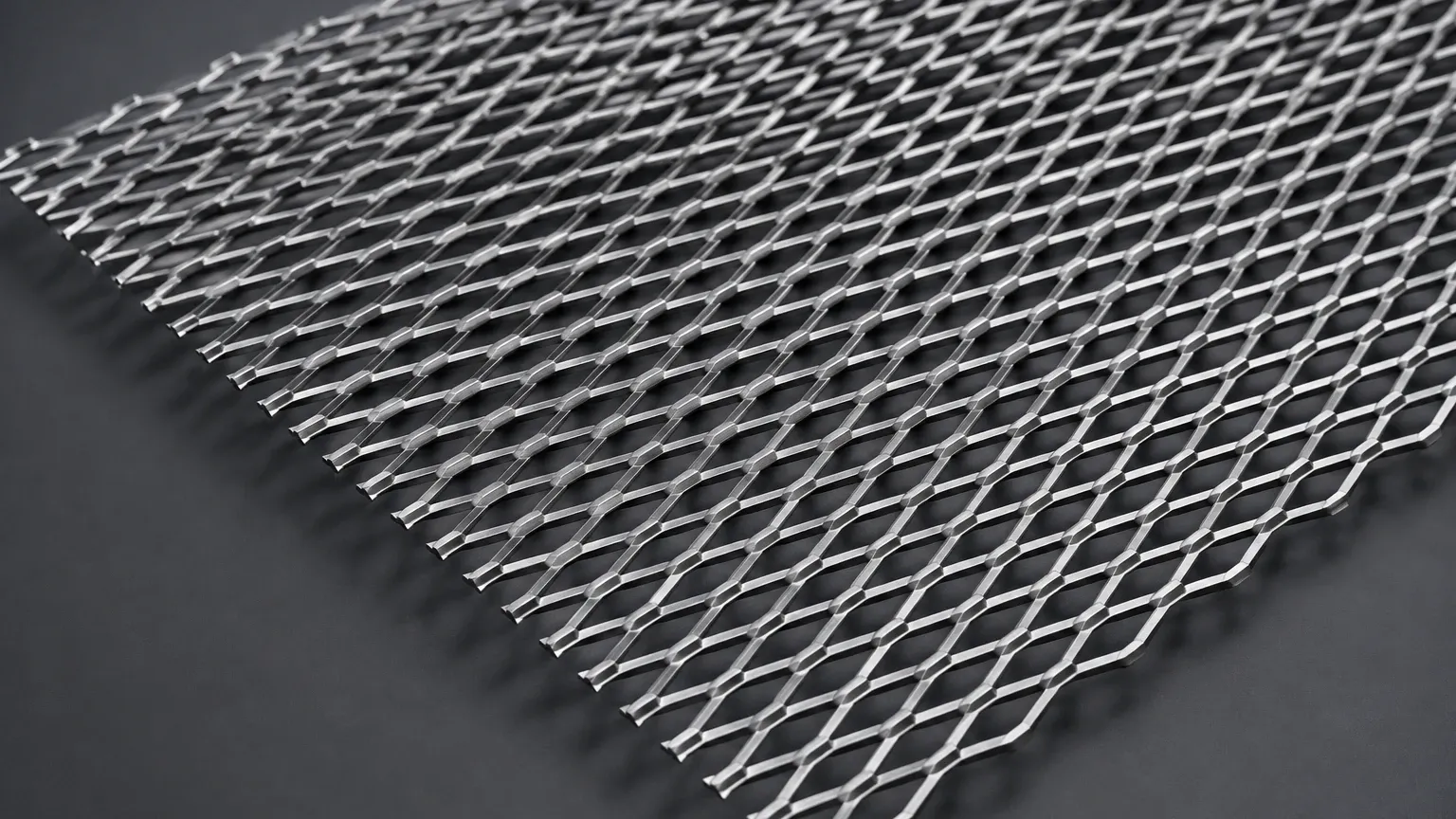
Comparing Perforated & Expanded Metal for Industrial Use
Deciding between Perforated & Expanded Metal is a common challenge for engineers. While both materials offer filtration and support capabilities, their physical characteristics differ significantly.
Perforated metal offers a flat surface and highly precise hole patterns, which is ideal for applications requiring exact circular or square apertures. However, the punching process creates scrap material, which increases the unit cost. Furthermore, perforated metal is generally heavier than expanded metal of the same thickness.
In contrast, 250d expanded metal is more resource-efficient. The expansion process creates a truss-like structure that is naturally stiffer than a flat perforated sheet of the same weight. For applications where weight reduction is a priority—such as in portable filtration units or aerospace components—expanded metal is often the superior choice. Additionally, the angled strands of expanded metal can be used to deflect flow or create turbulence, which may be advantageous in certain mixing or heat exchange applications.
Selection Criteria for Engineers and Procurement Teams
To ensure the successful integration of 250d expanded metal into a project, several selection criteria must be confirmed during the procurement phase:
* Pressure Drop Requirements: Engineers must calculate the expected pressure drop across the mesh. If the 250d specification creates too much resistance, a mesh with a larger open area or thinner strands may be required.
* Compatibility with Housing: The overall thickness of the expanded metal (especially in its "raised" form) must be compatible with the filter housing or support frame. If tolerances are tight, flattened expanded metal should be specified.
* Welding and Fabrication: Stainless steel 250d expanded metal is highly weldable. However, the thin strands require precise welding techniques (such as TIG or resistance welding) to ensure a secure bond without burning through the material. Kaifil provides expert fabrication services to ensure that expanded metal components are integrated seamlessly into larger filter assemblies.
* Total Cost of Ownership: While expanded metal may have a lower initial purchase price than perforated metal, the total cost should include maintenance and replacement cycles. Stainless steel expanded metal offers a long service life, reducing the frequency of system shutdowns.
Customization and OEM Solutions from Kaifil
As a professional manufacturer, Kaifil understands that standard specifications do not always meet the unique demands of specialized industrial processes. We offer comprehensive customization options for 250d expanded metal to align with specific engineering requirements.
Our capabilities include custom material sourcing, precision slitting to specific widths, and secondary processing such as flattening, degreasing, and annealing. We work closely with OEM partners to develop filtration components that meet exact performance benchmarks. Whether you require 250d expanded metal as a standalone component or as part of a complex multi-layer filter cartridge, our engineering team provides the technical support necessary to optimize your design.
When evaluating suppliers, it is essential to confirm the quality of the raw material and the consistency of the expansion process. Inconsistent strand widths or uneven expansion can lead to structural weak points and bypass paths in filtration systems. Kaifil’s commitment to quality control ensures that every sheet or component of 250d expanded metal meets the rigorous standards required by the chemical, pharmaceutical, and food processing industries.
By selecting the appropriate material grade and geometric configuration, engineers can leverage the unique properties of 250d expanded metal to improve the efficiency and durability of their industrial filtration systems. For detailed technical data or to discuss a custom project, reviewing the available product options and application support is the recommended next step in the procurement process.
