


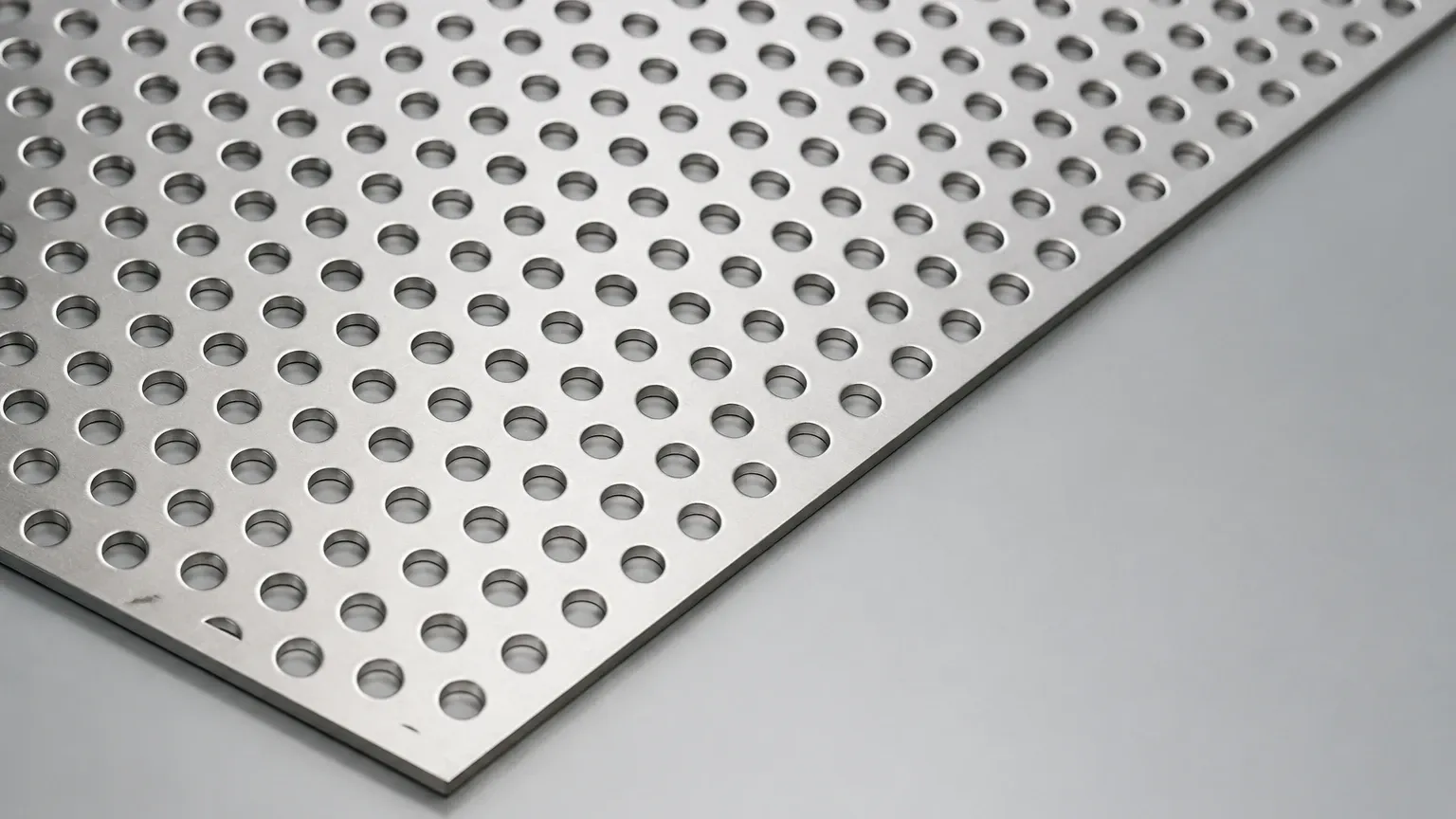
Perforated Metal 6mm
In the landscape of industrial filtration and structural engineering, the specification of perforated media requires a precise balance between mechanical strength and functional permeability. Among the various configurations available, perforated metal 6mm—typically referring to a 6mm hole diameter—serves as a versatile standard for medium-coarse filtration, protective screening, and architectural reinforcement. Selecting the correct material, hole pattern, and thickness for a 6mm perforation profile is critical for ensuring the longevity of the component and the efficiency of the overall system.
For engineers and procurement specialists, understanding the technical nuances of perforated metal 6mm involves more than just selecting a hole size. It requires an evaluation of the open area percentage, the pitch (center-to-center distance), and the manufacturing method, whether it involves mechanical punching or laser cutting. This guide examines the engineering considerations and industrial applications of this specific perforation size within the broader context of Perforated & Expanded Metal solutions.
Technical Specifications: The Geometry of 6mm Perforations
When specifying perforated metal 6mm, the primary geometric factor is the relationship between the hole diameter ($D$) and the pitch ($P$). The pitch is the distance from the center of one hole to the center of the adjacent hole. This relationship determines the "Open Area," which is the percentage of the sheet that is comprised of holes rather than solid metal.
Hole Patterns and Open Area Calculations
For a standard 60-degree staggered pattern, which is the most common and structurally sound configuration, the open area percentage is calculated using the following formula:
Open Area % = (D² × 90.69) / P²
If a 6mm hole is set at a 9mm pitch, the open area is approximately 40.3%. If the pitch is increased to 12mm, the open area drops significantly to roughly 22.6%. This calculation is vital for engineers designing filtration systems, as the open area directly correlates to the pressure drop across the filter and the flow velocity of the fluid or gas passing through the media.
The "Rule of Thumb" for Thickness
In mechanical punching—the most cost-effective method for producing perforated metal 6mm—a fundamental engineering constraint exists: the hole diameter should generally not be smaller than the material thickness. For a 6mm hole, the stainless steel or alloy sheet should ideally be 6mm thick or less. Attempting to punch 6mm holes in 8mm or 10mm plate increases the risk of tool breakage and can result in significant burrs or deformations around the hole exit, which negatively impacts filtration precision and hygiene in food-grade applications.
Material Selection for Industrial Environments
The performance of perforated metal 6mm is heavily dependent on the alloy selected. Because these components are often exposed to corrosive fluids, high temperatures, or mechanical stress, material choice is a primary driver of the total cost of ownership.
Stainless Steel 304 and 316L
Stainless steel is the industry standard for perforated filtration components due to its corrosion resistance and mechanical durability.
* SS304: Suitable for general industrial applications, architectural grilles, and basic water treatment. It offers good strength and oxidation resistance but may succumb to pitting in high-chloride environments.
* SS316L: The preferred choice for chemical processing, pharmaceutical manufacturing, and marine environments. The addition of molybdenum and the low carbon content (the "L" designation) provide superior resistance to localized corrosion and make the material more suitable for welding without risking intergranular corrosion.
Specialty Alloys
In high-temperature or highly acidic environments, engineers may opt for Duplex stainless steel or Nickel alloys. These materials maintain the structural integrity of the 6mm perforations under extreme thermal cycling, which is common in petrochemical refining and exhaust gas filtration.
Manufacturing Processes: Punching vs. Expanded Metal
While "perforated metal" usually implies holes punched out of a solid sheet, it is important to distinguish this from expanded metal, although both fall under the category of Perforated & Expanded Metal.
Mechanical Punching
This process uses a CNC press to drive pins through the metal sheet. It allows for precise margins (the unperforated area around the edges) and a wide variety of hole shapes, including round, square, and slotted. For a 6mm specification, punching provides a clean, consistent aperture that is essential for accurate particle retention in sieving and sorting applications.
Expanded Metal Alternatives
Expanded metal is created by simultaneously slitting and stretching the material. While it does not result in a perfectly round 6mm hole, an expanded mesh can be manufactured with a 6mm aperture (Short Way of Design, or SWD). The advantage of expanded metal is that it produces no scrap waste, making it a more economical choice for structural reinforcement or safety guards where the exact circularity of the hole is less critical than the overall weight-to-strength ratio.
Industrial Applications of Perforated Metal 6mm
The 6mm hole size is a "middle-ground" specification that bridges the gap between fine mesh filtration and heavy-duty structural screening. Its applications are diverse across several sectors:
1. Industrial Filtration and Strainers
In hydraulic systems and large-scale water intake filters, perforated metal 6mm acts as a primary strainer or a support core for finer wire mesh layers. In these roles, the 6mm holes prevent large debris—such as stones, wood chips, or plastic waste—from entering pumps and sensitive downstream equipment. The 6mm size is particularly effective in suction strainers where high flow rates must be maintained without causing cavitation.
2. Food and Beverage Processing
In the food industry, 6mm perforated sheets are used in drying trays, sorting screens, and scalping decks. For example, in grain processing, 6mm holes are used to separate larger impurities from the product stream. Because these surfaces come into direct contact with consumables, they are often electropolished to remove microscopic burrs and ensure a "clean-in-place" (CIP) compatible surface.
3. Architectural and Acoustic Panels
Beyond filtration, perforated metal 6mm is frequently used in building envelopes and interior acoustic treatments. When used as an acoustic baffle, the 6mm holes allow sound waves to pass through the metal into sound-absorbent material behind it. The specific open area achieved by the 6mm pattern determines the Noise Reduction Coefficient (NRC) of the assembly.
4. Heat Dissipation and Ventilation
In power electronics and HVAC systems, 6mm perforations provide a balance between airflow and safety. The holes are small enough to prevent fingers or large tools from contacting internal components (meeting specific IP ratings) while allowing sufficient air volume to pass through for cooling.
Engineering Evaluation: Risks and Quality Control
When integrating perforated metal 6mm into a technical project, engineers must account for several potential risks that can affect the performance of the component.
Burr Management and Surface Finish
The punching process naturally creates a "breakout" side on the bottom of the sheet, which can leave sharp edges or burrs. In filtration, these burrs can trap particles, leading to premature clogging, or they can break off and contaminate the filtrate. Specifying a deburring process or a specific surface finish (such as pickling or passivation) is essential for high-purity applications.
Flatness and Internal Stress
Perforating a sheet introduces significant internal stress into the metal, which often causes the material to curl or bow. For 6mm perforated sheets that must be welded into a cylindrical filter cartridge or bolted into a flat frame, a secondary leveling process is required to ensure the material meets flatness tolerances. Engineers should specify the maximum allowable deviation from flatness in their technical drawings.
Margin Consistency
Margins refer to the solid areas at the edges of the sheet. If a 6mm perforated sheet is to be welded, a "blank margin" is necessary to provide a clean welding surface. Inconsistent margins can lead to alignment issues during assembly and may compromise the structural integrity of the filter housing.
Procurement Checklist for Engineers
Before ordering perforated metal 6mm, technical teams should confirm the following parameters to ensure the product meets the application requirements:
1. Hole Diameter: Confirm 6mm is the exact requirement (metric vs. imperial equivalents).
2. Pitch and Pattern: Specify 60-degree staggered, 45-degree staggered, or square pattern.
3. Material Grade: Select based on chemical exposure (e.g., SS304 vs. SS316L).
4. Sheet Thickness: Ensure it is compatible with the 6mm hole size for punching.
5. Margins: Define the width of the unperforated borders on all four sides.
6. Secondary Operations: Identify if the sheet requires leveling, degreasing, or deburring.
7. Quantity and Dimensions: Standard sheet sizes (e.g., 1220x2440mm) are more cost-effective than custom-cut sizes, though custom fabrication is often necessary for specific filter components.
Conclusion: Optimizing Performance with Precision
Perforated metal 6mm is a fundamental component in modern industrial infrastructure. Whether it is used as a robust support for a wire mesh filter or as a standalone screen for coarse separation, its performance is dictated by the precision of its manufacture and the suitability of its material grade. By focusing on the relationship between hole size, pitch, and thickness, engineers can design systems that maximize flow efficiency while maintaining the structural durability required for demanding environments.
For those seeking specialized configurations or integrated filtration components, exploring high-quality Perforated & Expanded Metal options ensures that the final product adheres to the strict tolerances required by the chemical, pharmaceutical, and food processing industries. Proper specification at the procurement stage prevents common issues such as excessive pressure drops, premature corrosion, and mechanical failure, ultimately reducing the long-term operational costs of the filtration system.
