


8×8 Expanded Metal
In the landscape of industrial filtration and structural support, expanded metal serves as a versatile, cost-effective, and rigid material choice. Among the various specifications available to engineers and procurement specialists, 8×8 expanded metal represents a specific category of mesh often defined by its aperture size or diamond dimensions. Understanding the technical nuances of this material is essential for ensuring it meets the rigorous demands of chemical processing, hydraulic systems, and industrial filtration applications.
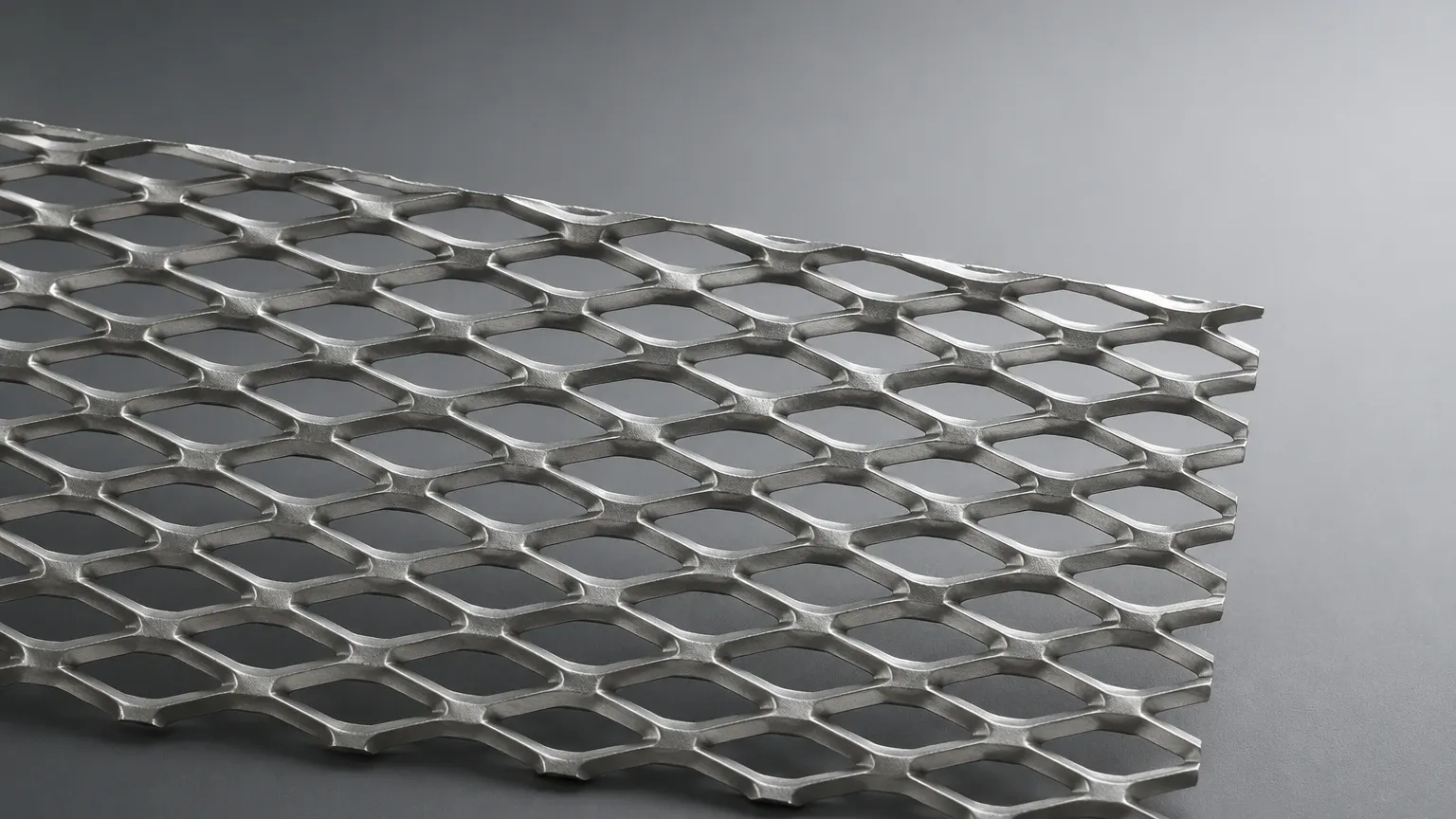
Unlike perforated metal, which is created by punching holes and removing material, expanded metal is manufactured through a process of simultaneous slitting and stretching. This results in a continuous piece of metal with a diamond-shaped pattern that possesses a high strength-to-weight ratio. When discussing Perforated & Expanded Metal, the 8×8 designation typically refers to the nominal dimensions of the diamond opening, often measured in millimeters, which dictates the material's flow characteristics and mechanical properties.
Understanding 8×8 Expanded Metal Specifications
To accurately specify 8×8 expanded metal for an industrial project, engineers must look beyond the nominal size and evaluate the specific geometric parameters that define the mesh. In the expanded metal industry, these are categorized as the Long Way of the Diamond (LWD) and the Short Way of the Diamond (SWD).
LWD and SWD Dimensions
In an 8×8 configuration, the LWD and SWD are often closely matched to create a more square-like diamond appearance, though variations exist depending on the stretching ratio used during manufacturing. The LWD is the distance from the center of a bond to the center of the next bond across the long axis, while the SWD measures the same across the short axis. For 8×8 expanded metal, these dimensions are critical because they determine the size of the particles that can pass through the mesh and the overall structural rigidity of the sheet.
Strand Width and Thickness
The performance of the mesh is further defined by the strand width and the thickness of the base material. The strand width is the amount of metal between the diamond openings, and the thickness refers to the gauge of the original sheet. These two factors combined determine the "Open Area" percentage. In filtration, a higher open area reduces pressure drop, while a thicker strand increases the burst pressure and mechanical durability of the filter component.
Raised vs. Flattened Expanded Metal
8×8 expanded metal is available in two primary forms:
1. Standard (Raised): The strands are set at an angle to the plane of the sheet. This creates a three-dimensional surface that provides excellent grip and directional flow control but may require more space in a filter housing.
2. Flattened: The raised mesh is passed through a cold-roll reducing mill, which flattens the strands and bonds into the same plane. Flattened 8×8 expanded metal is often preferred for filtration support because it provides a smooth surface that won't abrade the fine wire mesh layers it supports.
Manufacturing Processes and Material Selection
The utility of 8×8 expanded metal is largely determined by the material from which it is fabricated. At Kaifil, the focus is on high-performance alloys that can withstand corrosive environments and high temperatures.
Stainless Steel (304 and 316L)
Stainless steel is the industry standard for expanded metal used in filtration. Grade 304 offers excellent corrosion resistance for general industrial use, while Grade 316L is specified for environments involving high salt concentrations, acids, or pharmaceutical-grade requirements. The low carbon content in 316L also improves weldability, which is vital when the expanded metal is rolled into cylinders for filter cartridges.
Specialized Alloys
For extreme conditions, such as those found in chemical processing or aerospace, expanded metal can be produced from Monel, Inconel, or Titanium. These materials ensure that the 8×8 grid maintains its structural integrity even when exposed to aggressive chemical reagents or thermal cycling.
The Expansion Process
The manufacturing process itself is inherently sustainable. Because the metal is slit and stretched rather than punched, there is virtually no scrap material produced. This makes expanded metal a more economical choice compared to perforated metal for large-scale industrial projects. The process also creates a "truss-like" structure where the bonds (the intersections of the strands) act as structural nodes, distributing mechanical loads evenly across the sheet.
Applications in Industrial Filtration and Support
8×8 expanded metal is a staple in the design of complex filtration systems. Its primary role is often as a structural skeleton or a protective barrier.
Filter Media Support
In high-pressure hydraulic or gas filtration, fine wire mesh or pleated paper media lack the structural strength to resist collapse under high differential pressures. A layer of flattened 8×8 expanded metal is often used as a support tube (core) or an outer wrap (cage). The 8×8 aperture provides a stable surface for the media while maintaining a high open area to ensure efficient fluid throughput.
Pre-Filtration and Debris Catching
In water treatment and HVAC systems, 8×8 expanded metal serves as an effective pre-filter. It is capable of capturing larger debris, such as leaves, plastic fragments, or metal shavings, before they reach the more sensitive secondary filtration stages. This extends the service life of the entire system and reduces maintenance costs.
Flame Arrestors and Heat Shields
The geometric configuration of expanded metal makes it an excellent candidate for flame arrestors. The metal strands act as a heat sink, dissipating the thermal energy of a flame front and preventing its propagation through a vent or pipe. The 8×8 size provides a balance between airflow and surface area for heat dissipation.
Engineering Considerations for Performance and Durability
When integrating 8×8 expanded metal into a product design, engineers must account for several technical factors to ensure long-term reliability.
Pressure Drop (Delta P)
The resistance to flow is a critical metric in any filtration system. The open area of 8×8 expanded metal must be calculated accurately to predict the pressure drop across the filter. If the strand width is too large, the restricted flow can lead to pump cavitation or system inefficiencies. Conversely, if the open area is too high, the mesh may lack the necessary strength to support the filter media.
Mechanical Bonding and Integrity
Because expanded metal is a single, continuous piece of material, it does not suffer from the weakness of woven wire mesh, where individual wires can shift or fray. This mechanical integrity is crucial in high-vibration environments, such as automotive or aerospace applications, where the 8×8 grid must remain dimensionally stable over thousands of operational hours.
Surface Treatment and Finishing
To enhance performance, 8×8 expanded metal can undergo various finishing processes. Electropolishing is common for stainless steel components used in the food and beverage or pharmaceutical industries to remove burrs and create a microscopically smooth surface that resists bacterial growth. Other treatments include galvanizing for carbon steel variants or powder coating for aesthetic and additional corrosion protection.
Selection Criteria and Procurement Checklist
Selecting the right 8×8 expanded metal involves more than just choosing a diamond size. Procurement teams and engineers should use the following checklist to ensure the material is fit for purpose:
1. Material Grade: Is the alloy compatible with the fluid or gas being filtered? (e.g., 316L for marine environments).
2. Form Factor: Does the application require the 3D profile of "Raised" mesh or the smooth profile of "Flattened" mesh?
3. Dimensional Tolerances: What are the allowable variances in LWD, SWD, and overall sheet thickness? Precise tolerances are required for automated assembly processes.
4. Open Area Percentage: Has the flow rate been calculated to ensure the mesh does not create an excessive bottleneck?
5. Edge Configuration: Will the sheet be supplied with "random shears" (open diamonds at the edges) or "bond shears" (closed diamonds)? This affects how the mesh is welded or framed.
6. Quantity and Customization: Is the project a standard size, or does it require custom-slit coils or pre-formed cylinders?
Customization and OEM Solutions
In many industrial scenarios, off-the-shelf expanded metal does not meet the specific requirements of a high-performance system. This is where custom manufacturing becomes essential. Manufacturers like Kaifil specialize in providing tailored solutions that go beyond standard 8×8 patterns.
Customization options include:
* Variable Pitch: Adjusting the expansion ratio to create non-standard diamond sizes tailored to specific filtration accuracies.
* Multi-Layer Composites: Sintering 8×8 expanded metal with multiple layers of fine wire mesh to create a robust, high-precision filter element that combines structural strength with fine filtration capabilities.
* Precision Fabrication: Cutting, rolling, and welding expanded metal into specific shapes, such as conical filters, basket strainers, or pleated support structures.
By working closely with an OEM partner, engineering teams can optimize the design of their filtration components, reducing the total cost of ownership through improved durability and more efficient performance.
Conclusion
8×8 expanded metal is a fundamental component in the toolkit of modern industrial design. Its unique combination of structural rigidity, high open area, and material efficiency makes it an ideal choice for support structures and primary filtration layers. Whether utilized in its raised form for maximum surface area or flattened for a smooth support interface, this material provides the reliability required for demanding B2B applications.
For engineers and purchasing professionals seeking high-quality filtration components, understanding the technical specifications of 8×8 expanded metal is the first step toward achieving optimized system performance. By focusing on material integrity, precise geometric tolerances, and application-specific customization, industries can ensure their filtration systems operate at peak efficiency with minimal downtime.
