


Perforated Metal Panels
In industrial filtration and structural engineering, perforated metal panels serve as foundational components for fluid dynamics, mechanical support, and particle separation. These panels are manufactured by mechanically punching or laser-cutting a series of holes into metal sheets, creating a controlled open area that dictates flow rates and filtration efficiency. For engineers and procurement specialists, selecting the correct perforated specification is not merely a matter of material choice but a complex calculation of mechanical strength, chemical compatibility, and hydraulic performance.
Kaifil specializes in the production of high-precision Perforated & Expanded Metal solutions, focusing on the rigorous requirements of the chemical processing, pharmaceutical, and food and beverage sectors. Understanding the technical nuances of these components is essential for optimizing system longevity and reducing maintenance cycles in demanding industrial environments.
Engineering Fundamentals of Perforated Metal Panels
The performance of a perforated metal panel is defined by its geometric configuration. The relationship between hole size, shape, and pitch (the distance between the centers of adjacent holes) determines the functional characteristics of the panel.
Hole Patterns and Geometry
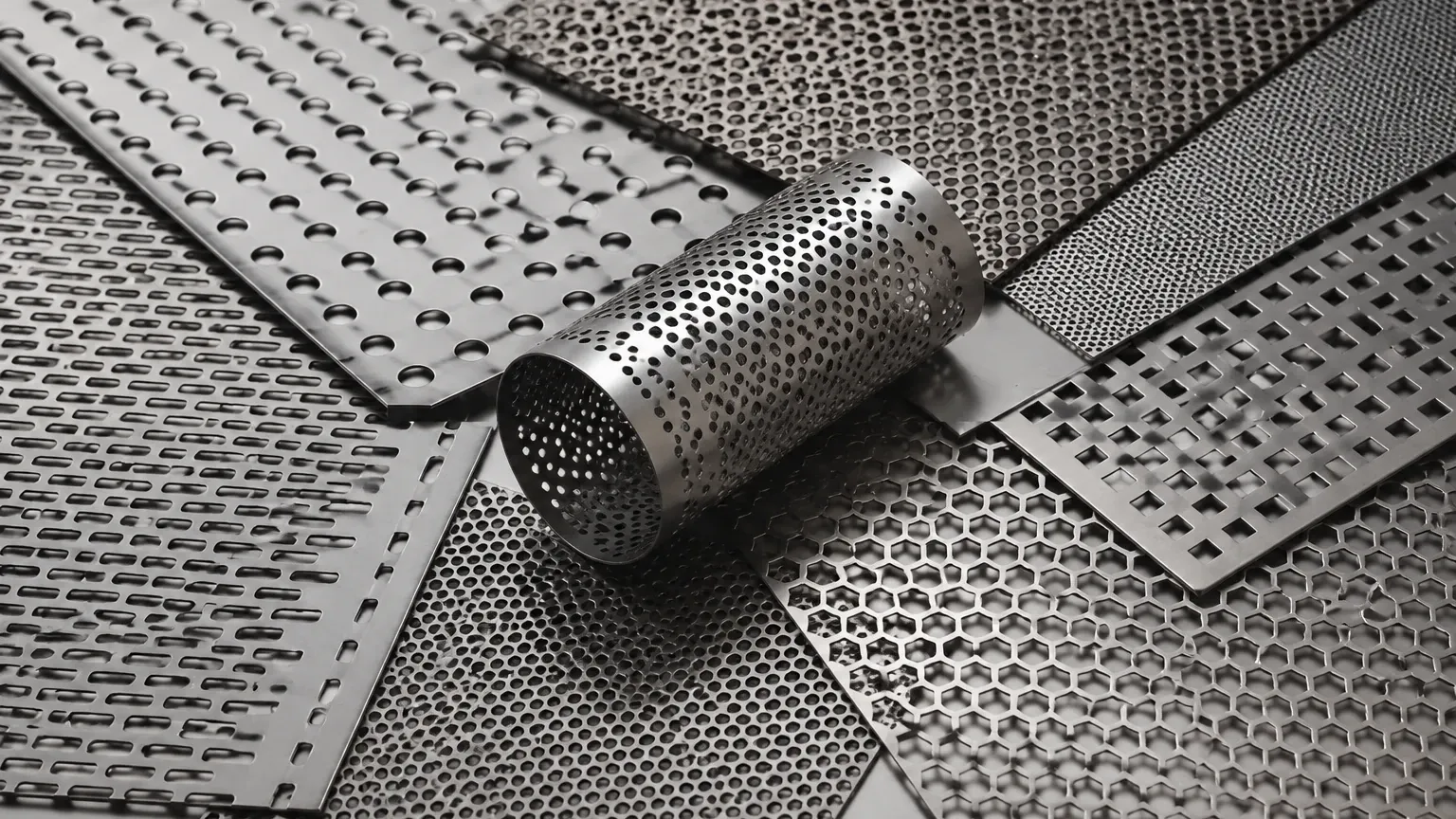
Round holes are the most common industrial configuration due to their structural stability and ease of manufacturing. They are typically arranged in a 60-degree staggered pattern, which provides the highest degree of open area and uniform strength across the sheet. Other patterns include:
* Square Holes: Often used when a higher open area is required for airflow or high-volume liquid discharge, though they offer less structural rigidity than round patterns.
* Slotted Holes: Ideal for sorting and grading applications where elongated particles must be separated or retained.
* Hexagonal Patterns: Providing an extremely high open area (up to 80%), these are used in specialized applications where weight reduction and maximum flow are prioritized over extreme mechanical stress.
Calculating Open Area
The "Open Area" percentage is a critical metric for engineers. It represents the ratio of the area of the holes to the total area of the sheet. For a standard 60-degree staggered round hole pattern, the formula is:
OA = (D² × 90.69) / P²
Where *D* is the hole diameter and *P* is the pitch. Accurate calculation of the open area is vital for predicting pressure drop across the filter and ensuring that the structural integrity of the panel can withstand the operating pressure of the system.
Material Selection and Chemical Compatibility
The environment in which perforated metal panels operate dictates the material grade. Industrial filtration often involves corrosive fluids, high temperatures, or strict hygienic requirements.
1. Stainless Steel 304/304L: The standard for general industrial use, offering good corrosion resistance and excellent formability. It is widely used in water treatment and general manufacturing.
2. Stainless Steel 316/316L: Containing molybdenum, this grade is essential for applications involving chlorides or marine environments. It is the preferred choice for pharmaceutical and chemical processing due to its superior resistance to pitting and crevice corrosion.
3. Carbon Steel: Frequently used in hydraulic systems or structural applications where corrosion is not a primary concern or where the panels will be post-treated with protective coatings.
4. Specialty Alloys: For extreme environments, materials like Hastelloy or Monel may be used to resist highly acidic or alkaline media.
Kaifil’s manufacturing process ensures that the selected material maintains its metallurgical properties during perforation, preventing localized stress corrosion cracking in the finished component.
Key Performance Indicators in Industrial Filtration
When integrating perforated metal panels into a filtration system—whether as a primary filter or a support cage—several performance indicators must be evaluated.
Pressure Drop (ΔP)
Every perforated layer introduces a degree of resistance to flow. An excessive pressure drop can lead to pump cavitation, energy inefficiency, and potential system failure. Engineers must balance the need for a small hole size (for filtration) with the requirement for a high open area (to maintain flow). In many cases, a perforated panel with larger holes is used as a support structure for a finer wire mesh, combining mechanical strength with high-precision filtration.
Structural Integrity and Yield Strength
Perforated panels are often subjected to high differential pressures, especially during backwashing or when the filter cake builds up. The "bridge" (the metal remaining between the holes) must be thick enough to resist deformation. The yield strength of the panel is influenced by the material thickness (gauge) and the hole-to-bridge ratio. In high-pressure hydraulic applications, using a heavier gauge material with a smaller open area may be necessary to prevent the collapse of the filter element.
Surface Finish and Cleanability
In the food, beverage, and pharmaceutical industries, surface roughness (Ra) is a critical factor. Perforation can leave burrs or sharp edges that trap contaminants and impede cleaning-in-place (CIP) processes. High-quality perforated metal panels undergo secondary processes such as deburring, electropolishing, or pickling to ensure a smooth, hygienic surface that meets stringent regulatory standards.
Customization and Secondary Manufacturing Processes
Standard off-the-shelf perforated sheets rarely meet the specific requirements of complex industrial machinery. Customization is often required to ensure seamless integration into existing systems.
Margins and Unperforated Areas
A critical aspect of custom design is the inclusion of margins—solid metal areas around the perimeter of the perforated pattern. These margins are essential for welding the panel to end caps, flanges, or support frames. Without precise margins, the welding process can cause distortion or create weak points in the assembly. Kaifil provides customized margin configurations to simplify the final assembly process for OEM partners.
Forming and Fabrication
Perforated metal panels are frequently formed into cylinders, cones, or pleated structures. This requires precise control over the perforation alignment to ensure that the holes do not overlap or weaken at the seam. Advanced CNC punching and rolling equipment allow for the creation of complex shapes with consistent tolerances, ensuring that the final filter cartridge fits perfectly within its housing.
Integration with Wire Mesh for Multi-Layer Filtration
In many advanced filtration applications, perforated metal panels do not act alone. They are often used as the "inner core" or "outer guard" for multi-layer filter elements.
In this configuration, the perforated panel provides the structural skeleton capable of withstanding high pressure, while one or more layers of fine stainless steel wire mesh perform the actual filtration. These layers can be mechanically wrapped or sintered together. Sintering involves bonding the mesh and the perforated plate at a molecular level through heat and pressure, creating a robust, monolithic component that cannot delaminate under high stress or vibration.
This hybrid approach is common in polymer filtration, hydraulic oil systems, and high-viscosity chemical processing, where the fine mesh provides the necessary micron rating and the perforated panel ensures the assembly remains dimensionally stable.
Selection Criteria for Engineers and Purchasing Teams
To ensure the successful procurement of perforated metal panels, technical teams should confirm the following parameters before finalizing an order:
* Micron Rating vs. Hole Size: Is the perforated panel the primary filter, or is it a support for a mesh? If it is the primary filter, the hole size must be smaller than the smallest particle to be retained.
* Operating Pressure and Temperature: Ensure the material gauge and alloy can withstand the peak operating conditions without fatigue.
* Flow Velocity: Calculate the required open area to keep the flow velocity within the limits of the system design.
* Dimensional Tolerances: Specify the allowable variance in sheet size, hole diameter, and flatness. This is particularly important for panels that will be automatically loaded into assembly lines.
* Regulatory Compliance: For food and pharmaceutical applications, ensure the materials are FDA-compliant and that the manufacturing process avoids the use of prohibited lubricants or coolants.
Common Risks and Mitigation Strategies
One of the primary risks in using low-quality perforated metal is the presence of "slugs" (the metal circles punched out of the holes) remaining in the finished product. If these slugs enter a fluid stream, they can cause catastrophic damage to downstream pumps or valves. Professional manufacturers like Kaifil employ rigorous cleaning and inspection protocols to ensure every panel is free of debris and burrs.
Another risk is material thinning during the forming process. When a perforated sheet is rolled into a cylinder, the outer surface undergoes tension. If the material is too thin or the holes are too close together, the bridges may crack. Engineering the correct pitch-to-thickness ratio is essential for preventing these failures.
Conclusion
Perforated metal panels are indispensable components in modern industrial filtration. By understanding the interplay between hole geometry, material science, and hydraulic resistance, engineers can specify solutions that improve process efficiency and equipment durability. Whether used as a standalone screen or a reinforced support for fine mesh, the precision of the perforation determines the ultimate reliability of the filtration system. For those seeking specialized guidance or custom manufacturing, reviewing the available Perforated & Expanded Metal options is the first step toward optimizing industrial filtration performance.
