


Perforated Metal Screen
In industrial filtration and separation processes, the perforated metal screen serves as a fundamental component designed to provide structural integrity while maintaining specific flow characteristics. Unlike woven wire mesh, which is created by interlacing wires, a perforated metal screen is produced through a mechanical punching or laser-cutting process on sheet metal. This manufacturing method results in a rigid, durable medium capable of withstanding high pressure and abrasive environments. For engineers and procurement specialists, selecting the correct perforated metal screen requires a deep understanding of material properties, hole geometry, and the mechanical stresses of the intended application.
At Kaifil, the focus remains on delivering high-precision filtration solutions that bridge the gap between standard industrial requirements and custom engineering needs. As a manufacturer specializing in stainless steel filtration, we recognize that the performance of a filtration system often depends on the precision of its primary screening element. Whether used as a standalone filter or as a support cage for finer mesh media, Perforated & Expanded Metal components are essential for ensuring long-term operational efficiency.
Understanding the Engineering Fundamentals of Perforated Metal Screens
The primary function of a perforated metal screen is to allow the passage of fluids or gases while retaining solid particles larger than the hole diameter. However, the engineering of these screens extends beyond simple hole sizing. Engineers must evaluate several critical parameters to ensure the component performs reliably under industrial loads.
Hole Patterns and Geometry
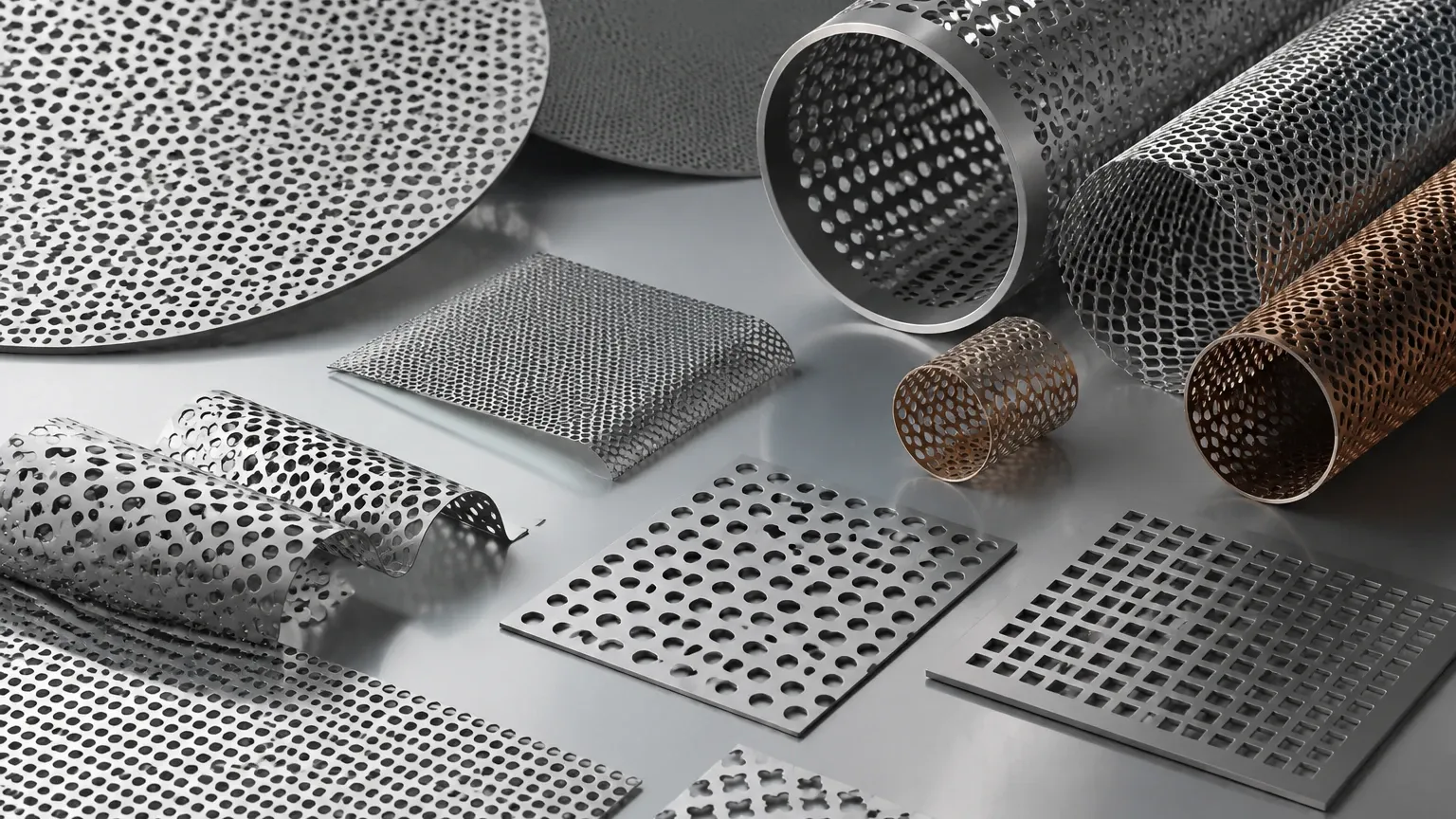
The geometry of the perforations significantly impacts both the filtration efficiency and the structural strength of the sheet. The most common patterns include:
* Round Holes: These are the industry standard due to their versatility and the ease of manufacturing. Round holes provide a balanced distribution of stress across the metal sheet, making them ideal for high-pressure applications.
* Square Holes: Often used when a higher open area is required. While they offer high throughput, square holes can create stress concentration points at the corners, which may lead to fatigue in high-vibration environments.
* Slotted Holes: These are typically employed for the filtration of elongated particles or in applications where the flow direction is critical to the separation process.
Pitch and Arrangement
The arrangement of the holes—whether staggered or straight—determines the "bridge" width (the distance between holes). A staggered 60-degree pattern is the most popular choice because it maximizes the open area while maintaining the highest possible structural strength. Straight patterns are easier to align for specific mechanical assemblies but generally offer lower structural resilience.
Material Selection for Demanding Industrial Environments
Material compatibility is a non-negotiable factor in industrial filtration. The perforated metal screen must resist corrosion, temperature fluctuations, and mechanical wear. Kaifil specializes in stainless steel alloys, which are the preferred materials for the majority of B2B industrial applications.
Stainless Steel 304/304L
This is the most widely used grade for general industrial applications. It offers excellent corrosion resistance and is suitable for most food and beverage or water treatment environments. The "L" (low carbon) variant is preferred when welding is required, as it prevents carbide precipitation that can lead to intergranular corrosion.
Stainless Steel 316/316L
For more aggressive environments, such as chemical processing or marine applications, SS316 is the standard. The addition of molybdenum provides superior resistance to chlorides and pitting. In pharmaceutical and high-purity chemical sectors, SS316L is often the baseline requirement to ensure zero contamination and long-term durability.
Specialty Alloys
In extreme cases involving high temperatures or highly acidic/alkaline fluids, materials like Duplex stainless steel or Monel may be used. These materials ensure that the perforated metal screen does not degrade prematurely, which would otherwise lead to bypass issues or system-wide contamination.
Calculating Open Area and Flow Dynamics
For an engineer, the "Open Area Percentage" is the most critical metric for determining the pressure drop across a filter. The open area is the ratio of the total area of the holes to the total area of the sheet.
The Importance of Pressure Drop
A higher open area reduces the initial pressure drop (ΔP), allowing for higher flow rates. However, as the open area increases, the mechanical strength of the screen decreases. The engineering challenge lies in finding the "sweet spot" where the screen is open enough to allow efficient flow but thick and rigid enough to resist deformation under the weight of the filter cake or the force of the fluid pump.
Formulaic Approach
For a standard 60-degree staggered round hole pattern, the open area (OA%) is calculated as:
`OA% = (d² * 90.69) / p²`
Where `d` is the hole diameter and `p` is the pitch (center-to-center distance).
Accurate calculations at the design phase prevent the common pitfall of undersizing a filtration unit, which leads to frequent cleaning cycles and increased energy consumption by pumps trying to overcome excessive resistance.
Structural Roles: Filtration Media vs. Support Components
A perforated metal screen often serves a dual purpose in industrial filtration systems. Understanding these roles helps in specifying the correct thickness and hole size.
Primary Filtration
In coarse filtration applications, such as intake screens for water treatment or pre-filters in chemical processing, the perforated sheet is the primary medium. It captures large debris to protect downstream equipment like pumps and valves. In these instances, the hole size is dictated by the smallest particle that must be excluded.
Support for Fine Media
In many high-precision applications, a perforated metal screen acts as a support cage or core for finer media, such as woven wire mesh or sintered metal fibers. The perforated core provides the mechanical strength to withstand high differential pressures, while the finer media performs the actual filtration. This configuration is common in stainless steel filter cartridges used in hydraulic systems and oil filtration.
Customization and Precision Manufacturing Capabilities
One of the primary advantages of working with a professional manufacturer like Kaifil is the ability to customize every aspect of the perforated metal screen. Off-the-shelf solutions rarely meet the specific tolerances required for high-performance industrial machinery.
Custom Dimensions and Shapes
Beyond flat sheets, perforated metal can be formed into cylinders, cones, or custom-shaped baskets. Precision rolling and welding are required to ensure that the seam of a perforated cylinder does not create a weak point or a gap where unfiltered fluid could bypass the system.
Edge Configurations
Engineers must specify whether they require "finished" or "unfinished" edges. A finished edge (margins) means the perforation pattern stops before the edge of the sheet, leaving a solid metal border. This is crucial for welding the screen into a housing or for providing a smooth surface for gaskets and seals. Unfinished edges, where the pattern is cut through, are usually only acceptable for internal components where edge bypass is not a concern.
Surface Treatments
To enhance performance, screens can undergo various surface treatments:
* Electropolishing: Removes surface impurities and creates a microscopically smooth finish, which is essential in the pharmaceutical and food industries to prevent bacterial growth.
* Passivation: Enhances the natural chromium oxide layer of stainless steel to maximize corrosion resistance.
* Deburring: Essential for removing sharp edges created during the punching process, ensuring the screen does not damage other filter layers or injure maintenance personnel.
Maintenance, Cleaning, and Replacement Cycles
The total cost of ownership (TCO) for a perforated metal screen is heavily influenced by its cleanability and lifespan. Unlike disposable polymer filters, stainless steel perforated screens are designed for long-term reuse.
Cleaning Protocols
Depending on the contaminant, perforated screens can be cleaned using:
* Backwashing: Reversing the flow of fluid to dislodge particles from the holes.
* Ultrasonic Cleaning: Using high-frequency sound waves in a solvent bath to remove fine particles trapped in the margins or surface imperfections.
* Chemical Cleaning: Using mild acids or bases to dissolve organic or mineral scaling, provided the material (e.g., SS316L) is compatible with the cleaning agent.
When to Replace
While durable, perforated screens are not permanent. They should be inspected regularly for:
* Blinding: Permanent clogging of holes that cannot be removed by cleaning.
* Erosion: Thinning of the metal bridges due to high-velocity abrasive particles.
* Deformation: "Dishing" or bowing of the screen, which indicates that the differential pressure has exceeded the material's yield strength.
Procurement Considerations for Industrial Engineers
When sourcing a perforated metal screen, providing a complete technical data sheet to the manufacturer ensures the final product meets the application's demands. Purchasing teams should confirm the following details before finalizing an order:
1. Exact Material Grade: Specify 304, 316, or 316L based on chemical compatibility.
2. Hole Specifications: Diameter, shape, and pitch (staggered or straight).
3. Sheet Thickness: Measured in gauge or millimeters; this is vital for structural integrity.
4. Margin Requirements: Specify the width of the solid borders on all four sides.
5. Flatness Tolerances: Critical for screens that must be installed into tight-fitting grooves or housings.
6. Quantity and OEM Requirements: For large-scale equipment manufacturing, discuss long-term supply and batch consistency.
By focusing on these technical boundaries, engineers can ensure that the perforated metal screen they integrate into their system will provide reliable, predictable performance. For those seeking specialized designs or technical consultation on material selection, Kaifil offers the manufacturing expertise necessary to develop high-performance filtration components tailored to demanding industrial environments.
For more information on available specifications and custom design options, Review product options and application support to find the optimal solution for your filtration challenges.
