


Perforated Metal Architecture
In modern industrial and commercial design, the intersection of functionality and aesthetics is often found in the application of specialized metal components. Perforated metal architecture has evolved from its roots in industrial filtration and heavy-duty screening to become a cornerstone of contemporary building envelopes, interior partitions, and environmental control systems. For engineers and purchasing teams, selecting the right material involves balancing structural integrity, airflow requirements, and long-term durability.
As a professional manufacturer, Kaifil specializes in custom stainless steel solutions that bridge the gap between high-precision industrial filtration and architectural utility. Understanding the technical nuances of Perforated & Expanded Metal is essential for ensuring that a project meets both its performance specifications and its design intent.
Technical Fundamentals: Perforated vs. Expanded Metal
While often grouped together in architectural specifications, perforated and expanded metals are manufactured through distinct processes that yield different physical properties. Choosing between them requires an understanding of how these processes affect the final product’s strength and transparency.
Perforated Metal
Perforated metal is produced by mechanically punching or laser-cutting holes into a solid metal sheet. This process allows for extreme precision in hole placement and shape. Engineers can specify exact "open area" percentages, which are critical for applications involving ventilation or acoustic dampening. Because the surrounding metal remains a flat, continuous plane (unless secondary forming is applied), perforated sheets maintain high dimensional stability and are easier to frame or weld into complex assemblies.
Expanded Metal
Expanded metal is created by simultaneously slitting and stretching a metal sheet. This process creates diamond-shaped openings without any material waste, making it a highly cost-effective and sustainable option. The resulting mesh is comprised of interconnected strands that are tilted at an angle to the original plane of the sheet. This three-dimensional structure provides inherent rigidity and a unique visual depth that changes depending on the viewing angle. In perforated metal architecture, expanded metal is frequently used for sunscreens and security fencing due to its high strength-to-weight ratio.
Engineering Considerations for Architectural Applications
When specifying metal components for a building project, several technical parameters must be evaluated to ensure the material performs as expected over its lifecycle.
1. Open Area and Transparency
The "open area" refers to the percentage of the sheet that is comprised of holes. This is perhaps the most critical metric in perforated metal architecture. It dictates the volume of air that can pass through a facade for HVAC efficiency, the amount of natural light that enters a space, and the effectiveness of the material as a communication or security barrier.
For round hole patterns, the open area is typically calculated based on whether the holes are in a staggered (60-degree) or straight-row configuration. Staggered patterns generally offer higher strength and a more uniform appearance, while straight rows are often preferred for specific aesthetic alignments.
2. Material Selection and Corrosion Resistance
Architectural elements are often exposed to harsh environmental conditions, including UV radiation, moisture, and industrial pollutants.
* Stainless Steel (304 and 316): As a specialist in stainless steel filtration and components, Kaifil recommends Grade 316 for coastal or highly corrosive industrial environments due to its superior molybdenum content. Grade 304 is the standard for most interior and general exterior applications, offering an excellent balance of cost and corrosion resistance.
* Aluminum: Valued for its lightweight properties and natural oxide layer, aluminum is common in large-scale facade systems where reducing the structural load on the building frame is a priority.
* Carbon Steel: While cost-effective, carbon steel requires secondary finishes such as powder coating or galvanization to prevent oxidation, which must be factored into the total cost of ownership.
3. Gauge and Structural Integrity
The thickness of the metal (gauge) must be sufficient to withstand wind loads, seismic activity, and potential impact. In architectural screens, a common error is specifying a gauge that is too thin for the span between supports, leading to "oil canning" or visible warping. Engineering teams must calculate the deflection limits based on the specific alloy and the percentage of open area.
Functional Benefits in Modern Design
Beyond the visual appeal, perforated metal architecture serves several critical mechanical functions that contribute to a building's performance.
Solar Shading and Thermal Control
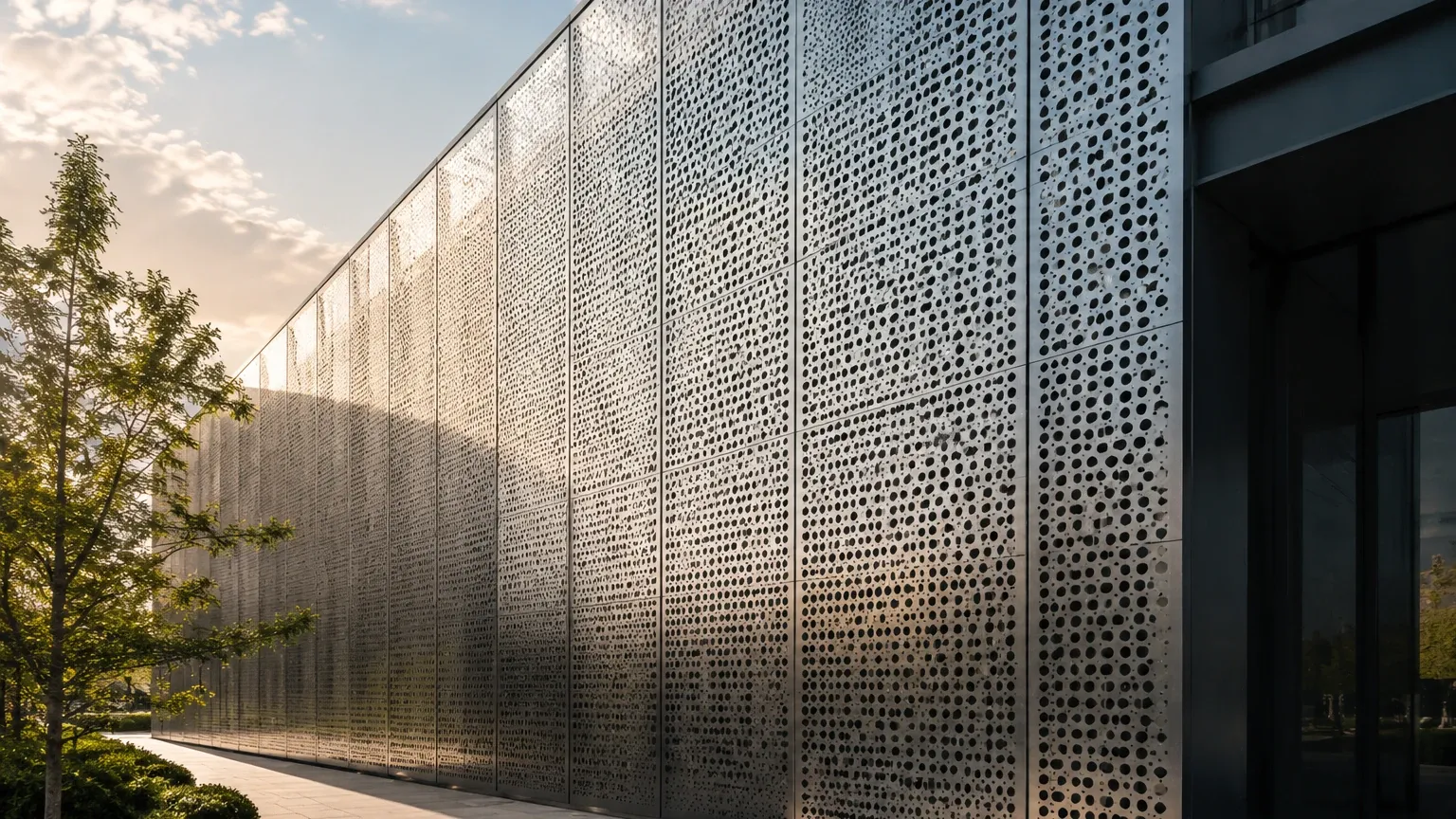
Strategic use of perforated panels on a building’s exterior can significantly reduce solar heat gain. By calculating the angle of the sun and the corresponding hole size/pitch, designers can create a "breathable" skin that blocks direct sunlight while maintaining views for occupants. This reduces the load on HVAC systems and contributes to LEED or other green building certifications.
Acoustic Performance
In large open spaces like transit hubs or auditoriums, metal panels are often used as acoustic baffles. When paired with sound-absorbent backing materials, the perforations allow sound waves to pass through the metal and be trapped by the insulation, reducing echo and improving speech intelligibility. The diameter and spacing of the holes are tuned to target specific frequency ranges.
Ventilation and Safety
In parking structures and industrial enclosures, perforated metal provides necessary airflow to prevent the buildup of exhaust fumes or heat while providing a secure barrier. Unlike glass, metal panels are resistant to breakage and provide a high level of security without creating a claustrophobic, solid-walled environment.
Customization and Manufacturing Precision
One of the primary advantages of working with an OEM-capable manufacturer like Kaifil is the ability to move beyond standard stock patterns. Customization in perforated metal architecture allows for the realization of complex design visions.
* Variable Perforation: Modern CNC equipment allows for "image perforation," where the size or density of holes varies across a panel to create a larger graphic or photographic image when viewed from a distance.
* Custom Margins: Unlike standard warehouse sheets, custom-manufactured panels can include solid borders (margins) on all four sides. This simplifies the installation process by providing a solid area for bolting or welding, ensuring a cleaner finish and stronger attachment points.
* Precision Forming: Beyond flat panels, metal can be corrugated, curved, or folded into cassettes. These three-dimensional shapes add structural stiffness and create dynamic shadows on the building's surface.
Selection Criteria and Risk Mitigation
For purchasing teams, the procurement of architectural metal involves several risks that can impact project timelines and budgets. To mitigate these, confirm the following with your supplier before production:
1. Tolerance Standards: Ensure the manufacturer adheres to industry-standard tolerances for flatness, squareness, and hole diameter. In architectural applications, even minor deviations can become highly visible when multiple panels are installed side-by-side.
2. Finish Compatibility: If the panels require post-production coating (like PVDF or powder coating), ensure the metal surface is free of oils or lubricants used during the punching process. Residual contaminants can lead to coating failure or delamination.
3. Lead Times and Logistics: Custom perforated projects require specialized tooling and production scheduling. Early collaboration with the manufacturer helps in aligning delivery dates with the construction schedule, especially for large-scale facades.
4. Total Cost Considerations: While the initial material cost is important, consider the "total cost of ownership." Choosing a higher-grade stainless steel may have a higher upfront cost but eliminates the need for frequent maintenance or replacement due to corrosion over a 20-year cycle.
The Role of the Manufacturer
Success in perforated metal architecture depends on the manufacturer's ability to translate engineering drawings into precise physical components. Kaifil’s experience in high-performance industrial filtration translates directly to the architectural sector; the same rigor required to produce a micron-rated filter cartridge is applied to the production of architectural screens. This ensures that every panel meets the exact specifications for hole alignment, material purity, and structural reliability.
Whether the goal is to improve the energy efficiency of a commercial office building or to provide a durable, aesthetic screen for an industrial facility, the selection of metal components is a technical decision that impacts the long-term viability of the structure. By focusing on material science and precision manufacturing, project teams can achieve results that are as functional as they are visually striking.
For detailed specifications on available patterns, material grades, and customization options for your next project, Review product options and application support to ensure your architectural vision is supported by engineering excellence.
