


Aluminum Perforated Metal Sheets
Aluminum perforated metal sheets are a fundamental component in industrial engineering, offering a unique combination of high strength-to-weight ratios, corrosion resistance, and versatile fabrication options. In the realm of industrial filtration and structural design, selecting the correct material and perforation pattern is critical to ensuring long-term performance and operational efficiency. This guide examines the technical specifications, engineering considerations, and procurement criteria essential for professionals integrating these components into complex systems.
Understanding Aluminum Perforated Metal Sheets in Industrial Applications
Perforation is the process of mechanically punching or laser-cutting holes into metal sheets to create a specific pattern of openings. When utilizing aluminum, this process results in a product that is significantly lighter than its stainless steel or carbon steel counterparts—typically weighing about one-third as much—without sacrificing the structural rigidity required for many industrial tasks.
In the context of Perforated & Expanded Metal, aluminum is often selected for environments where weight reduction is a priority or where the natural oxide layer of the metal provides necessary protection against atmospheric corrosion. Unlike expanded metal, which is slit and stretched to create diamond-shaped openings without material waste, perforated metal is produced by removing slugs of material. This allows for higher precision in hole geometry and spacing, which is vital for filtration accuracy and predictable flow dynamics.
Technical Specifications: Alloy Selection and Properties
The performance of aluminum perforated metal sheets is largely dictated by the specific alloy used. Industrial applications typically demand alloys that balance formability with mechanical strength.
* 3003-H14 Aluminum: This is the most common alloy for general perforation. It is alloyed with manganese, providing excellent corrosion resistance and moderate strength. It is highly workable and suitable for applications requiring bending or forming after perforation.
* 5005 Aluminum: Often chosen for architectural or high-end industrial applications where anodizing is required. It offers a more uniform finish and superior resistance to marine environments compared to the 3000 series.
* 6061-T6 Aluminum: A structural-grade alloy that provides much higher tensile strength. While more difficult to perforate due to its hardness, it is the preferred choice for load-bearing components or heavy-duty filtration support cages.
Engineers must consider the temper of the aluminum as well. The punching process introduces internal stresses into the material. Selecting the correct temper ensures the sheet remains flat and does not warp excessively during the manufacturing process.
Geometric Configurations and Filtration Efficiency
The geometry of the perforation determines the "open area" percentage, which is the most critical factor for flow rates, pressure drop, and filtration efficiency.
Hole Patterns
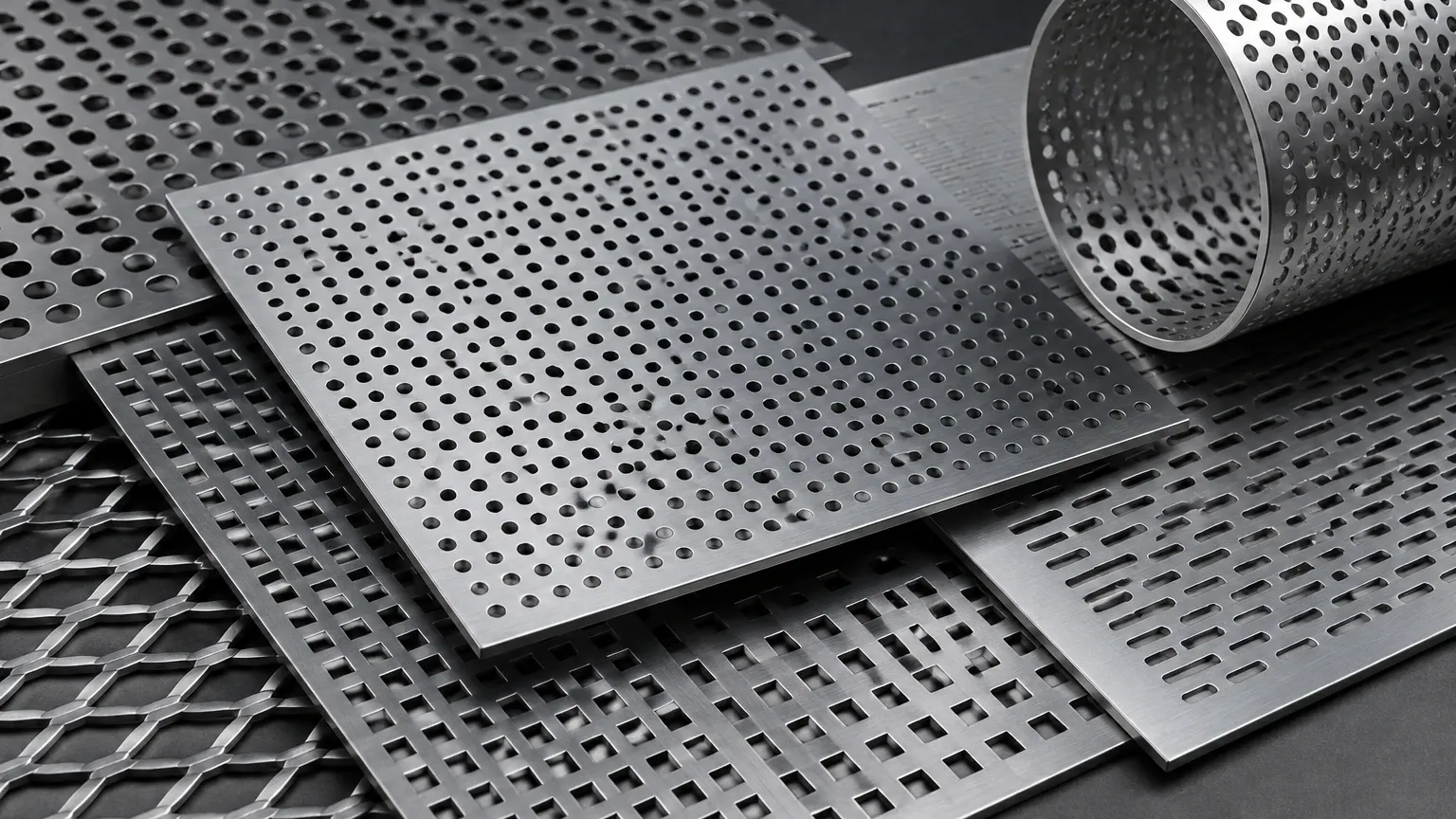
1. Round Holes: The most popular and efficient pattern. Round holes offer the greatest structural stability and are the easiest to manufacture with high precision. They are typically arranged in a 60-degree staggered pattern, which maximizes the open area while maintaining the strength of the metal "bridges" (the material between the holes).
2. Square Holes: These provide a higher open area compared to round holes but are more prone to stress concentration at the corners. They are often used in applications where high visibility or maximum airflow is required.
3. Slotted Holes: Elongated openings used primarily for sorting or sifting solid materials. They are effective in preventing "blinding" (clogging) in specific industrial processing applications.
Calculating Open Area
For a standard 60-degree staggered round hole pattern, the open area percentage is calculated using the formula:
% Open Area = (D² × 90.69) / P²
Where *D* is the hole diameter and *P* is the pitch (the distance from the center of one hole to the center of the adjacent hole). Accurate calculation of the open area is essential for engineers to predict the pressure drop across the filter or screen, ensuring that the system's pumps or fans can maintain the required flow rates.
Engineering Advantages: Why Choose Aluminum?
Beyond weight savings, aluminum perforated metal sheets offer several distinct engineering advantages that make them a preferred choice in specialized sectors:
* Thermal and Electrical Conductivity: Aluminum is an excellent conductor. In electronic enclosures or heat exchange systems, perforated aluminum sheets facilitate heat dissipation while providing EMI/RFI shielding.
* Non-Magnetic Properties: For sensitive medical equipment (such as MRI rooms) or specialized laboratory environments, aluminum’s non-magnetic nature is a technical necessity.
* Surface Finishing: Aluminum accepts a wide range of finishes. Anodizing not only improves corrosion resistance but also hardens the surface, making it more resistant to abrasion. Powder coating can also be applied for color coding or additional chemical protection.
* Sustainability: Aluminum is 100% recyclable. In large-scale industrial projects, the scrap generated from the perforation process (the slugs) is easily reclaimed, contributing to a lower total environmental footprint.
Critical Evaluation Criteria for Technical Procurement
When sourcing aluminum perforated metal sheets for industrial use, purchasing teams and engineers should evaluate suppliers based on several technical benchmarks:
Dimensional Tolerances
Standard industrial tolerances usually follow the NAAMM (National Association of Architectural Metal Manufacturers) guidelines. However, for precision filtration, tighter tolerances on hole diameter and pitch may be required. It is essential to confirm that the manufacturer can maintain consistency across the entire sheet, especially for large-production OEM runs.
Flatness and Stress Relief
The punching process inherently causes the metal to curl. High-quality perforated sheets must undergo a leveling process (usually through roller leveling) to restore flatness. For components that will be automatically welded or integrated into tight-tolerance assemblies, specifying a flatness requirement is mandatory.
Edge Conditions and Margins
"Margins" refer to the unperforated area around the edges of the sheet. Standard sheets may have "minimum margins" or "no margins" (resulting in partial holes at the edges). For safety and ease of installation, engineers often specify "safe margins," where a solid border is maintained. This prevents sharp edges and provides a clean surface for welding or bolting.
Common Risks and Mitigation in Specification
Specifying perforated metal involves navigating several potential pitfalls that can affect the longevity of the final product:
1. Burr Formation: Mechanical punching always creates a slight burr on the exit side of the hole. In filtration applications, these burrs can trap particles or damage delicate secondary filter media (like fine wire mesh). Specifying a deburring process or choosing a manufacturer with high-precision tooling is necessary to mitigate this risk.
2. Galvanic Corrosion: While aluminum is corrosion-resistant, it is highly susceptible to galvanic corrosion when in contact with dissimilar metals (like stainless steel or copper) in the presence of an electrolyte. Engineers must ensure that fasteners and mounting frames are either made of compatible materials or are properly insulated.
3. Work Hardening: The area around each punched hole becomes work-hardened. If the sheet requires significant forming or deep drawing after perforation, the material may crack. In such cases, choosing a softer alloy or an annealed temper is advisable.
Customization and OEM Solutions
In many B2B scenarios, standard off-the-shelf sheets do not meet the rigorous demands of specialized industrial equipment. Customization allows for the optimization of hole patterns to match specific flow characteristics or the creation of non-standard shapes and sizes that reduce assembly time.
Manufacturers like Kaifil specialize in providing tailored filtration components where aluminum perforated metal sheets serve as the structural backbone. Whether the application involves a support cage for a hydraulic filter or a precision screen for food processing, the integration of Perforated & Expanded Metal requires a deep understanding of both material science and fluid dynamics.
Information to Confirm Before Procurement
To ensure a successful procurement process, engineers should provide the following data points to their manufacturing partner:
* Material Grade: Specify the exact alloy and temper (e.g., 3003-H14).
* Hole Specifications: Define the hole shape, diameter, and pitch.
* Pattern Orientation: Specify if the staggered pattern should run parallel to the length or width of the sheet.
* Margins: Provide exact dimensions for all four sides of the sheet.
* Secondary Operations: Indicate if the sheets require leveling, deburring, anodizing, or forming into cylindrical shapes.
* Application Environment: Disclose the chemical exposure and temperature ranges the sheet will encounter to verify material compatibility.
By focusing on these technical details, procurement teams can avoid common specification errors and ensure that the aluminum perforated metal sheets they receive are fit for purpose in demanding industrial environments. The choice of aluminum, when backed by precise engineering and quality manufacturing, provides a durable, efficient, and cost-effective solution for a wide array of filtration and structural challenges.
