


Perforated Metal Container
In industrial filtration and material processing, the choice of containment systems significantly influences operational efficiency, product purity, and equipment longevity. A perforated metal container is a specialized industrial vessel engineered to facilitate fluid flow, drainage, or air circulation while retaining solid media. These components are essential in sectors ranging from chemical processing and pharmaceuticals to food production and hydraulic systems.
As a professional manufacturer, Kaifil provides custom stainless steel filtration solutions that leverage advanced manufacturing techniques to meet rigorous industrial standards. Understanding the engineering principles behind these containers—specifically the selection of Perforated & Expanded Metal—is critical for engineers and purchasing teams tasked with optimizing filtration performance and minimizing downtime.
Engineering Fundamentals of Perforated Metal Containers
The performance of a perforated metal container is primarily dictated by its geometric configuration and material properties. Unlike standard storage bins, industrial filtration containers must balance mechanical strength with specific flow characteristics. This balance is achieved through precise perforation patterns and the calculation of "open area."
Open Area Calculations
The open area is the percentage of the total surface area that is occupied by holes. This metric determines the flow rate and pressure drop across the container. For instance, a container with a 40% open area will offer less resistance to fluid flow than one with 20%, but it may sacrifice structural rigidity. Engineers must calculate the required flow velocity to ensure the container does not become a bottleneck in the system.
Hole Patterns and Geometry
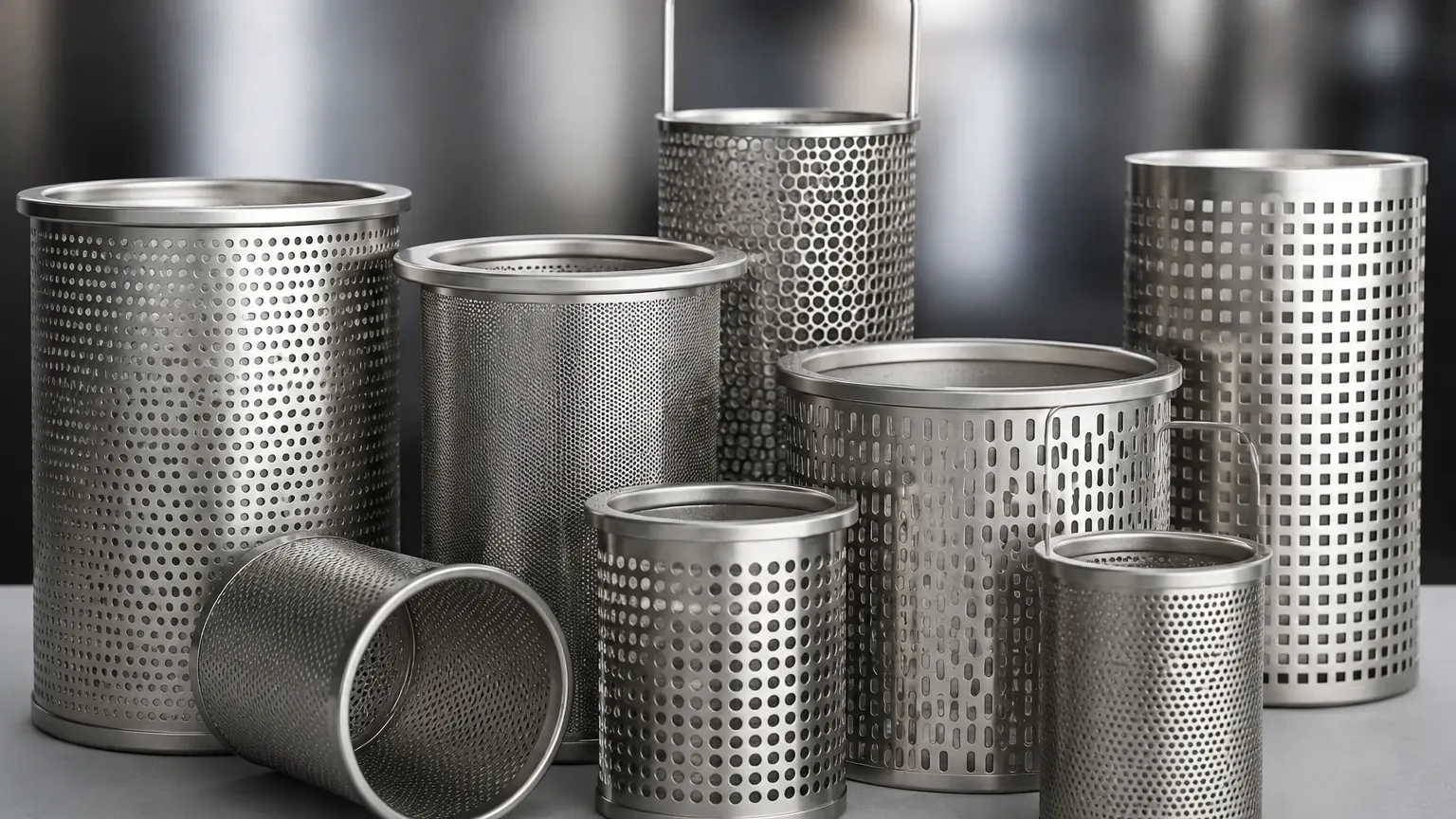
The arrangement of holes—staggered or straight—affects both the strength of the container and the efficiency of the filtration process.
- Staggered Patterns: Usually 60-degree configurations, these provide the highest strength-to-weight ratio and are preferred for high-pressure applications.
- Straight Patterns: Holes are aligned in rows and columns, often used for aesthetic purposes or specific alignment requirements in material handling, though they generally offer lower structural integrity than staggered designs.
- Hole Shapes: While round holes are the most common due to ease of manufacturing and uniform stress distribution, square and slotted holes are utilized when specific particle shapes need to be screened or when higher open areas are required.
Material Selection for Industrial Environments
Material compatibility is a non-negotiable factor in B2B procurement. Industrial environments often involve exposure to corrosive chemicals, extreme temperatures, and high-pressure cleaning cycles. A perforated metal container manufactured by Kaifil typically utilizes high-grade stainless steel to ensure durability.
Stainless Steel 304 vs. 316
- SS 304: This is the standard grade for most industrial applications. It offers excellent corrosion resistance and formability, making it suitable for food processing and general industrial filtration.
- SS 316/316L: For environments involving chlorides (such as marine applications) or highly acidic chemicals, SS 316 is the preferred choice. The addition of molybdenum enhances pitting resistance. SS 316L (low carbon) is often specified for welded containers to prevent intergranular corrosion in the heat-affected zone.
Specialty Alloys and Surface Treatments
In specialized chemical processing, exotic alloys like Monel or Hastelloy may be required. Furthermore, surface finishes such as electropolishing or pickling are applied to remove surface impurities and enhance the chromium oxide layer, which is vital for preventing rust and ensuring a smooth, easy-to-clean surface in pharmaceutical and food-grade applications.
Comparing Perforated and Expanded Metal in Container Design
When designing a filtration or processing vessel, engineers must decide between perforated and expanded metal. Each offers distinct advantages depending on the application requirements.
Perforated Metal Characteristics
Perforated metal is created by punching holes into a solid sheet. This process allows for extreme precision in hole size and spacing. In a perforated metal container, this precision is necessary for fine filtration where the retention of specific particle sizes is critical. It provides a smooth surface that is easier to clean and sterilize, making it the industry standard for the pharmaceutical and food and beverage sectors.
Expanded Metal Characteristics
Expanded metal is produced by slitting and stretching a single sheet, creating a diamond-patterned mesh. Because no material is lost during the process, it is often more cost-effective. Expanded metal provides excellent grip and structural rigidity, making it suitable for heavy-duty industrial baskets or containers used in heat treatment and parts washing where high airflow is more important than precise filtration accuracy.
For many high-performance applications, Kaifil integrates Perforated & Expanded Metal to create multi-layered containers that offer both the precision of perforated sheets and the structural reinforcement of expanded mesh.
Key Performance Indicators (KPIs) for Procurement
When evaluating a perforated metal container for a specific project, technical professionals should focus on several key performance indicators to ensure the component meets the system's operational demands.
1. Filtration Accuracy: Defined by the hole size (aperture). It is essential to confirm that the hole size is smaller than the minimum particle size that needs to be retained.
2. Structural Load Capacity: The container must withstand the weight of the media it holds, as well as the differential pressure (ΔP) exerted by fluid flow. This is particularly important in hydraulic and high-viscosity chemical applications.
3. Chemical Compatibility: The material must be inert to the fluids and cleaning agents used in the process to prevent contamination and premature failure.
4. Ease of Maintenance: In B2B operations, downtime is a significant cost. Containers should be designed for easy removal, cleaning (such as ultrasonic cleaning compatibility), and reinstallation.
Customization and OEM Capabilities
Standard off-the-shelf containers rarely meet the exact needs of complex industrial systems. Customization is often necessary to integrate the container into existing machinery or to meet specific process parameters. Kaifil specializes in providing OEM solutions that address these unique requirements.
Dimensional Customization
Containers can be manufactured in various shapes—cylindrical, rectangular, or conical—to fit specific housings. Custom heights, diameters, and wall thicknesses are engineered to handle specific volume and pressure requirements.
Integration Features
Custom features such as reinforced rims, specialized handles (e.g., drop handles or fixed bails), and mounting brackets can be added. For filtration cartridges, the end caps and connection types (such as threaded, flange, or NPT) must be precisely machined to ensure a leak-proof seal within the filtration housing.
Multi-Stage Filtration
In some instances, a perforated metal container serves as a support structure for finer wire mesh liners. This "basket-in-basket" design allows for very fine filtration (down to micron levels) while maintaining the structural strength required to handle high flow rates.
Applications Across Diverse Industries
The versatility of the perforated metal container makes it a staple in numerous industrial sectors. Each application demands a different set of technical specifications.
Chemical and Petrochemical Processing
In these environments, containers are used for catalyst recovery and straining raw materials. The primary concern is chemical resistance and the ability to withstand high temperatures. The precision of the perforation ensures that valuable catalysts are not lost during the process.
Food and Beverage Industry
Hygiene is the priority here. Perforated containers are used for blanching, steaming, and filtering juices or oils. The use of SS 304 or 316 with electropolished finishes ensures that there are no burrs or pits where bacteria can accumulate, complying with food safety standards.
Pharmaceutical Manufacturing
Containers in the pharmaceutical sector are often used for sterilization cycles and ingredient straining. They must be able to withstand repeated autoclave cycles and be manufactured to extremely tight tolerances to ensure batch consistency.
Hydraulic and Water Treatment
In hydraulic systems, perforated metal containers act as suction strainers to protect pumps from large debris. In water treatment, they serve as pre-filters in desalination plants or municipal water systems, removing larger solids before the water reaches more sensitive membrane filters.
Maintenance and Lifecycle Management
To maximize the total cost of ownership (TCO), a proactive maintenance schedule is required. While stainless steel is highly durable, the accumulation of debris can lead to "blinding" (clogging of the holes), which increases pressure drop and energy consumption.
Cleaning Protocols
- Mechanical Cleaning: Manual brushing or high-pressure water jets can remove surface debris.
- Chemical Cleaning: Soaking the container in specific solvents or acids (passivation) can remove scaled-on deposits without damaging the base metal.
- Ultrasonic Cleaning: This is the most effective method for fine-holed perforated containers, as high-frequency sound waves create cavitation bubbles that dislodge particles from deep within the perforations.
Replacement Cycles
Regular inspection for signs of stress cracking, corrosion, or deformation is vital. In high-vibration environments, the weld points should be checked frequently. Replacing a container before a structural failure occurs prevents catastrophic damage to downstream equipment like pumps and valves.
Conclusion: Selecting the Right Partner
Selecting a perforated metal container involves more than just picking a size; it requires a deep understanding of material science, fluid dynamics, and manufacturing precision. Engineers must confirm material certifications, hole pattern accuracy, and weld quality before making a procurement decision.
Kaifil’s expertise in Perforated & Expanded Metal ensures that every container is engineered for the specific rigors of its intended application. By focusing on high-quality stainless steel and customized designs, Kaifil helps industrial operators achieve reliable filtration, reduce maintenance costs, and ensure the long-term integrity of their processing systems.
