


Corrugated Perforated Metal Panels
In industrial engineering and architectural design, the integration of structural strength and functional permeability is a frequent challenge. Corrugated perforated metal panels represent a specialized solution that addresses this need by combining the mechanical rigidity of corrugated profiles with the ventilation and filtration capabilities of perforated sheets. These components are essential in environments ranging from chemical processing plants to high-performance HVAC systems, where airflow control and structural integrity must coexist.
As a manufacturer specializing in precision filtration and metal components, Kaifil provides these panels to meet rigorous industrial standards. Understanding the technical nuances of material selection, perforation geometry, and corrugation profiles is critical for engineers and procurement teams tasked with optimizing system performance and longevity.
The Engineering Logic Behind Corrugated Perforated Metal
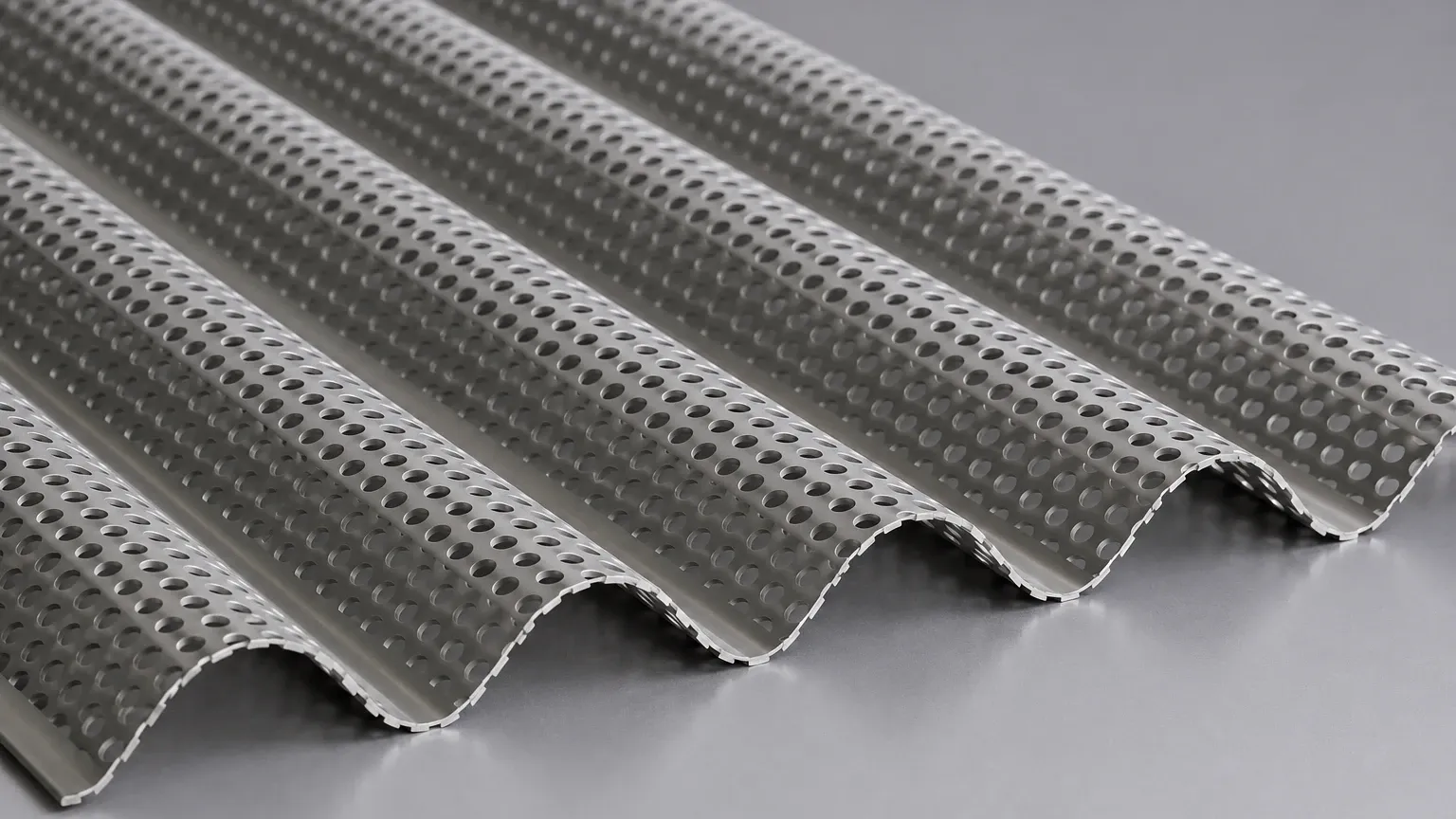
The primary advantage of corrugated perforated metal panels over flat perforated sheets lies in their increased moment of inertia. By cold-forming a flat sheet into a series of alternating ridges and grooves—the corrugations—the material gains significant structural stiffness along the direction of the folds. This allows the panel to span greater distances between supports without sagging or buckling, even when the material gauge is relatively thin.
When these panels are perforated, they retain this structural advantage while gaining functional transparency. In industrial applications, this combination is used to create lightweight, high-strength structures that allow for the passage of air, light, liquid, or sound. The corrugation process effectively compensates for the loss of material strength caused by the perforation holes, making Perforated & Expanded Metal solutions ideal for heavy-duty environments.
Material Science and Environmental Suitability
Selecting the correct alloy is the first step in ensuring the durability of corrugated perforated metal panels. Because these panels are often exposed to corrosive chemicals, high temperatures, or extreme weather, the material must be matched to the specific operating environment.
Stainless Steel (304 and 316)
Stainless steel is the industry standard for most filtration and industrial processing applications. Grade 304 offers excellent corrosion resistance for general use, while Grade 316 contains molybdenum, providing superior resistance to chlorides and marine environments. For chemical processing or pharmaceutical applications, stainless steel is preferred due to its ability to withstand aggressive cleaning agents and high-pressure steam sterilization.
Aluminum Alloys
For applications where weight reduction is a priority, such as in aerospace or mobile industrial equipment, aluminum is the preferred choice. It offers a high strength-to-weight ratio and natural atmospheric corrosion resistance. However, engineers must account for aluminum’s lower melting point and different thermal expansion rates compared to steel.
Carbon and Galvanized Steel
In less corrosive environments or where cost-efficiency is paramount, carbon steel may be used. To prevent oxidation, these panels are typically galvanized (coated with zinc) or powder-coated. While effective, any damage to the coating—such as scratches during installation—can lead to localized corrosion, which is a critical consideration for long-term maintenance cycles.
Key Design Parameters for Perforation Patterns
The performance of corrugated perforated metal panels is largely dictated by the geometry of the perforations. The choice of hole shape, size, and spacing influences both the airflow characteristics and the structural limits of the panel.
1. Hole Shapes: Round holes are the most common due to their manufacturing efficiency and uniform stress distribution. Square holes offer a higher open area for maximum ventilation, while slotted holes are often utilized for specific sorting or drainage requirements.
2. Open Area Percentage: This is the ratio of the total area of the holes to the total area of the sheet. A higher open area increases permeability but reduces the structural strength of the metal. Engineering calculations must balance the required CFM (cubic feet per minute) of airflow with the mechanical load the panel must bear.
3. Pitch and Orientation: Holes can be arranged in a 60-degree staggered pattern, a 45-degree staggered pattern, or straight rows. The 60-degree staggered pattern is generally preferred as it provides the highest strength and the most uniform open area.
Corrugation Profiles and Their Impact
The specific profile of the corrugation determines how the panel interacts with its environment. There are three primary types of profiles used in industrial settings:
* Sinusoidal (Wave) Profile: Characterized by smooth, continuous curves. This profile is often used for aesthetic applications or where gentle airflow deflection is required. It is easier to clean than sharper profiles, making it suitable for food processing environments.
* Trapezoidal (Box) Profile: These consist of flat tops and angled sides. Trapezoidal corrugations offer the highest structural rigidity and are the standard for load-bearing industrial walkways, heavy-duty machinery guards, and large-scale filtration housings.
* V-Rib Profile: A more aggressive fold that provides extreme stiffness in a compact height. These are frequently used as support structures for finer filter media, preventing the media from collapsing under high differential pressure.
Industrial Applications: From Filtration to Protection
Because of their versatility, corrugated perforated metal panels are found across various sectors. Their dual-purpose nature makes them more than just a surface; they are functional components of larger systems.
Filtration Support and Pre-Filtration
In large-scale liquid or air filtration systems, these panels serve as the "backbone" for more delicate filter meshes. By placing a corrugated perforated panel behind a fine wire mesh, the system can handle significantly higher pressures without deforming the mesh. Additionally, they can act as coarse pre-filters, capturing large debris before it reaches the primary filtration stage.
HVAC and Acoustic Damping
In high-velocity HVAC systems, corrugated panels are used to diffuse air and reduce turbulence. When backed with acoustic insulation, the perforated surface allows sound waves to enter the insulating material, where they are dissipated. The corrugated shape increases the surface area available for sound absorption compared to a flat panel.
Industrial Safety and Ventilation
Machinery guards made from corrugated perforated metal allow operators to monitor equipment visually while ensuring adequate cooling airflow. The corrugation adds the necessary impact resistance to protect personnel from moving parts or projectile debris in the event of a mechanical failure.
Selection Guide: Factors Influencing Performance
When specifying corrugated perforated metal panels for a project, engineers should evaluate the following criteria to ensure the component meets the application's demands:
* Differential Pressure ($ΔP$): In filtration and ventilation, the pressure drop across the panel is a critical metric. Engineers must ensure the open area is sufficient to prevent excessive energy consumption by fans or pumps.
* Load-Bearing Requirements: Will the panel be subjected to foot traffic, snow loads, or high-velocity wind? The gauge of the metal and the depth of the corrugation must be calculated to handle these peak loads.
* Edge Treatments: Standard panels may have "unfinished" edges where the perforation pattern is cut through. For safety and ease of installation, panels can be manufactured with solid margins (unperforated borders) or framed with U-channels.
* Corrosion Allowance: In aggressive chemical environments, the material thickness should include a corrosion allowance to ensure the structural integrity remains intact over the intended service life.
Installation and Maintenance Considerations
Proper installation is essential to prevent premature failure of corrugated perforated metal panels. One of the most common risks is galvanic corrosion, which occurs when two dissimilar metals (e.g., an aluminum panel and a steel support frame) come into contact in the presence of moisture. Using non-conductive gaskets or ensuring all components are of the same material grade mitigates this risk.
Maintenance requirements are generally low, especially for stainless steel variants. However, in filtration or food-grade applications, the panels should be inspected for "blinding"—the clogging of perforations by debris. The corrugated profile can sometimes trap particles in the valleys of the folds, so high-pressure washing or ultrasonic cleaning may be necessary depending on the process material.
Total Cost of Ownership and Quality Assurance
While the initial purchase price is a factor, the total cost of ownership (TCO) for corrugated perforated metal panels is influenced by their service life and maintenance needs. Investing in high-quality manufacturing—where hole deburring is precise and corrugation angles are consistent—reduces the risk of stress cracking and localized corrosion.
Kaifil emphasizes precision in the manufacturing of Perforated & Expanded Metal products to ensure that every panel meets the exact tolerances required for industrial integration. By selecting the right material and design parameters at the outset, purchasing teams can avoid the costs associated with frequent replacements and system downtime.
In conclusion, corrugated perforated metal panels are a sophisticated engineering choice for demanding B2B applications. By understanding the interplay between material science, perforation geometry, and structural corrugation, technical professionals can implement solutions that provide long-term reliability and optimized performance in any filtration or industrial environment.
